Burundi: A Land of Heritage and Harmony
A small, densely populated country on the shores of Lake Tanganyika, with a complex history and a natural environment of extraordinary depth.
Burundi is one of the smallest and most densely populated countries in Africa, sitting at the convergence of the Great Rift Valley lakes region and the highlands of Central Africa. It borders Rwanda to the north, Tanzania to the east and south, and the Democratic Republic of Congo to the west. Lake Tanganyika, the world’s longest freshwater lake and the second deepest, forms its entire western boundary.
Burundi has had a difficult history, marked by ethnic violence in 1972 and the civil war of 1993 to 2005. The country has struggled economically and politically, and travel requires careful research into current conditions. Despite these challenges, Burundi has a natural setting that is genuinely beautiful and a culture that carries real depth.
Lake Tanganyika
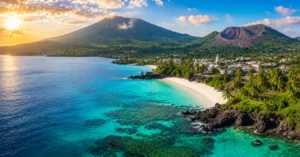
Lake Tanganyika is the main draw for visitors who make it to Burundi. The lake is 673 kilometers long and sits in a rift valley, its extraordinary depth and age having produced a remarkable diversity of cichlid fish found nowhere else in the world.
Hundreds of species of colorful cichlids evolved in the lake over millions of years in isolation, making it one of the most important freshwater biodiversity hotspots on earth. The clear water and the mountain backdrop make lakeside towns like Bujumbura and Nyanza-Lac genuinely beautiful.
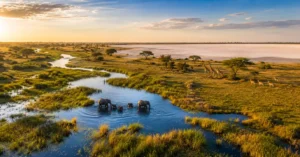
Snorkeling and diving in Lake Tanganyika is a unique experience. The lake’s extraordinary clarity allows visibility of many meters, and the colorful cichlid fish that dart around the rocky shoreline are unlike anything in any other freshwater environment in the world. The lake also has Nile crocodiles and hippos that inhabit the shallower areas and the river mouths.
Bujumbura
Bujumbura, the capital, sits on the northern end of the lake and has a pleasant tropical atmosphere with good restaurants, beach bars, and lake views that have made it one of the more livable capital cities in Central Africa. The city has a compact center with a mix of colonial-era and modern buildings and a lively market area.
The Livingstone-Stanley Monument at nearby Mugere, about 10 kilometers south of Bujumbura, marks the reputed site where explorers David Livingstone and Henry Morton Stanley met in 1871 after Livingstone had been out of contact with the outside world for years. The monument sits on the lakeshore and the location itself, with the lake stretching to the horizon in both directions, has a quiet historic power.
Kibira National Park
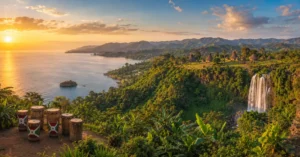
Kibira National Park in the north contains one of the largest remaining montane rainforests in Central Africa. The park covers about 40,000 hectares on the Congo-Nile ridge and is home to chimpanzees, black-and-white colobus monkeys, and a rich community of forest birds. The high altitude and the mist that rolls through the forest create an atmospheric and primordial environment.
The park protects one of the most important water catchment areas in Burundi, with rivers flowing both east to Tanzania and west to the Congo Basin originating in its forests. The combination of biodiversity and hydrological importance makes it one of the most ecologically significant protected areas in the Great Lakes region.
Rumonge and the Southern Shore
The town of Rumonge on the southern part of the lake has a pleasant waterfront and serves as a base for boat trips on the lake. The southern shore of Lake Tanganyika in Burundi is less visited than the Bujumbura area and has a more rural character, with fishing villages, palm trees, and views across the water to the Democratic Republic of Congo on the opposite shore.
Culture and Food
Burundian culture has deep roots in the shared Hutu, Tutsi, and Twa heritage of the Great Lakes region. The ingoma drummers of Burundi, who perform on tall royal drums, are one of the most recognized cultural traditions in the region and UNESCO has inscribed the royal drumming tradition as an Intangible Cultural Heritage. Performances of the royal drums, accompanied by dancing, are an extraordinary spectacle.
Ugali (a stiff maize or sorghum porridge), beans, sweet potatoes, and Lake Tanganyika fish are the dietary staples. Brochettes (grilled meat skewers) are popular street food.
Practical Travel Tips for Burundi
Most nationalities need a visa obtained in advance from a Burundian embassy, though e-visa options have become available for some nationalities. The official languages are French, Kirundi, and English. The Burundian franc is the currency.
Malaria prevention is essential. Yellow fever vaccination is required. The political situation has been unstable in recent years and current advisories should be checked carefully before travel.