Iceland packs volcanoes, glaciers, waterfalls, geothermal pools and black sand beaches into one island you can drive around in a loop, and the best trips plan for weather, daylight and road conditions before anything else. This guide covers 16 of the best places to visit in Iceland, from Reykjavík and the Golden Circle to the South Coast, Vatnajökull, Mývatn and the Westfjords, with how long to stay, when to go, and what travelers from the U.S., UK, Canada and Australia should know about Schengen entry rules, volcanic activity, winter driving and beach safety right now. For more on the country, see our Iceland destination guide or browse our Europe destination guides.
- First trip: Reykjavík, the Golden Circle and the South Coast.
- Waterfalls and beaches: Seljalandsfoss, Skógafoss and the South Coast.
- Glaciers: Vatnajökull, Skaftafell and Jökulsárlón.
- Geothermal areas: Mývatn and the Reykjanes Peninsula.
- Northern Iceland: Akureyri, Goðafoss and Húsavík.
- Remote areas: The Westfjords, Landmannalaugar and Grímsey.
- Entry rules: Iceland is in the Schengen area, and the UK government says you can travel without a visa for up to 90 days in any 180-day period.
- Volcanic activity: Canada’s government says the Reykjanes Peninsula, near Grindavík and the Blue Lagoon, has had recurring eruptions since July 2023, and that further eruptions could occur at any time and without warning.
- Beach safety: Canada says sneaker waves have killed people at Reynisfjara and Kirkjufjara beaches.
- Official safety source: Safetravel Iceland, run by ICE-SAR, is the official source for safe travel, and 112 is the emergency number.
Table of contents
- How to Choose the Best Places to Go in Iceland
- Reykjavík: Best for Museums, Harbor Walks and Nightlife
- Golden Circle: Best for Þingvellir, Geysir and Gullfoss
- Reykjanes Peninsula: Best for Lava Fields and Geothermal Spas
- South Coast Waterfalls: Best for Seljalandsfoss and Skógafoss
- Reynisfjara and Vík: Best for Black Sand and Sea Stacks
- Vatnajökull and Skaftafell: Best for Glaciers and Hiking
- Jökulsárlón: Best for Icebergs in a Glacier Lagoon
- Eastfjords: Best for Quiet Villages and Mountain Views
- Mývatn: Best for Geothermal Landscapes and Lava Formations
- Akureyri and Goðafoss: Best for a Northern Town and a Wide Waterfall
- Húsavík: Best for Whale Watching
- Snæfellsnes Peninsula: Best for a Mini Iceland
- Westfjords: Best for Remote Cliffs and Waterfalls
- Westman Islands: Best for Puffins and Volcano History
- Landmannalaugar: Best for Colorful Mountains and Highland Hikes
- Grímsey: Best for the Arctic Circle
- Sample Iceland Itineraries
- Best Ways to Get Around Iceland
- Best Time to Visit Iceland
- Entry, Safety and Practical Rules for US, UK, Canadian and Australian Travelers
- Frequently Asked Questions
- Final Thoughts
How to Choose the Best Places to Go in Iceland
Iceland is bigger than it looks, and daylight, weather and road closures shape every plan. The best approach for a first visit is to pick one region, choose two or three bases and keep driving days short. Reykjavík with the Golden Circle and South Coast suits a first trip, and the Ring Road loop suits a longer visit.
UNESCO lists three World Heritage properties in Iceland: Þingvellir National Park, Surtsey and Vatnajökull National Park. That is why this guide links to the official listing wherever one exists.
| Your trip | A good starting plan |
|---|---|
| First visit, about 5 days | Reykjavík, Golden Circle and South Coast |
| 7 to 10 days | Add Vatnajökull and Jökulsárlón |
| Ring Road loop | Reykjavík, South Coast, Vatnajökull, Eastfjords, Mývatn and Akureyri |
| Northern lights | Reykjavík, Akureyri and the South Coast, from autumn to spring |
| Remote and wild | Westfjords, Landmannalaugar and Grímsey |
| Short stopover | Reykjavík and the Reykjanes Peninsula |
Reykjavík: Best for Museums, Harbor Walks and Nightlife
Reykjavík is the capital and the base for most trips. The city is compact and walkable, with a church that dominates the skyline, a harbor concert hall, museums and a lively cafe and bar scene. Most day trips start here.
Take normal city care. The UK government says petty theft and antisocial behavior occur, especially around bars in downtown Reykjavík, so take sensible precautions with your belongings.
Suggested time: Two to three days.
Best season: Summer for long daylight, winter for northern lights trips.
Planning tip: Use Reykjavík as a base for day trips, and check weather and road conditions each morning.
Golden Circle: Best for Þingvellir, Geysir and Gullfoss
The Golden Circle is the classic day trip from Reykjavík. UNESCO lists Þingvellir National Park, inscribed in 2004, and the route usually continues to the Geysir geothermal area and the Gullfoss waterfall.
Stay back from hot springs and cliff edges. The UK government says going too close to the ocean, cliff edges and hot springs are common causes of accidents in Iceland. Do not leave the marked paths near geothermal areas.
Suggested time: One day.
Best season: Any time, but winter days are short and roads can be icy.
Planning tip: Start early, and check the road and weather forecast on road.is the day before.
Reykjanes Peninsula: Best for Lava Fields and Geothermal Spas
The Reykjanes Peninsula is the area closest to the main airport, with lava fields, steam vents and the Blue Lagoon. It is also an active volcanic area. Canada says the peninsula has had recurring eruptions since July 2023, that volcanic gas could reach areas far from eruption sites, including Reykjavík, and that further eruptions could occur at any time.
Check current alerts before you go. The UK government says eruptions have affected Grindavík, that more are likely and that you should follow local alerts before going near any eruption site. It adds that you should never attempt to walk on newly solidified lava, because the surface crust can break without warning.
Suggested time: Half a day.
Best season: Any time.
Planning tip: Check Safetravel Iceland for the latest closures and gas warnings before you plan a stop here.
South Coast Waterfalls: Best for Seljalandsfoss and Skógafoss
The South Coast is the most popular route outside the Golden Circle, with waterfalls near the Ring Road and views of glaciers inland. Seljalandsfoss and Skógafoss are the main stops, and both are easy to reach from the road.
Spray makes paths slick, so wear shoes with grip and a waterproof layer. Plan for changing weather, because the UK government says the weather can change quickly and make driving conditions challenging, and that strong winds can damage rental cars with sand or ash.
Suggested time: One day.
Best season: Late spring to early autumn for easy driving.
Planning tip: Open car doors carefully in strong wind, and check forecasts before you set off.
Reynisfjara and Vík: Best for Black Sand and Sea Stacks
Reynisfjara is a black sand beach near the village of Vík, known for basalt columns and offshore sea stacks. It is a popular spot on the South Coast, and a dangerous one.
Respect the sea. Canada says sneaker waves have killed people at Reynisfjara and Kirkjufjara beaches. Stay well back from the water line, never turn your back on the waves, and heed warning signs.
Suggested time: Half a day.
Best season: Any time, with extra care in winter storms.
Planning tip: Keep a long distance from the water, and keep children close.
Vatnajökull and Skaftafell: Best for Glaciers and Hiking
Vatnajökull National Park covers a large part of the southeast, with glacier tongues, ice caps and volcanic landscapes. UNESCO lists Vatnajökull National Park, Dynamic Nature of Fire and Ice, inscribed in 2019. Skaftafell is the usual base for day hikes.
Glacier walks and ice cave trips should be done with licensed guides. Canada advises never going alone when hiking or visiting remote areas. Check conditions with Safetravel Iceland, and share a travel plan with someone you trust.
Suggested time: Two days.
Best season: Summer for hiking, winter for ice cave trips.
Planning tip: Book guided glacier tours ahead, and check the weather the morning of the trip.
Jökulsárlón: Best for Icebergs in a Glacier Lagoon
Jökulsárlón is a glacier lagoon on the southeast coast, with floating icebergs and a short river to the sea. Boat tours run in season, and the black sand beach nearby is known for ice chunks that wash up.
It is a long way from Reykjavík, so many visitors stay overnight in the area. Keep a safe distance from the water and do not walk on ice.
Suggested time: Half a day, as part of a southeast trip.
Best season: Summer for boat tours, winter for ice on the beach.
Planning tip: Book a boat tour ahead in summer, and dress in layers.
Eastfjords: Best for Quiet Villages and Mountain Views
The Eastfjords are a stretch of narrow fjords and small fishing villages, with winding roads and fewer visitors than the South Coast. Seyðisfjörður is a popular stop.
Roads can be slow in bad weather. Canada says most bridges outside Reykjavík are one lane, and that storms are common from October to March and can make driving dangerous. Fill the tank and allow extra time in winter.
Suggested time: Two days.
Best season: Summer, when mountain roads are clear.
Planning tip: Check road conditions daily on road.is, and keep flexible plans.
Mývatn: Best for Geothermal Landscapes and Lava Formations
Lake Mývatn in the north is known for volcanic landscapes, steaming vents, lava formations and bird life. Nearby, hot spring baths offer a quieter alternative to the Blue Lagoon.
Stay on marked paths near geothermal areas, and keep away from steam vents. The UK government warns that hot springs are a common cause of accidents.
Suggested time: One to two days.
Best season: Summer, though winter brings snow and northern lights.
Planning tip: Combine Mývatn with Akureyri and Goðafoss in one northern loop.
Akureyri and Goðafoss: Best for a Northern Town and a Wide Waterfall
Akureyri is the main town of the north, at the head of a long fjord, with a small center, a botanical garden and a good base for day trips. Goðafoss is a wide waterfall near the Ring Road, and is easy to reach by car.
The town is a good winter base for northern lights trips, but winter driving needs care. Canada says winter tires are mandatory from November to April and headlights must be on at all times.
Suggested time: Two days.
Best season: Summer for long days, winter for northern lights.
Planning tip: Check the road and weather forecast before driving between towns in winter.
Húsavík: Best for Whale Watching
Húsavík is a small harbor town on the north coast, known for whale watching tours. Boat trips run in season, and the museum in town explains the wildlife.
Dress warmly, even in summer, because it is cold on the water. Book with an operator that provides thermal suits and a safety briefing.
Suggested time: One day.
Best season: Late spring to early autumn.
Planning tip: Book morning trips for calmer water, and carry a windproof layer.
Snæfellsnes Peninsula: Best for a Mini Iceland
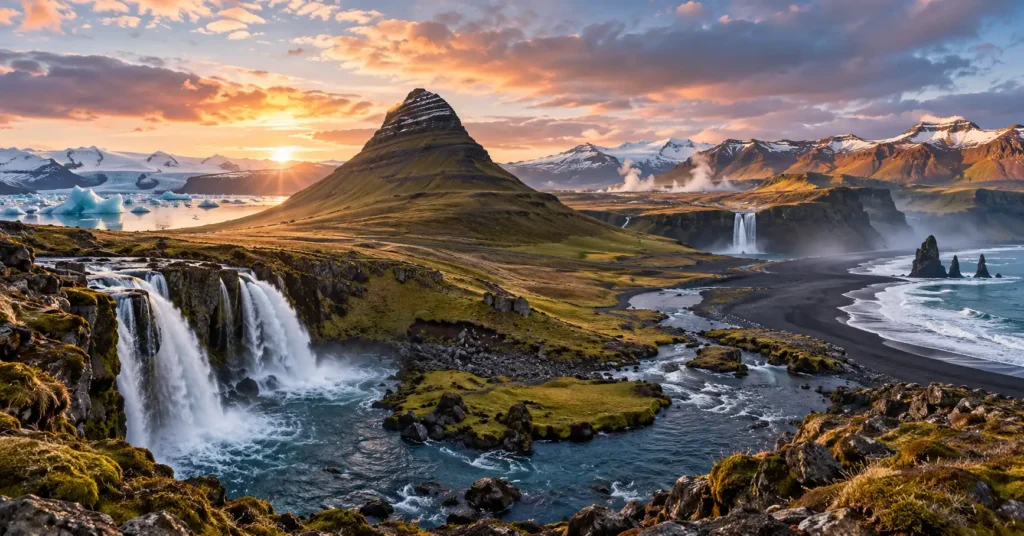
Snæfellsnes is a peninsula in the west with a volcano and glacier at the tip, lava coasts, fishing villages and the cone-shaped Kirkjufell mountain. It is a good two day trip from Reykjavík, and works as a quieter alternative to the South Coast.
The peninsula is easy to drive, but weather changes quickly. Check forecasts, and keep spare time for road closures in winter.
Suggested time: Two days.
Best season: Late spring to early autumn.
Planning tip: Stay in a village on the peninsula so you can enjoy the evening light.
Westfjords: Best for Remote Cliffs and Waterfalls
The Westfjords are the most remote part of the country, with steep fjords, bird cliffs, beaches and Dynjandi waterfall. Roads are slow, and services are limited.
Plan carefully. The UK government says emergency medical assistance and search and rescue may be limited in some areas, so share a travel plan and carry extra food and clothing. Check Safetravel Iceland, the Icelandic Met Office and the road administration before you go.
Suggested time: Three to four days.
Best season: Summer, when roads are open and daylight is long.
Planning tip: Leave your itinerary with your hotel or with Safetravel Iceland.
Westman Islands: Best for Puffins and Volcano History
The Westman Islands are a small archipelago off the south coast, reached by ferry or a short flight. Surtsey is one of Iceland’s UNESCO properties. UNESCO lists Surtsey, inscribed in 2008, as a natural World Heritage property.
The main island, Heimaey, has a village, a volcano and puffin colonies in summer. Check ferry schedules, which depend on weather and season.
Suggested time: One to two days.
Best season: Summer for puffins.
Planning tip: Check the ferry or flight schedule, and keep a spare day in case of weather.
Landmannalaugar: Best for Colorful Mountains and Highland Hikes
Landmannalaugar is a highland area with colorful rhyolite mountains, lava fields and hot springs. It is reached on interior roads that are open only in summer, and many visitors join guided trips.
The UK government says some roads, such as in the highlands or interior roads, require 4-wheel drive, and that many highland tracks open only briefly in summer. Drive slowly across rivers, because levels can rise quickly. Off-road driving is strictly controlled, so stay on marked tracks.
Suggested time: One to three days.
Best season: Summer, once highland roads open.
Planning tip: Check that the road is open on road.is, and use a guided tour if you do not have a suitable vehicle.
Grímsey: Best for the Arctic Circle
Grímsey is a small island off the north coast that touches the Arctic Circle. Visit Iceland says the midnight sun dips and rises again there roughly from June 7 to July 7. The island is reached by ferry or a short flight from the north coast.
It is a remote stop, with limited services and weather that can disrupt travel. Plan an extra day in case your ferry or flight is delayed.
Suggested time: One to two days.
Best season: Summer.
Planning tip: Book ferry or flight tickets ahead, and keep a spare day.
Sample Iceland Itineraries
These are starting points, not fixed routes. Iceland’s weather changes quickly, so keep flexible days and short driving legs.
| Trip length | Route | Why it works |
|---|---|---|
| 5 days | Reykjavík (2), Golden Circle (1), South Coast (2) | The classic first trip |
| 8 days | Reykjavík (2), South Coast (2), Vatnajökull and Jökulsárlón (2), return (2) | Adds the glaciers |
| 10 days | Reykjavík (2), South Coast (2), Vatnajökull (2), Eastfjords (1), Mývatn (1), Akureyri (1), return (1) | A fuller Ring Road loop |
Best Ways to Get Around Iceland
A rental car is the most flexible way to see the country, and the Ring Road links most of the main sights. Tours and buses reach popular areas, flights link Reykjavík with the north and east, and ferries serve the islands.
Driving rules matter. Canada says winter tires are mandatory from November to April, headlights must be on at all times, off-road driving is strictly forbidden, and highland roads are open only in summer. The UK government says drink-driving limits are lower than in the UK, and that some interior roads require 4-wheel drive.
Best Time to Visit Iceland
Iceland changes sharply by season, and daylight is the main factor.
| Season | What to expect |
|---|---|
| Summer | Long daylight, open highland roads and the best weather for driving. Visit Iceland puts the midnight sun period at roughly mid-May to mid-July. |
| Autumn | Colors, fewer crowds and the start of northern lights season in late summer. |
| Winter | Short days, snow and ice, and storms from October to March, according to Canada. Good for northern lights and ice caves. |
| Spring | Changeable weather, with roads and services opening up. Early spring is still a good time for northern lights. |
Visit Iceland and Safetravel describe the northern lights season as running from about late August to late April, and Visit Iceland’s guides also give September to April. The lights depend on clear skies and darkness, so allow several nights.
Entry, Safety and Practical Rules for US, UK, Canadian and Australian Travelers
Visas and entry
Iceland is part of the Schengen area. The UK government says you can travel without a visa to the Schengen area, which includes Iceland, for up to 90 days in any 180-day period. Canada’s government gives the same 90 days in any 180-day period rule for Canadians.
- Passport: The UK government says your passport must have been issued less than 10 years before you arrive and must be valid for at least 3 months after you plan to leave the Schengen area. Canada gives the same 3 month rule.
- Entry/Exit System: The EU’s Entry/Exit System is being implemented across the Schengen area. Canada says it records trip details, a facial image and fingerprints on entry, and that no action is needed before you travel.
- ETIAS: Canada’s government said in August 2026 that ETIAS applications were not yet open. When it launches, apply only through the official EU website.
- Food: The UK government says you cannot take meat, milk or products containing them into Iceland.
- Cash: Declare currency worth 10,000 euros or more.
Entry rules change. Confirm the latest requirements with the Icelandic authorities or the EU’s official travel site before you book.
Safety: what each government says
Iceland is a safe country in terms of crime, but nature is the main risk.
- United States: The State Department lists Iceland at Level 1, Exercise Normal Precautions.
- Canada: Canada’s advice is to take normal security precautions. It warns about volcanic activity, storms, one-lane bridges, sneaker waves at Reynisfjara and Kirkjufjara, hot springs and the need to stay with companions in remote areas. It also says camping is illegal outside organized campsites unless the landowner grants permission.
- United Kingdom: The UK government says volcanic eruptions and earthquakes are common, warns about weather, driving, hot springs and limited search and rescue in remote areas, and points to Safetravel Iceland, the Icelandic Met Office and the road administration for alerts.
- Australia: Check Smartraveller for the latest advice.
Practical rules
- Emergency number: Call 112. The Safetravel app lets hikers send their GPS location to emergency services.
- Travel plan: Share a travel plan with a trusted person or on the Safetravel site.
- Water and cliffs: Stay away from the ocean’s edge, cliff edges and hot springs.
- Currency: Iceland uses the króna, and cards are widely accepted.
- Travel insurance: Get coverage that includes your activities and emergency evacuation.
Frequently Asked Questions
What are the best places to visit in Iceland for first-timers?
For a first trip, start with Reykjavík, the Golden Circle and the South Coast. They cover the capital, the classic geothermal and waterfall route and the black sand beaches in a short, easy loop.
How many days do you need in Iceland?
For a first visit, 5 to 7 days is enough for Reykjavík, the Golden Circle and the South Coast. Add 3 to 5 days if you want to drive the full Ring Road.
What is the best time to visit Iceland?
Summer has long daylight and open roads, and winter is the time for northern lights and ice caves. Safetravel and Visit Iceland describe the northern lights season as running from about late August to late April.
Do Americans need a visa for Iceland?
Not for short stays. Iceland is in the Schengen area, and visa-free stays are limited to 90 days in any 180-day period. The EU’s Entry/Exit System now records entries, and ETIAS had not opened as of Canada’s August 2026 advice.
Is Iceland safe for tourists?
Yes in terms of crime. The U.S. State Department lists Iceland at Level 1, and Canada advises normal security precautions. The main risks are weather, volcanic activity, driving conditions and dangerous natural features such as sneaker waves and hot springs.
Can you visit the Blue Lagoon and Reykjanes during eruptions?
It depends on current conditions. Canada says the Reykjanes Peninsula has had recurring eruptions since July 2023, and that further eruptions could occur at any time. Check Safetravel Iceland and the Icelandic Met Office for current closures before you plan a visit.
Final Thoughts
The best places to visit in Iceland are the ones that fit your season, your daylight and your comfort with changing weather. Pick one region, check road and volcano conditions on the official sites, and give each stop enough time to feel like more than a photo stop. Then come back for another region on your next trip.