
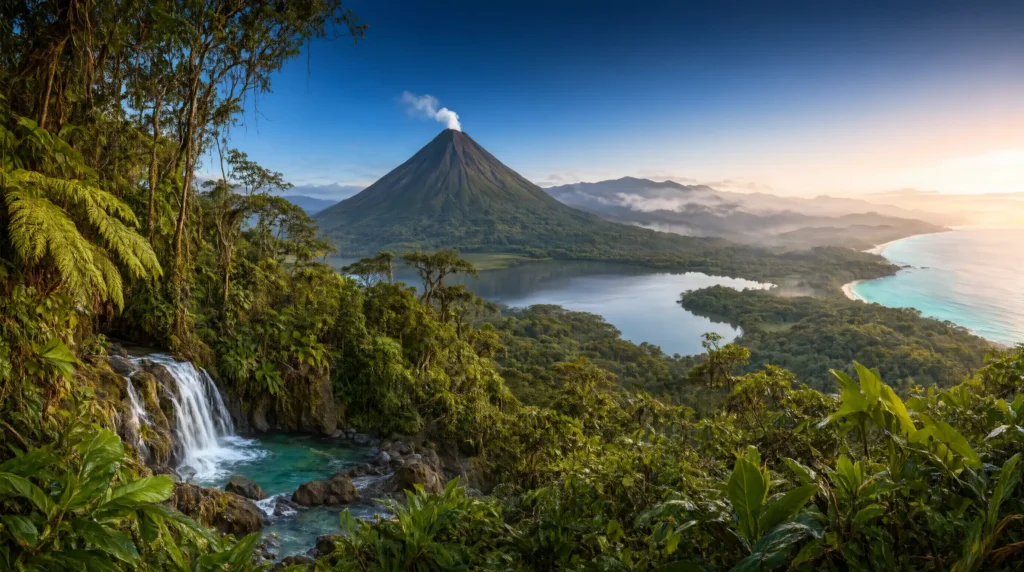
Costa Rica fits volcanoes, cloud forest, two coasts and some of the best wildlife viewing in Central America into one small country, and the best trips pick two or three regions rather than racing across all of them. This guide covers 16 of the best places to visit in Costa Rica, from San José and Arenal to Monteverde, Manuel Antonio, Corcovado and Tortuguero, with how long to stay, when to go, and what travelers from the U.S., UK, Canada and Australia should know about entry rules, park bookings, rip currents and crime right now. For more on the country, see our Costa Rica destination guide or browse our North America destination guides.
- First trip: San José, La Fortuna and Arenal, Monteverde and Manuel Antonio.
- Volcanoes and hot springs: Arenal, Poás and Rincón de la Vieja.
- Cloud forest and wildlife: Monteverde, Tortuguero, Corcovado and Cahuita.
- Beaches and surf: Tamarindo, Santa Teresa, Manuel Antonio and Puerto Viejo.
- Remote adventure: Corcovado, Chirripó and Cocos Island.
- Entry rules: The UK and Canadian governments say tourists can stay up to 180 days without a visa, and the immigration officer sets the exact period on arrival.
- Safety level: The U.S. State Department lists Costa Rica at Level 2, and Canada advises a high degree of caution, in both cases because of crime. Rip currents are another major risk.
- Park bookings: Most national parks sell tickets through the official SINAC online system, and Corcovado uses a separate reservation process.
- Green season: Hurricane season usually runs from June to November, according to the UK government, and flooding and landslides can close roads.
Table of contents
- How to Choose the Best Places to Go in Costa Rica
- San José: Best for Museums and a Gateway Stop
- Poás Volcano: Best for a Crater Viewpoint
- La Fortuna and Arenal: Best for Volcano Views and Hot Springs
- Río Celeste and Tenorio: Best for a Blue River Hike
- Monteverde: Best for Cloud Forest Walks
- Rincón de la Vieja: Best for Volcano Trails and Hot Springs
- Tamarindo and Guanacaste Beaches: Best for Surf and Sunsets
- Santa Teresa: Best for Surf and Nicoya Peninsula Beaches
- Manuel Antonio: Best for Rainforest Meets Beach
- Uvita and Marino Ballena: Best for Whale Season and Quiet Beaches
- Osa Peninsula and Corcovado: Best for Remote Rainforest
- Tortuguero: Best for Canals and Turtle Nesting
- Cahuita and Puerto Viejo: Best for Caribbean Culture and Reefs
- Chirripó: Best for a High Mountain Hike
- Cocos Island: Best for Remote Diving
- Diquís Stone Spheres: Best for Pre-Columbian Heritage
- Sample Costa Rica Itineraries
- Best Ways to Get Around Costa Rica
- Best Time to Visit Costa Rica
- Entry, Safety and Practical Rules for US, UK, Canadian and Australian Travelers
- Frequently Asked Questions
- Final Thoughts
How to Choose the Best Places to Go in Costa Rica
Costa Rica is small, but mountain roads are slow, so a 100 mile trip can take half a day. The best plan for a first visit is to pick two regions, choose three or four bases and treat everything else as a day trip. The central highlands and the northern volcano area pair well with either the Pacific coast or the Caribbean coast.
UNESCO lists four World Heritage properties in Costa Rica: the Precolumbian Chiefdom Settlements with Stone Spheres of the Diquís, and three natural properties, Área de Conservación Guanacaste, Cocos Island National Park and the Talamanca Range-La Amistad Reserves. That is why this guide links to the official listing wherever one exists.
| Your trip | A good starting plan |
|---|---|
| First visit, about 10 days | San José, La Fortuna, Monteverde and Manuel Antonio |
| 14 days | Add Tortuguero or Corcovado |
| Volcanoes | Arenal, Poás, Rincón de la Vieja and Río Celeste |
| Wildlife | Tortuguero, Corcovado, Monteverde and Cahuita |
| Surf and beaches | Tamarindo, Santa Teresa and Puerto Viejo |
| Hiking | Chirripó, Río Celeste and Arenal |
San José: Best for Museums and a Gateway Stop
San José is the capital and the main airport hub, and it works best as a one or two night stop. The city has museums, markets and a growing food scene. Most visitors use it to start or end a trip.
Take care in the city. The UK government says muggings and theft are significant problems and advises watching who is near you at ATMs and keeping bags in sight on buses. Avoid walking alone at night in poorly lit or remote areas, and use radio-dispatched official taxis rather than unofficial ones.
Suggested time: One to two days.
Best season: December to April for dry weather.
Planning tip: Book your first night near the airport if your flight arrives late.
Poás Volcano: Best for a Crater Viewpoint
Poás is a volcano near San José with a crater viewpoint. It is a short day trip from the capital, and often combined with coffee farms and waterfalls.
Check access before you go. The UK government says Poás has had a recent, significant series of eruptions, and Canada lists it among the active volcanoes. Sinac’s booking system controls entry, so book a time before you travel and check for closures.
Suggested time: Half a day.
Best season: Dry season mornings, when the crater is more likely to be clear.
Planning tip: Book your slot on the official SINAC site, and have a backup plan if the park is closed.
La Fortuna and Arenal: Best for Volcano Views and Hot Springs
La Fortuna is the base for Arenal volcano, with waterfalls, hanging bridges, hot springs and river trips. Canada lists Arenal among the active volcanoes, along with Poás, Rincón de la Vieja and Turrialba, and says eruptions can happen at any time, sometimes with short-notice evacuations.
Choose licensed tour operators for rafting and canopy tours, and check that your insurance covers them. The UK government notes that many standard policies exclude activities like zip-lining and surfing.
Suggested time: Three days.
Best season: December to April for the driest weather.
Planning tip: Book hot springs and adventure tours through your hotel or a licensed operator.
Río Celeste and Tenorio: Best for a Blue River Hike
Tenorio Volcano National Park in the northern lowlands is known for the Río Celeste, a river with a vivid blue color. The trail leads through forest to a waterfall and a viewpoint.
Trails can be slippery after rain, and some sections may close at short notice. Wear shoes with good grip, carry water and check current conditions before you go.
Suggested time: Half a day to one day.
Best season: The dry season, though the river is blue most of the year.
Planning tip: Start early, and book your park entry ahead through the official system.
Monteverde: Best for Cloud Forest Walks
Monteverde is a mountain area with cloud forest reserves, hanging bridges and night walks. The mist and the elevation give it a cooler climate than the coast.
Choose a guide for wildlife viewing, because guides spot animals that visitors miss. Bring a rain jacket in every season. Roads to the area are winding, so allow extra time and avoid driving at night.
Suggested time: Two to three days.
Best season: December to April, though mist is part of the experience.
Planning tip: Book a guided night walk, and pack warm layers.
Rincón de la Vieja: Best for Volcano Trails and Hot Springs
Rincón de la Vieja is a volcano in Guanacaste with trails, waterfalls and thermal areas. Canada lists it among the active volcanoes. Some trails and viewpoints close when volcanic activity rises, so check conditions.
It pairs well with the dry Pacific coast of Guanacaste. Go with a guide for the longer trails.
Suggested time: Two days.
Best season: December to April.
Planning tip: Check the park’s current access, and avoid volcanic areas during and just after heavy rain, as the UK government advises.
Tamarindo and Guanacaste Beaches: Best for Surf and Sunsets
Tamarindo is a busy beach town on the northwest Pacific coast, with surf lessons, restaurants and sunset views. Other Guanacaste beaches are quieter, and the region has drier weather than much of the country.
Take beach safety seriously. The UK government says rip currents are very common and there are often no lifeguards, that drownings are a leading cause of accidental death and that about a third of those who drown are tourists. Swim only where locals do, and avoid swimming alone.
Suggested time: Three to four days.
Best season: December to April.
Planning tip: Ask your hotel about current rip conditions before you swim.
Santa Teresa: Best for Surf and Nicoya Peninsula Beaches
Santa Teresa is a surf town at the tip of the Nicoya Peninsula, with long beaches, yoga studios and small restaurants. Roads on the peninsula are unpaved in places, and the journey takes time.
It suits travelers who want a relaxed beach stay. Check the surf conditions and your own level before you paddle out.
Suggested time: Three to four days.
Best season: December to April.
Planning tip: Use a shuttle or a high-clearance vehicle, and avoid driving at night.
Manuel Antonio: Best for Rainforest Meets Beach
Manuel Antonio National Park is on the central Pacific coast, with forest trails, beaches and a high chance of seeing monkeys and sloths. It is a popular park, so book ahead in high season.
The park uses the SINAC online ticket system, and sources disagree on the weekly closing day, so confirm the opening days before you travel. A guide helps you spot wildlife. Keep food out of sight, because wildlife can take it.
Suggested time: Three days.
Best season: December to April.
Planning tip: Book your ticket online for the day and time you want, and check the weekly closing day.
Uvita and Marino Ballena: Best for Whale Season and Quiet Beaches
Uvita is a small town on the south Pacific coast, with a long beach and a marine national park. It is a base for whale-watching trips, and for waterfalls in the hills nearby.
Be careful in the water. The UK government says crocodiles are regularly seen on the Pacific coast, particularly between Playa Azul and Playa Esterillos. Choose licensed boat operators for marine trips.
Suggested time: Two to three days.
Best season: The dry months, and the whale seasons run at different times of year.
Planning tip: Book a marine tour with a licensed operator, and ask about its safety record.
Osa Peninsula and Corcovado: Best for Remote Rainforest
The Osa Peninsula is the most remote part of the Pacific coast, with Corcovado National Park, a large rainforest park. Getting there takes time, and lodges are often reached by boat or small plane.
Corcovado uses its own reservation process. According to SINAC’s booking pages, you reserve by emailing the park and pay by bank transfer, while most other parks use the online system. Plan well ahead, and use a licensed guide and an established operator. The UK government says to use an experienced local guide, especially for jungle trips and small boats.
Suggested time: Three to five days.
Best season: The dry months, from December to April.
Planning tip: Book transport, lodging and park access together through a reputable lodge or operator.
Tortuguero: Best for Canals and Turtle Nesting
Tortuguero is a remote national park on the Caribbean coast, reached only by boat or small plane. Boat trips along the canals are the main way to see birds, caimans and monkeys, and the beach is a nesting area for sea turtles.
Choose an established operator. The UK government says to use an established company and an experienced local guide, especially for jungle trips and small boats, and that Tortuguero has had incidents. Wear insect repellent and rain gear.
Suggested time: Two to three days.
Best season: Turtle nesting runs at specific times of year, so check the season when you book.
Planning tip: Book a package that includes transport, lodging and guides.
Cahuita and Puerto Viejo: Best for Caribbean Culture and Reefs
Cahuita and Puerto Viejo sit on the southern Caribbean coast, with a relaxed pace, Afro-Caribbean culture, wildlife trails and beaches. Cahuita has a national park with a coastal trail.
The coast has its own weather pattern, and rain can fall in months that are dry elsewhere. Rip currents are common on this coast too, so swim with caution. The UK government says muggings and theft are significant problems, particularly on the Atlantic coast, so watch your belongings.
Suggested time: Three to four days.
Best season: Weather differs from the Pacific side, so check the forecast.
Planning tip: Keep valuables locked up, and do not leave anything in a parked car.
Chirripó: Best for a High Mountain Hike
Chirripó National Park is a high mountain park with a multi-day hike with an overnight stay in a mountain hut. Cold nights and quick weather changes are normal, so pack warm layers.
Plan well ahead. Reservations for the hike and the hut are required through the park’s booking system, and spaces fill quickly in the dry season. Hike with a guide or a group if you are unsure of your fitness or navigation.
Suggested time: Three days.
Best season: The dry months, from December to April.
Planning tip: Book your hut and park entry months ahead.
Cocos Island: Best for Remote Diving
Cocos Island is far off the Pacific coast, and UNESCO lists the Cocos Island National Park, inscribed in 1997 and extended in 2002. Visits are by liveaboard dive boat, and it suits experienced divers.
Choose an established dive operator and check its safety record. The trip is long, and weather affects the crossing, so travel insurance that covers diving and evacuation matters.
Suggested time: Seven to ten days on a liveaboard.
Best season: Varies by operator, so check when you book.
Planning tip: Book with a licensed liveaboard operator and confirm insurance coverage.
Diquís Stone Spheres: Best for Pre-Columbian Heritage
In the south, UNESCO lists the Precolumbian Chiefdom Settlements with Stone Spheres of the Diquís, inscribed in 2014. It is a cultural stop on the south Pacific route between Manuel Antonio, Uvita and Osa.
It is a good complement to a nature-focused trip, and it is short, so many visitors combine it with a nearby lodge stay. Check the site’s visiting hours before you go.
Suggested time: Half a day.
Best season: The dry months.
Planning tip: Combine the visit with a stop in Uvita or Osa.
Sample Costa Rica Itineraries
These are starting points, not fixed routes. Costa Rica’s roads are slow, so keep the number of bases low.
| Trip length | Route | Why it works |
|---|---|---|
| 7 days | San José (1), La Fortuna (3), Manuel Antonio (3) | A short volcano and beach loop |
| 10 days | San José (1), La Fortuna (3), Monteverde (2), Manuel Antonio (3), San José (1) | The classic first route |
| 14 days | San José (1), Tortuguero (2), La Fortuna (3), Monteverde (2), Manuel Antonio (3), Uvita (2), San José (1) | Adds the Caribbean and the south |
Best Ways to Get Around Costa Rica
Domestic flights link San José with Tortuguero, Osa and Guanacaste. Shuttle vans run between the main tourist areas, public buses cover most towns, and a rental car is useful for flexibility. Boats are the main way to reach Tortuguero and parts of the Osa.
Road safety needs care. The UK government says the standard of driving is lower than in the UK, with speeding, risky overtaking and ignored traffic lights, and that single-lane bridges are common. Do not stop for strangers signaling for help, because they could be carjackers.
Best Time to Visit Costa Rica
Costa Rica has a dry season and a green season, and the two coasts differ.
| Season | What to expect |
|---|---|
| Dry season (December to April) | The most popular time, with the driest weather on the Pacific coast and higher prices. |
| Green season (May to November) | More rain, lusher scenery and lower prices. The UK government says the hurricane season usually runs from June to November. |
| Caribbean coast | Weather follows its own pattern, and rain can fall in months that are dry on the Pacific side. |
Canada says passport theft is extremely common, especially during peak tourist seasons from November to May and July to August, and that El Niño conditions in 2026 and 2027 are expected to strengthen, raising the likelihood of droughts, floods and severe storms.
Entry, Safety and Practical Rules for US, UK, Canadian and Australian Travelers
Visas and entry
Costa Rica does not require a visa for tourists from most Western countries.
- Length of stay: The UK government says you can visit Costa Rica without a visa for up to 180 days under a tourist visa waiver, with the immigration officer setting the exact period on arrival. Canada’s government says no visa is required for tourist stays up to 180 days. One section of Canada’s page mentions 90 days, so confirm the limit with Costa Rica’s immigration authority.
- Passport: The UK government says your passport must have an expiry date at least 1 day after the day you plan to leave. Canada says it must be valid for the duration of your stay, and airlines may apply stricter rules.
- Onward ticket: Canada says customs officials may ask for a return or onward ticket and proof of sufficient funds.
- Yellow fever: The UK government says you need a certificate of yellow fever vaccination if you are arriving from a country listed as a transmission risk.
- Departure tax: The UK government says you may need to pay a departure tax of 29 US dollars when leaving by air, though most airlines include it in the ticket price.
- Cash: Declare cash, travelers’ checks or goods worth 10,000 US dollars or more.
Entry rules change. Confirm the latest requirements with the Costa Rican embassy or the official immigration site before you book.
Safety: what each government says
Costa Rica is a popular destination, but crime and natural hazards need attention.
- United States: The State Department lists Costa Rica at Level 2, Exercise Increased Caution, citing crime.
- Canada: Canada’s advice is to exercise a high degree of caution because of crime. It warns about petty theft, violent crime, rip currents, active volcanoes, dangerous adventure tourism and wildlife in wooded areas.
- United Kingdom: The UK government says muggings and theft are significant problems, particularly on the Atlantic coast. It also warns about carjackers, gang violence in some urban areas, methanol in spirits, rip currents, crocodiles, volcanoes, earthquakes and the hurricane season.
- Australia: Check Smartraveller for the latest advice.
Practical rules
- Swimming: Swim only where lifeguards are present or locals swim, and take extra care on snorkeling tours.
- Valuables: Keep your passport and valuables secure, and do not leave anything in a parked car.
- Drinks: Do not leave drinks unattended in bars. Even small amounts of methanol can kill.
- Drugs: The UK government says the minimum sentence for drug possession or trafficking is 8 years in prison.
- Currency: Costa Rica uses the colón, and U.S. dollars are widely accepted in tourist areas.
- Travel insurance: Get coverage that includes adventure activities and emergency evacuation.
Frequently Asked Questions
What are the best places to visit in Costa Rica for first-timers?
For a first trip, start with San José, La Fortuna and Arenal, Monteverde and Manuel Antonio. They cover volcanoes, cloud forest and a beach in one route.
How many days do you need in Costa Rica?
For a first visit, 10 to 14 days is enough for three or four bases. Roads are slow, so fewer bases with longer stays work better than rushing.
What is the best time to visit Costa Rica?
December to April is the dry season and the most popular time, especially on the Pacific coast. The green season runs from about May to November, with more rain and lower prices, and the UK government says hurricane season usually runs from June to November.
Do Americans need a visa for Costa Rica?
No. The UK and Canadian governments say tourists can stay up to 180 days without a visa, with the immigration officer setting the exact period. You need a passport and may be asked for an onward ticket and proof of funds.
Is Costa Rica safe for tourists?
Mostly, with care. The U.S. State Department lists Costa Rica at Level 2 because of crime, and Canada advises a high degree of caution. The most serious everyday risks are theft and rip currents, so secure your valuables and swim carefully.
Do you need to book national parks in advance?
Often yes. Most parks sell tickets through the official SINAC system, Corcovado has its own reservation process, and hikes like Chirripó need advance booking. Check each park’s booking rules before you travel.
Final Thoughts
The best places to visit in Costa Rica are the ones that fit your season, your appetite for slow roads and your comfort with wild places. Pick two or three regions, book parks and tours ahead, and give each stop enough time to feel like more than a photo stop. Then come back for another region on your next trip.