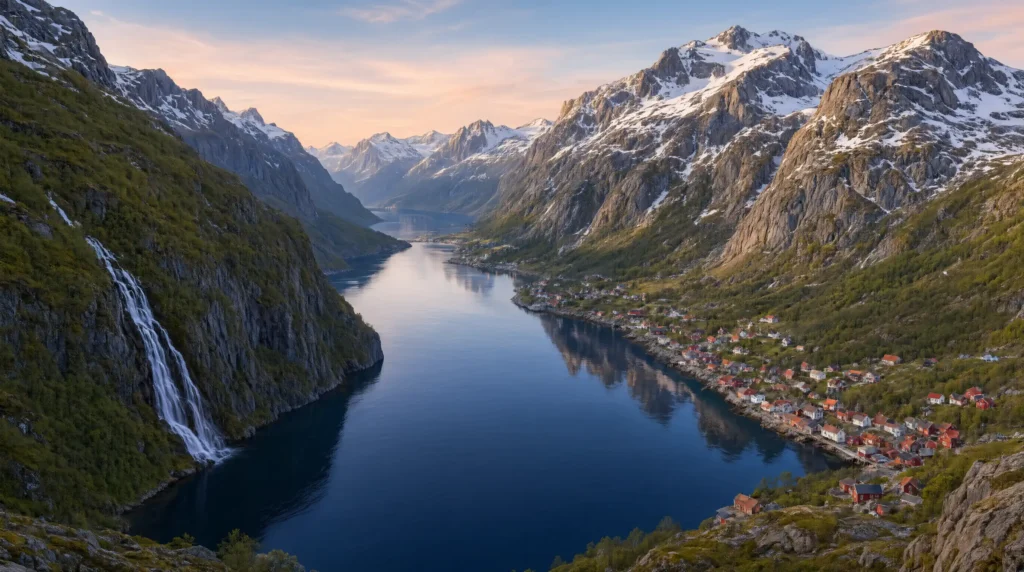
Norway pairs deep fjords and mountain trails with small harbor cities and an Arctic north, and the best trips choose one coast, a handful of bases and plenty of time on the water. This guide covers 16 of the best places to visit in Norway, from Oslo and Bergen to Lofoten, Tromsø and Svalbard, with how long to stay, when to go, and what travelers from the U.S., UK, Canada and Australia should know about Schengen entry rules, Arctic safety and winter driving right now. For more on the country, see our Norway destination guide or browse our Europe destination guides.
- First trip: Oslo, Bergen and the fjords (Nærøyfjord and Flåm, or Geirangerfjord).
- Fjords and mountains: Nærøyfjord, Geirangerfjord, Stavanger and Preikestolen, and Jotunheimen.
- Cities and culture: Oslo, Bergen, Trondheim and Ålesund.
- Arctic and northern lights: Tromsø, Alta, Lofoten and Svalbard.
- History: Bergen’s Bryggen, Røros, Urnes Stave Church and the Alta rock art.
- Islands: Lofoten, Senja and the Vega Archipelago.
- Entry rules: Norway is in the Schengen area, and the UK government says you can travel without a visa for up to 90 days in any 180-day period. Svalbard is outside Schengen, but you still need your passport.
- Northern lights: Visit Norway says many people come to see them from September to March.
- Svalbard: Anyone traveling outside the settlements must carry suitable means of scaring off polar bears, according to the Governor of Svalbard.
Table of contents
- How to Choose the Best Places to Go in Norway
- Oslo: Best for Museums and Waterfront Walks
- Bergen: Best for Harbor History and Rain Gear
- Nærøyfjord and Flåm: Best for Narrow Fjords and Mountain Rail
- Geirangerfjord: Best for Waterfalls and Steep Walls
- Ålesund: Best for Art Nouveau and Coastal Views
- Stavanger and Preikestolen: Best for Fjord Cliffs
- Trondheim: Best for Medieval Streets and the River
- Røros: Best for a Mining Town Frozen in Time
- Urnes and the Sognefjord: Best for Medieval Wooden Churches
- Jotunheimen: Best for High Mountain Hiking
- Lofoten: Best for Fishing Villages and Peaks
- Senja: Best for a Quieter Arctic Coast
- Vega Archipelago: Best for Island Life and Birds
- Tromsø: Best for Northern Lights and Arctic Activities
- Alta: Best for Rock Art and the Arctic
- Svalbard: Best for Polar Bears and Arctic Landscapes
- Sample Norway Itineraries
- Best Ways to Get Around Norway
- Best Time to Visit Norway
- Entry, Safety and Practical Rules for US, UK, Canadian and Australian Travelers
- Frequently Asked Questions
- Final Thoughts
How to Choose the Best Places to Go in Norway
Norway is long, and travel between regions is slow. The best plan for a first visit is to choose one region, pick two or three bases and treat everything else as a day trip. The southwest pairs Bergen with the fjords, the middle of the country links the Geirangerfjord area with Ålesund and Trondheim, and the north is a separate trip for Tromsø, Lofoten and the Arctic.
UNESCO lists eight World Heritage properties in Norway, seven cultural and one natural. That is why this guide links to the official listing wherever one exists.
| Your trip | A good starting plan |
|---|---|
| First visit, about 7 days | Oslo, Bergen and a fjord day |
| 10 to 14 days | Add Geirangerfjord, Ålesund and Trondheim |
| Fjords and hiking | Bergen, Nærøyfjord, Stavanger and Jotunheimen |
| Arctic and northern lights | Tromsø, Alta and Lofoten |
| Culture and history | Oslo, Bergen, Røros and Urnes |
| Wildlife and polar landscape | Svalbard |
Oslo: Best for Museums and Waterfront Walks
Oslo is the capital and the usual entry point. The city sits at the head of a fjord, and its waterfront is a mix of the opera house, new architecture and museums you can reach on foot. Vigeland Park and the Munch museum are favorite stops, and ferries run to small islands in the fjord in summer.
Oslo is a small city, so two or three days is enough. Keep an eye on your bag in crowded places. Canada’s advice notes that petty theft such as pickpocketing is a concern from May to September, especially in crowded places like Oslo Central Station, and the UK government says there is a small risk of petty theft, particularly at airports and railway stations in and around Oslo.
Suggested time: Two to three days.
Best season: Late spring to early autumn.
Planning tip: Use the public transport day pass, and plan outdoor time for the long summer evenings.
Bergen: Best for Harbor History and Rain Gear
Bergen is a main gateway to the western fjords. UNESCO’s listing of Bryggen calls it the old wharf of Bergen and a reminder of the city’s importance as part of the Hanseatic League’s trading empire from the 14th to the mid-16th century. Many fires have damaged the wooden houses, the last in 1955, and about 62 buildings remain of the former townscape.
The city is surrounded by hills and gets a lot of rain, so pack waterproofs in every season. A funicular and short trails above the town give views over the harbor.
Suggested time: Two to three days.
Best season: Late spring to early autumn.
Planning tip: Walk Bryggen early in the morning, before the cruise ship crowds arrive.
Nærøyfjord and Flåm: Best for Narrow Fjords and Mountain Rail
The Nærøyfjord is one of two fjords on UNESCO’s West Norwegian Fjords listing. UNESCO says the two fjords, Geirangerfjord and Nærøyfjord, are set 120 km from one another, among the world’s longest and deepest, and have narrow, steep-sided rock walls that rise up to 1,400 m from the sea. Nærøyfjord is the narrower and quieter of the two, and a boat trip from Flåm or Gudvangen is the usual way to see it.
Flåm sits at the end of a branch of the Sognefjord and is linked to the main railway line by a mountain railway. Many visitors do a day trip from Bergen, but an overnight stay lets you see the fjord without the day-trip crowds.
Suggested time: One to two days.
Best season: Late spring to early autumn for boat trips.
Planning tip: Book fjord boat and train tickets ahead for July and August.
Geirangerfjord: Best for Waterfalls and Steep Walls
Geirangerfjord is the second UNESCO fjord on the West Norwegian Fjords listing, and it is the classic image of a fjord with waterfalls dropping down steep rock walls. UNESCO notes that the walls have numerous waterfalls and that free-flowing rivers cross forests to glacial lakes, glaciers and rugged mountains.
The village is small and busy in summer when cruise ships call. Take a boat trip in the early morning or evening, and walk to a viewpoint for a wider view. Mountain roads may be closed in winter, so check conditions if you travel outside summer.
Suggested time: One to two days.
Best season: Late spring to early autumn.
Planning tip: Stay overnight so you can see the fjord after the cruise ships leave.
Ålesund: Best for Art Nouveau and Coastal Views
Ålesund is a coastal town on the west coast, rebuilt in a distinctive Art Nouveau style after a fire. Its compact center sits on islands and is easy to walk, with a viewpoint above the town reached by a stairway.
It works as a base for the Geirangerfjord area and for coastal day trips. Allow time for weather, since the coast can be windy and wet.
Suggested time: Two days.
Best season: Late spring to early autumn.
Planning tip: Climb to the viewpoint in the evening for the best light.
Stavanger and Preikestolen: Best for Fjord Cliffs
Stavanger is a harbor city in the southwest and the base for hikes on the Lysefjord. Preikestolen, also called Pulpit Rock, is a flat cliff ledge above the fjord, and a hike to the top is a popular day trip from Stavanger. The Kjeragbolten boulder is a longer, more demanding hike nearby.
Treat mountain hikes seriously. The UK government says the weather can change quickly, producing Arctic conditions even in summer on exposed mountain tops, and Canada advises travelers not to go off marked trails or go alone. Wear proper footwear and carry layers.
Suggested time: Two to three days.
Best season: Summer, once the trails are clear of snow.
Planning tip: Start early, check the forecast and carry extra layers and water.
Trondheim: Best for Medieval Streets and the River
Trondheim is a university city in central Norway with a medieval cathedral, colorful wooden warehouses along the river and a lively food scene. It is a good stop between the fjords and the north.
The city is compact and easy by foot or bike. It also makes a base for day trips along the coast and into the mountains.
Suggested time: Two days.
Best season: Late spring to early autumn.
Planning tip: Walk the old town bridge area in the morning, when the river is still.
Røros: Best for a Mining Town Frozen in Time
Røros is a small wooden mining town in the mountains. UNESCO lists the Røros Mining Town and the Circumference, inscribed in 1980 and extended in 2010. The town is known for its preserved wooden houses and its mining history.
It is a quiet stop in the interior, and a good place to see Norway away from the fjords. Winters are cold, so pack accordingly if you visit between November and March.
Suggested time: One to two days.
Best season: Summer for walking, winter for snow and atmosphere.
Planning tip: Stay overnight to see the town without the day visitors.
Urnes and the Sognefjord: Best for Medieval Wooden Churches
Urnes Stave Church sits above the Lustrafjord, a branch of the Sognefjord. UNESCO lists the Urnes Stave Church, inscribed in 1979, as one of Norway’s World Heritage sites. Stave churches are medieval wooden churches with carved doorways and steep roofs.
The church is small and easy to combine with a drive along the fjord. A ferry crosses the water to reach it from the main road.
Suggested time: Half a day.
Best season: Late spring to early autumn.
Planning tip: Check opening times before you go, because many stave churches have limited seasons.
Jotunheimen: Best for High Mountain Hiking
Jotunheimen National Park is a high-mountain area in southern Norway, with peaks, glacial lakes and a network of marked trails and mountain huts. It is a place for multi-day hikes as well as shorter walks.
Plan carefully. The UK government says winter is long and can last well into April, and that temperatures can fall to minus 25 degrees Celsius or lower in exposed areas. Check the forecast and hut opening dates before you go.
Suggested time: Two to four days.
Best season: Late June to early September.
Planning tip: Book mountain huts early, and carry a map and compass or a reliable offline app.
Lofoten: Best for Fishing Villages and Peaks
Lofoten is an island chain in northern Norway, with steep peaks rising from the sea, red fishing cabins and long beaches. UNESCO lists the Lofoten islands on Norway’s tentative list for World Heritage status. Hiking, kayaking and wildlife trips are the main activities.
The islands are north of the Arctic Circle. The UK government says nearly half of Norway is in the Arctic Circle, and that emergency medical assistance and search and rescue are limited in remote areas, so plan hikes conservatively.
Suggested time: Four to five days.
Best season: Summer for hiking and long light, late winter for northern lights.
Planning tip: Rent a car and book your cabins early, because lodging is limited.
Senja: Best for a Quieter Arctic Coast
Senja is a large island in the north, with mountains that fall into the sea, small villages and fewer visitors than Lofoten. It is a good option if you want similar scenery with a lighter touch.
A scenic road runs along the coast, and the island suits drivers who like to stop often. Services are limited, so fill the tank and plan food ahead.
Suggested time: Two to three days.
Best season: Summer, and winter for northern lights.
Planning tip: Combine Senja with Tromsø, and check road conditions in winter.
Vega Archipelago: Best for Island Life and Birds
The Vega Archipelago is a group of islands off the coast of Helgeland in north-central Norway. UNESCO lists Vegaøyan, the Vega Archipelago, inscribed in 2004. It is a quiet coastal area of small islands.
It is a long way from the main tourist routes, so it suits travelers who want a slow trip by ferry and a night or two in small guesthouses.
Suggested time: Two days.
Best season: Summer.
Planning tip: Check ferry schedules, since services are less frequent than on the main routes.
Tromsø: Best for Northern Lights and Arctic Activities
Tromsø is the main base for northern lights trips. Visit Norway says that many people come to see the northern lights from September to March, and that Tromsø sits directly beneath the aurora oval, with the most active seasons in autumn and spring. It also lists the polar night as running from the end of November to the middle of January. The midnight sun period in Tromsø falls roughly from the end of May to the end of July, though sources differ on exact dates.
Winter trips include dog sledding, whale watching and aurora tours, and summer brings hiking and midnight sun walks. Dress warmly. Temperatures can fall to minus 25 degrees Celsius or lower, with strong wind chill in exposed areas.
Suggested time: Three to four days.
Best season: September to March for lights, summer for midnight sun.
Planning tip: Book several nights, because clouds can hide the aurora on any single evening.
Alta: Best for Rock Art and the Arctic
Alta is a town in the far north, known for its rock carvings. UNESCO’s listing of the Rock Art of Alta says the thousands of paintings and carvings at 45 sites date from about 4200 to 500 B.C., and that more rock art made by hunter-gatherers is found in Alta than anywhere else in northern Europe.
Alta is also a good northern lights base, and it has a museum that explains the rock art. Winter trips need warm clothing and flexible plans.
Suggested time: Two days.
Best season: Summer for the rock art, winter for northern lights.
Planning tip: Check museum hours and boardwalk access, which can change by season.
Svalbard: Best for Polar Bears and Arctic Landscapes
Svalbard is an Arctic archipelago, with Longyearbyen as the main settlement. It is not part of the Schengen area, and Canada’s advice says you still need a valid passport and must meet Schengen rules when returning to mainland Norway. The UK government says you will need your passport to travel to and enter Svalbard.
Polar bears are a serious risk. The Governor of Svalbard says that anyone traveling outside the settlements must be equipped with suitable means of scaring off polar bears, and recommends carrying firearms. Canada advises not leaving settlements without a guide and proper equipment. The simplest approach for most visitors is to join an organized tour.
Suggested time: Three to five days.
Best season: Summer for midnight sun and boat trips, late winter for snow and light.
Planning tip: Book guided trips and do not leave Longyearbyen on your own.
Sample Norway Itineraries
These are starting points, not fixed routes. Norway’s distances are large, so keep the number of bases low.
| Trip length | Route | Why it works |
|---|---|---|
| 7 days | Oslo (2), Bergen (2), Flåm and Nærøyfjord (2), Oslo by train (1) | The classic fjord loop |
| 10 days | Oslo (2), Bergen (2), Flåm (1), Geirangerfjord (2), Ålesund (1), Trondheim (2) | Adds the coast and the middle of the country |
| 14 days | Oslo (2), Bergen (2), Stavanger (2), Geirangerfjord (2), Trondheim (1), fly to Tromsø (3), Lofoten (2) | A fuller trip from south to Arctic |
Best Ways to Get Around Norway
Trains and buses link the main cities, and coastal ferries and fjord boats are part of everyday transport. Flights are the practical option for the north, including Tromsø, Lofoten and Svalbard. A rental car is the easiest way to reach rural areas, but winter driving needs care.
The UK government says you must use winter tires with a minimum 3 mm tread if snow or ice covers the roads, that studded tires or snow chains may be required, and that headlights must be on during the daytime all year.
Best Time to Visit Norway
Norway changes sharply with the season, and the best time depends on what you want.
| Season | What to expect |
|---|---|
| Spring | Melting snow, some mountain roads and trails still closed, and fewer crowds. |
| Summer | Long days, open hiking trails and boat trips. The busiest and most expensive period. In the far north, the midnight sun. |
| Autumn | Colors, fewer crowds and the start of the northern lights season. |
| Winter | Snow, polar night in the far north and northern lights. The UK government says winter is long and can last well into April. |
The UK government says police enforce bans on campfires in many hiking areas during the summer months, and that wildfire risk is higher during hot, dry periods. It also advises checking avalanche risk with the Norwegian Avalanche Warning Service.
Entry, Safety and Practical Rules for US, UK, Canadian and Australian Travelers
Visas and entry
Norway is part of the Schengen area. The UK government says you can travel without a visa to the Schengen area, which includes Norway, for up to 90 days in any 180-day period, and that overstaying can lead to a ban of up to 3 years. Canada’s government gives the same 90 days in any 180-day period rule for Canadians.
- Passport: The UK government says your passport must have been issued less than 10 years before you arrive and must be valid for at least 3 months after you plan to leave the Schengen area. Canada gives the same 3 month rule.
- Entry/Exit System: The EU’s Entry/Exit System is replacing the manual stamping of passports, and the UK government says your digital record is valid for 3 years. Canada says no action is needed before you travel.
- ETIAS: Canada’s government said in August 2026 that ETIAS applications were not yet open. When it launches, apply only through the official EU website.
- Cash: The UK government says to declare cash or travelers’ checks of 25,000 Norwegian krone or more.
- Food: You cannot take meat, milk or products containing them into EEA countries without special permission.
Entry rules change. Confirm the latest requirements with the Norwegian authorities or the EU’s official travel site before you book.
Safety: what each government says
Norway is a safe destination for most travelers. The main risks are weather, mountain terrain and Arctic conditions.
- United States: The State Department lists Norway at Level 1, Exercise Normal Precautions.
- Canada: Canada’s advice is to take normal security precautions. It warns that adventure tourism may lead to serious safety concerns if not well organized, that avalanches can be fatal in winter, and that polar bears in Svalbard pose a high safety risk.
- United Kingdom: The UK government says terrorist attacks cannot be ruled out, notes a small risk of petty theft around Oslo’s airports and stations, and warns about rapid weather changes, avalanches and limited emergency help in remote Arctic areas.
- Australia: Check Smartraveller for the latest advice.
Practical rules
- Hiking: Check the forecast, stay on marked trails and do not hike alone in remote areas.
- Avalanches: Check the Norwegian Avalanche Warning Service before winter trips in the mountains.
- Drugs: Illegal drugs, including cannabis, carry severe penalties.
- Currency: Norway uses the Norwegian krone.
- Travel insurance: Get coverage that includes your activities and emergency evacuation.
Frequently Asked Questions
What are the best places to visit in Norway for first-timers?
For a first trip, start with Oslo, Bergen and a fjord day on the Nærøyfjord or Geirangerfjord. They cover the capital, the main fjord gateway and the best-known scenery in one route.
How many days do you need in Norway?
For a first visit, 7 to 10 days is enough for Oslo, Bergen and the fjords. Add 4 to 5 days for the Arctic north, which is usually a separate trip.
What is the best time to visit Norway?
Summer is best for hiking, fjord boats and the midnight sun in the north. Visit Norway says many people come for the northern lights from September to March. Winter is long, and can last well into April.
Do Americans need a visa for Norway?
Not for short stays. Norway is in the Schengen area, and visa-free stays are limited to 90 days in any 180-day period. The EU’s Entry/Exit System now records entries, and ETIAS had not opened as of Canada’s August 2026 advice.
Is Norway safe for tourists?
Yes. The U.S. State Department lists Norway at Level 1, and Canada advises normal security precautions. The main risks are weather, avalanches and mountain terrain, plus polar bears if you visit Svalbard.
Do you need a gun or a guide in Svalbard?
The Governor of Svalbard says anyone traveling outside the settlements must be equipped with suitable means of scaring off polar bears, and recommends carrying firearms. For most visitors the practical answer is to join an organized tour with a guide.
Final Thoughts
The best places to visit in Norway are the ones that fit your season, your pace and your comfort in the outdoors. Pick one region, check the Schengen rules for your passport, and give each stop enough time to feel like more than a photo stop. Then come back for another region on your next trip.