
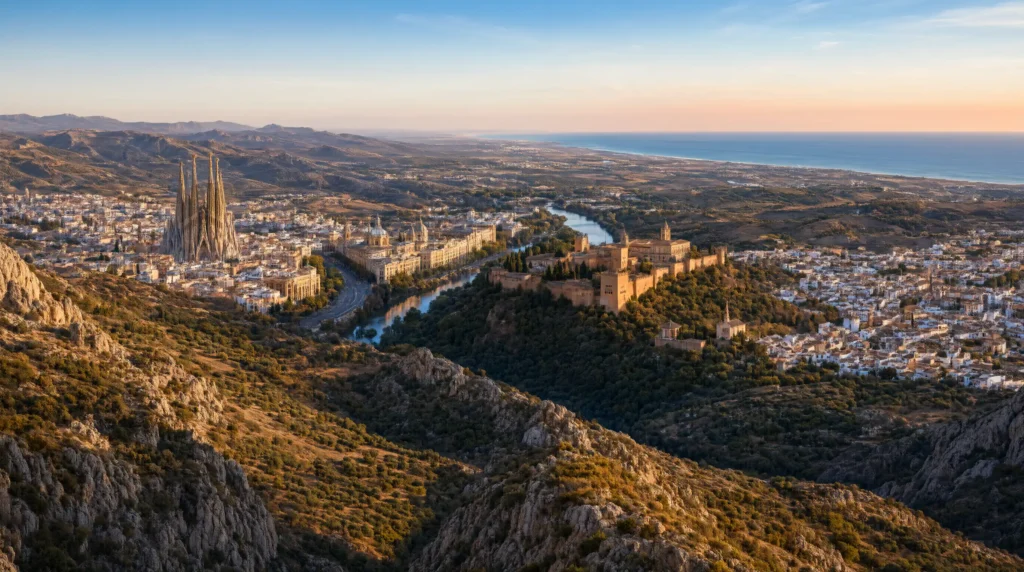
Spain fits Moorish palaces, Roman aqueducts, Gothic cathedrals, Atlantic coast towns and island beaches into one country, and the best trips pick a region and move slowly. This guide covers 16 of the best places to visit in Spain, from Barcelona and Madrid to Granada, San Sebastián and the islands, with how long to stay, when to go, and what travelers from the U.S., UK, Canada and Australia should know about Schengen entry rules, the Entry/Exit System, heat and safety right now. For more on the country, see our Spain destination guide or browse our Europe destination guides.
- First trip: Madrid, Barcelona, Seville and Granada.
- History and architecture: Granada, Córdoba, Toledo, Segovia, Salamanca and Barcelona.
- Food and coast: San Sebastián, Valencia, Bilbao and Málaga.
- Pilgrimage: Santiago de Compostela and the Camino routes.
- Islands: Mallorca, Ibiza and Tenerife.
- Entry rules: Spain is in the Schengen area, and the UK government says you can travel without a visa for up to 90 days in any 180-day period.
- Safety level: The U.S. State Department lists Spain at Level 2, Exercise Increased Caution, and Canada advises a high degree of caution, in both cases because of the terrorism threat. Most trips are trouble free, but read the safety section.
- Alhambra: Advance booking is recommended because visitor numbers are limited, and entry to the Nasrid Palaces is only at the time slot on your ticket.
- Heat: Extreme heat can affect many parts of Spain in summer, so plan sightseeing for early morning and evening.
Table of contents
- How to Choose the Best Places to Go in Spain
- Barcelona: Best for Gaudí and City Beaches
- Madrid: Best for Art Museums and Late Nights
- Seville: Best for Moorish Palaces and Flamenco
- Granada: Best for the Alhambra
- Córdoba: Best for the Mezquita and Patio Streets
- Toledo: Best for a Medieval Hilltop City
- Segovia: Best for a Roman Aqueduct
- Salamanca: Best for a Golden Sandstone University City
- Valencia: Best for Modern Architecture and Paella
- San Sebastián: Best for Food and Beaches
- Bilbao: Best for Contemporary Art and Basque Culture
- Santiago de Compostela: Best for Pilgrim Routes
- Málaga and Ronda: Best for Andalusian Coast and Cliffs
- Mallorca: Best for Coves and Mountain Villages
- Ibiza: Best for Old Town Walls and Quiet Coves
- Tenerife: Best for a Volcano and Warm Winters
- Sample Spain Itineraries
- Best Ways to Get Around Spain
- Best Time to Visit Spain
- Entry, Safety and Practical Rules for US, UK, Canadian and Australian Travelers
- Frequently Asked Questions
- Final Thoughts
How to Choose the Best Places to Go in Spain
Spain is large, and the cities are far apart. Fast trains link Madrid with Barcelona, Seville, Valencia and others, but you still lose half a day each time you move. The best plan for a first visit is to pick three or four bases, give each at least two nights, and treat everything else as a day trip.
UNESCO lists 50 World Heritage properties in Spain: 44 cultural, four natural and two mixed. That is why this guide links to the official listing wherever one exists.
| Your trip | A good starting plan |
|---|---|
| First visit, about 10 days | Madrid, Seville, Granada and Barcelona |
| Moorish Spain | Seville, Córdoba and Granada |
| Medieval and Roman cities | Toledo, Segovia and Salamanca |
| Food and coast | San Sebastián, Bilbao and Valencia |
| Pilgrim trails | Santiago de Compostela |
| Beach and island time | Mallorca, Ibiza or Tenerife |
Barcelona: Best for Gaudí and City Beaches
Barcelona mixes architecture, food and a Mediterranean beach in one city. UNESCO’s listing of the Works of Antoni Gaudí covers seven properties in or near the city, including Parque Güell, Palacio Güell, Casa Milà, Casa Vicens, Casa Batlló and Gaudí’s work on the Nativity façade and Crypt of La Sagrada Familia. The Palau de la Música Catalana and the Hospital de Sant Pau are also on UNESCO’s list.
Book timed tickets for the major sights on their official sites, and arrive at the time on your ticket. Take care with your belongings. Canada’s advice says petty crime such as pickpocketing and bag snatching is common, especially in Madrid and Barcelona, and around tourist sites and transport hubs.
Suggested time: Three to four days.
Best season: Spring and autumn. Summer is hot and crowded.
Planning tip: Keep valuables spread across different pockets, and use a cross-body bag in the Metro and on the Ramblas.
Madrid: Best for Art Museums and Late Nights
Madrid is the capital and a good first or last stop. The Prado, the Reina Sofía and the Thyssen museums sit close to one another, and the Retiro park is the place for a break. UNESCO lists the Paseo del Prado and Buen Retiro, a landscape of arts and sciences, inscribed in 2021, which covers the museum boulevard and the park. Dinner starts late, and the city is at its liveliest in the evening.
The Monastery and Site of the Escorial, a short trip out of the city, is also on UNESCO’s list, inscribed in 1984. Madrid is also a rail hub for Toledo, Segovia and Salamanca.
Suggested time: Three days.
Best season: Spring and autumn.
Planning tip: Book museum tickets ahead and plan outdoor time for the morning, since summer afternoons are very hot.
Seville: Best for Moorish Palaces and Flamenco
Seville is the capital of Andalusia and one of the most atmospheric cities in the country. UNESCO’s listing of the Cathedral, Alcázar and Archivo de Indias in Seville, inscribed in 1987, covers its main monuments. The old town is easy to explore on foot, with the Santa Cruz quarter, Plaza de España and the riverfront within a short walk.
Seville is very hot in summer. The UK government warns that extreme weather can affect many parts of Spain, particularly over the summer months, and tells visitors to check the national weather agency’s warnings. Visit in spring or autumn if you can, and rest during the afternoon.
Suggested time: Three days.
Best season: Spring and autumn.
Planning tip: Book the cathedral and Alcázar early in the day, and save the evening for a flamenco show.
Granada: Best for the Alhambra
Granada’s main sight is the Alhambra. UNESCO’s listing of the Alhambra, Generalife and Albayzín describes the Alhambra fortress and residence, the Generalife gardens that were the former rural residence of the emirs who ruled this part of Spain in the 13th and 14th centuries, and the Albaycín district, a repository of Moorish vernacular architecture.
Plan the visit well ahead. The official Alhambra ticket page says that, because of the great demand and the limit on visitors per day, advance booking is recommended. It also says you can only enter the Nasrid Palaces in the time slot on your ticket, and that if you do not enter at the designated time, you cannot visit that space. Bring your ID, and arrive early.
Suggested time: Two days.
Best season: Spring and autumn.
Planning tip: Book your Alhambra ticket as early as possible, then spend the second day in the Albaycín and at the evening viewpoints.
Córdoba: Best for the Mezquita and Patio Streets
Córdoba is a small city with a great deal of history. UNESCO lists the Historic Centre of Cordoba, inscribed in 1984 and extended in 1994, and the Caliphate City of Medina Azahara, inscribed in 2018. The Mezquita, a mosque turned cathedral, is the centerpiece, and the old Jewish quarter and its patios fill the rest of a visit.
Córdoba is hot in summer and is easy as a day trip from Seville or Madrid by fast train. An overnight stay gives you the old town in the evening, when it is quiet.
Suggested time: One to two days.
Best season: Spring and autumn.
Planning tip: Visit the Mezquita first thing in the morning, and avoid the middle of the day in summer.
Toledo: Best for a Medieval Hilltop City
Toledo sits on a hill above a bend in the river, with narrow streets, a cathedral and a mix of Christian, Jewish and Muslim heritage. UNESCO lists the Historic City of Toledo, inscribed in 1986.
It is an easy day trip from Madrid by train, but it is better as an overnight stay, once the day trippers leave. Wear comfortable shoes, because the old town is hilly and the streets are uneven.
Suggested time: One to two days.
Best season: Spring and autumn.
Planning tip: Stay overnight if you can, and walk the old town in the evening.
Segovia: Best for a Roman Aqueduct
Segovia is a small city north-west of Madrid, known for its Roman aqueduct and a fairy-tale castle. UNESCO lists the Old Town of Segovia and its Aqueduct, inscribed in 1985.
It is an easy day trip from Madrid by train, and it combines well with a lunch of the local roast. It can be cold in winter, because the city is high up.
Suggested time: One day.
Best season: Spring to autumn.
Planning tip: Pair Segovia with Ávila or Salamanca if you plan a longer loop from Madrid.
Salamanca: Best for a Golden Sandstone University City
Salamanca is a university city in the west, with honey-colored stone buildings, a large main square and a lively student scene. UNESCO lists the Old City of Salamanca, inscribed in 1988.
The city is compact and easy on foot. It works as an overnight stop between Madrid and Portugal or Santiago de Compostela.
Suggested time: One to two days.
Best season: Spring and autumn.
Planning tip: Walk the Plaza Mayor in the evening, when the stone is lit and the square fills up.
Valencia: Best for Modern Architecture and Paella
Valencia is a coastal city with a historic center, a city beach and a large park built in a former river bed. UNESCO lists La Lonja de la Seda de Valencia, the Silk Exchange, which was inscribed in 1996. The city is also the home of paella, which is best eaten at lunch.
Valencia is flat and bike friendly, and it is quieter than Barcelona. It makes a good beach city stop on the way between Madrid and Barcelona.
Suggested time: Two to three days.
Best season: Spring and autumn, and March for the Fallas festival.
Planning tip: Rent a bike for the riverbed park, and eat paella at lunch rather than dinner.
San Sebastián: Best for Food and Beaches
San Sebastián is a Basque coastal city known for its food, with pintxos bars in the old town and a curved city beach. The city is small and walkable, and the surrounding hills and coast add day trips.
It is also a base for the Basque coast and for nearby French Basque towns. Weather is milder and wetter than in the south, so pack a light rain jacket.
Suggested time: Two to three days.
Best season: Late spring to early autumn.
Planning tip: Move from bar to bar and order one or two pintxos at each, rather than sitting for a long meal.
Bilbao: Best for Contemporary Art and Basque Culture
Bilbao is a former industrial city that is now known for the Guggenheim Museum, a river walkway and a lively old town. UNESCO lists the Vizcaya Bridge, inscribed in 2006, near the city.
Bilbao works well with San Sebastián as a Basque pair. Both are easy by bus or train.
Suggested time: Two days.
Best season: Late spring to early autumn.
Planning tip: Book the Guggenheim for the morning, and spend the afternoon in the old town.
Santiago de Compostela: Best for Pilgrim Routes
Santiago de Compostela is the end point of the Camino de Santiago. UNESCO lists the Old Town of Santiago de Compostela, inscribed in 1985, and the Routes of Santiago de Compostela. UNESCO says the extension represents a network of almost 1,500 km, with a built heritage that includes cathedrals, churches, hospitals, hostels and bridges, and that the earliest routes followed the discovery in the 9th century of a tomb believed to be that of St. James the Greater.
You do not need to walk the full Camino to enjoy the city. A day or two around the cathedral is enough, and many visitors walk the last stage into town.
Suggested time: Two days.
Best season: Spring and early autumn.
Planning tip: Pack rain gear, because Galicia is often wet.
Málaga and Ronda: Best for Andalusian Coast and Cliffs
Málaga is a southern coastal city with a historic center, museums and a long beach. Ronda, inland, is a town built on both sides of a deep gorge, with a famous bridge. The area also includes the Antequera Dolmens Site, which UNESCO inscribed in 2016.
Málaga is also the main airport for the Costa del Sol. Combine the city with Ronda and the nearby white villages if you have a car.
Suggested time: Three to four days.
Best season: Spring and autumn.
Planning tip: Drive to Ronda early to see the gorge before the day-trip buses arrive.
Mallorca: Best for Coves and Mountain Villages
Mallorca is one of the Balearic Islands, with a mix of beaches, coves, a historic capital in Palma and a mountain range on the west coast. UNESCO lists the Cultural Landscape of the Serra de Tramuntana, inscribed in 2011.
The island is busy in July and August. Late spring and early autumn give you the beaches without the crowds. A rental car is the easiest way to reach the coves and villages.
Suggested time: Four to five days.
Best season: Late spring and early autumn.
Planning tip: Check sea conditions before you swim. The UK government says people drown in the sea in Spain every year and that a red flag means you must not enter the water.
Ibiza: Best for Old Town Walls and Quiet Coves
Ibiza is known for nightlife, but it has a quieter side. UNESCO lists Ibiza, Biodiversity and Culture, inscribed in 1999 as a mixed property. The walled old town, Dalt Vila, and the island’s coves and salt flats are the main sights.
Choose your base by the trip you want. The party areas and the quiet north coast are very different, and a few days on the quieter side is a good contrast.
Suggested time: Three to four days.
Best season: Late spring and early autumn.
Planning tip: Buy your own drinks and keep them in sight. The UK government warns about drink spiking in Spain.
Tenerife: Best for a Volcano and Warm Winters
Tenerife is one of the Canary Islands. UNESCO’s listing of Teide National Park says the Teide-Pico Viejo stratovolcano rises to 3,718 m, the highest peak on Spanish soil, and that it is regarded as the world’s third-tallest volcanic structure. A cable car and walking trails reach the high country, and the beaches are in the south.
The island is a good winter escape. Check conditions and permits before you plan a summit hike, and be aware that altitude can affect some visitors. The UK government notes that altitude sickness is a risk in some mountain areas.
Suggested time: Four to five days.
Best season: Spring and autumn, and winter for warmth.
Planning tip: Check the weather and any access rules for the national park before you go.
Sample Spain Itineraries
These are starting points, not fixed routes. Spain’s distances are large, so keep the number of bases low.
| Trip length | Route | Why it works |
|---|---|---|
| 7 days | Madrid (3), Seville (2), Granada (2) | The classic first loop |
| 10 days | Barcelona (3), Madrid (3), Seville (2), Granada (2) | Adds the Catalan capital |
| 14 days | Barcelona (3), Valencia (2), Madrid (3), Toledo (1), Córdoba (1), Seville (2), Granada (2) | A fuller loop with heritage cities |
Best Ways to Get Around Spain
High-speed trains link Madrid with Barcelona, Seville, Valencia, Málaga and other large cities, and they are the best way to cover long distances. Buses reach smaller towns, and flights are useful for the islands. A rental car is helpful for rural areas, such as Ronda, the Serra de Tramuntana and the white villages.
Thieves also target drivers. Canada’s advice says thieves may stage breakdowns or offer fake help, so avoid leaving valuables in parked cars and be cautious about anyone who stops to help.
Best Time to Visit Spain
Spain’s weather varies widely by region, and summer is hot in the south and center.
| Season | What to expect |
|---|---|
| Spring | Mild weather and good light in most regions. A strong choice for cities. |
| Summer | Hot in much of the country, especially the south and center. Beaches and the north are more comfortable. Book ahead. |
| Autumn | Warm sea and calmer towns. Canada notes that storms are common on the Mediterranean coast in autumn. |
| Winter | Cool in the center and north, mild in the Canary Islands. Fewer crowds at major sights. |
The UK government says extreme weather can affect many parts of Spain, particularly in summer, and that causing a wildfire is a criminal offence even if unintentional. Check the Spanish weather agency’s warnings and follow local rules on fire.
Entry, Safety and Practical Rules for US, UK, Canadian and Australian Travelers
Visas and entry
Spain is part of the Schengen area. The UK government says you can travel without a visa to the Schengen area, which includes Spain, for up to 90 days in any 180-day period, and that days in other Schengen countries count. Canada’s government gives the same 90 days in any 180-day period rule for Canadians.
- Passport: The UK government says your passport must have been issued less than 10 years before you arrive and must be valid for at least 3 months after the day you plan to leave the Schengen area. Canada gives the same 3 month rule.
- Entry/Exit System: The EU’s Entry/Exit System is being implemented across the Schengen area, and the UK government says your digital record is valid for 3 years. Canada says it records trip details, a facial image and fingerprints on entry, and that no action is needed before you travel.
- ETIAS: Canada’s government said in August 2026 that ETIAS applications were not yet open. When it launches, apply only through the official EU website.
- At the border: The UK government says you may need to show a hotel booking confirmation or proof of address.
Entry rules change. Confirm the latest requirements with the Spanish authorities or the EU’s official travel site before you book.
Safety: what each government says
Spain is a popular and generally easy destination, but governments do flag specific risks.
- United States: The State Department lists Spain at Level 2, Exercise Increased Caution, citing terrorism and unrest.
- Canada: Canada’s advice is to exercise a high degree of caution because of the terrorism threat, which it says is level 4 on a scale of 5. It also warns about pickpocketing, demonstrations and strikes, dangerous coastal waters and wildfires in summer.
- United Kingdom: The UK government says terrorists are likely to try to carry out attacks in Spain. It also warns about thieves who work in teams, thieves posing as police officers, drink spiking, extreme heat, wildfires, drownings and demonstrations. The emergency number is 112, and mountain rescue is 062.
- Australia: Check Smartraveller for the latest advice.
Practical rules
- Fake police: Genuine officers ask for ID, not your wallet. The UK warns that thieves posing as police may ask to see your wallet.
- Drugs: Illegal drugs, including cannabis, carry severe penalties, and small amounts can lead to arrest.
- Beach flags: A red flag means you must not enter the water.
- Currency: Spain uses the euro.
- Travel insurance: Get coverage that includes your activities and emergency medical costs.
Frequently Asked Questions
What are the best places to visit in Spain for first-timers?
For a first trip, start with Madrid, Barcelona, Seville and Granada. They are linked by fast trains and cover museums, Gaudí, Moorish palaces and the Alhambra in one route.
How many days do you need in Spain?
For a first visit, 10 to 14 days is enough for three or four bases, such as Barcelona, Madrid, Seville and Granada. Fewer bases with longer stays work better than moving every night.
What is the best time to visit Spain?
Spring and autumn suit most travelers. Summer is hot in the south and center, and the UK government warns about extreme heat and wildfires. Winter is quieter, with milder weather in the Canary Islands.
Do Americans need a visa for Spain?
Not for short stays. Spain is in the Schengen area, and visa-free stays are limited to 90 days in any 180-day period. The EU’s Entry/Exit System now records entries, and ETIAS has not opened yet as of Canada’s August 2026 advice.
Is Spain safe for tourists?
Mostly, with care. The U.S. State Department lists Spain at Level 2 because of terrorism and unrest, and Canada advises a high degree of caution. The most common problems are pickpocketing, bag snatching and scams, so keep valuables secure.
Do you need to book tickets for the Alhambra?
Yes. The official Alhambra site recommends advance booking because of the limit on visitors per day, and says you can only enter the Nasrid Palaces in the time slot on your ticket.
Final Thoughts
The best places to visit in Spain are the ones that fit your season, your pace and your tolerance for heat. Pick a few bases, check the Schengen rules and the current safety advice, and give each stop enough time to feel like more than a photo stop. Then come back for another region on your next trip.