Greece combines ancient sites, mountain monasteries and island towns, and the best trips pick one or two island groups and leave time for the mainland. This guide covers 16 of the best places to visit in Greece, from Athens and Delphi to Santorini, Crete and Corfu, with how long to stay, when to go, and what travelers from the U.S., UK, Canada and Australia should know about Schengen entry rules, ferries, wildfires and strikes right now. For more on the country, see our Greece destination guide or browse our Europe destination guides.
- First trip: Athens, Santorini and either Crete or Naxos.
- Ancient history: Athens, Delphi, Olympia, Mycenae and Delos.
- Mountains and monasteries: Meteora and Zagori.
- Islands: Santorini, Mykonos, Naxos, Milos, Crete, Rhodes, Corfu and Patmos.
- Cities: Athens and Thessaloniki.
- Entry rules: Greece is in the Schengen area, and the UK government says you can travel without a visa for up to 90 days in any 180-day period.
- Wildfire season: The UK government says there is a high risk of wildfires during the summer season from April to October. Causing a wildfire is a criminal offence, even if unintentional.
- Ferries and strikes: Weather can cause cancellations or delays, and strikes can disrupt transport. Reconfirm sailings before you go to the port.
- Acropolis tickets: Greece’s Ministry of Culture says tickets should only be bought online or at the official ticket offices.
Table of contents
- How to Choose the Best Places to Go in Greece
- Athens: Best for the Acropolis and Old Neighborhoods
- Delphi: Best for a Sanctuary on a Mountainside
- Meteora: Best for Monasteries on Rock Pillars
- Thessaloniki: Best for Byzantine Churches and Food
- Nafplio and Mycenae: Best for Bronze Age Palaces
- Olympia: Best for the Birthplace of the Games
- Mystras: Best for a Byzantine Hill Town
- Zagori: Best for Stone Villages and Gorges
- Santorini: Best for Caldera Views
- Mykonos and Delos: Best for Beaches and an Ancient Island
- Naxos: Best for Beaches and Mountain Villages
- Milos: Best for Colorful Coves and Boat Trips
- Crete: Best for Minoan Palaces and Mountain Gorges
- Rhodes: Best for a Medieval Walled City
- Corfu: Best for Venetian Streets and Green Hills
- Patmos: Best for a Quiet Island and Sacred Sites
- Sample Greece Itineraries
- Best Ways to Get Around Greece
- Best Time to Visit Greece
- Entry, Safety and Practical Rules for US, UK, Canadian and Australian Travelers
- Frequently Asked Questions
- Final Thoughts
How to Choose the Best Places to Go in Greece
Greece is a mainland and hundreds of islands, and ferry timetables shape every island trip. The best plan for a first visit is to pick Athens plus one island group, choose two or three bases and treat everything else as a day trip. The Cyclades (Santorini, Mykonos, Naxos, Milos) are easy to combine, while Crete, Rhodes and Corfu are separate trips.
UNESCO lists 21 World Heritage properties in Greece: 18 cultural and three mixed. That is why this guide links to the official listing wherever one exists.
| Your trip | A good starting plan |
|---|---|
| First visit, about 10 days | Athens, Santorini and Naxos |
| 14 days | Add Delphi, Meteora and Crete |
| Ancient sites | Athens, Delphi, Olympia, Mycenae and Delos |
| Island hopping | Naxos, Paros, Milos and Santorini |
| Mountains and culture | Meteora, Zagori and Thessaloniki |
| Slower pace | Patmos, Corfu and the Peloponnese |
Athens: Best for the Acropolis and Old Neighborhoods
Athens is the starting point for most trips and worth three days on its own. UNESCO’s listing of the Acropolis, Athens calls it a universal symbol of the classical spirit and the greatest architectural and artistic complex bequeathed by Greek Antiquity. It says that in the second half of the fifth century B.C. the most important monuments were built, including the Parthenon, the Erechtheon and the Propylaea.
Buy tickets from official sources. The Greek Ministry of Culture says tickets should only be bought online or at the official ticket offices, or for groups through licensed agencies. Beyond the Acropolis, the Plaka and Anafiotika neighborhoods, the Acropolis Museum and the markets fill the rest of a visit.
Take care on the metro and in crowds. The UK government says thefts of passports, wallets and handbags are common on the metro and in crowded tourist places.
Suggested time: Three days.
Best season: Spring and autumn. Summer is very hot at the archaeological sites.
Planning tip: Go to the Acropolis at opening time and spend the middle of the day indoors.
Delphi: Best for a Sanctuary on a Mountainside
Delphi is an ancient sanctuary on the slopes of Mount Parnassus, a day trip from Athens. UNESCO lists the Archaeological Site of Delphi, inscribed in 1987. The site and its museum can be covered in half a day.
Combine it with the road to Meteora or stay overnight in the village for a quiet evening. Heat is a risk on the exposed site in summer, so carry water and a hat.
Suggested time: One day or one night.
Best season: Spring and autumn.
Planning tip: Visit the museum first, then walk the site in the cooler part of the day.
Meteora: Best for Monasteries on Rock Pillars
Meteora is a group of monasteries on tall sandstone pillars in central Greece. UNESCO’s listing of Meteora says monks settled on these columns of the sky from the 11th century onwards, that 24 of the monasteries were built at the time of the revival of the eremetic ideal in the 15th century, and that their 16th-century frescoes mark a key stage in the development of post-Byzantine painting.
The town of Kalambaka is the base. Several monasteries can be visited, with different opening days, so check the schedule before you go. Dress modestly for the monasteries.
Suggested time: Two days.
Best season: Spring and autumn.
Planning tip: Start early and plan the monasteries around their opening days, which vary.
Thessaloniki: Best for Byzantine Churches and Food
Thessaloniki is a major city on the northern coast. UNESCO lists the Paleochristian and Byzantine Monuments of Thessalonika, inscribed in 1988. The waterfront, the White Tower and the city’s markets give the city a different feel from Athens.
It is a good place for food and an easy base for the northern mainland. Many visitors combine it with Meteora or the northern beaches.
Suggested time: Two days.
Best season: Spring and autumn.
Planning tip: Walk the waterfront at sunset, and plan a meal around the covered markets.
Nafplio and Mycenae: Best for Bronze Age Palaces
Nafplio is a small harbor town in the Peloponnese, with a fortress above the old town. It is a good base for ancient sites. UNESCO lists the Archaeological Sites of Mycenae and Tiryns, inscribed in 1999, and the Sanctuary of Asklepios at Epidaurus, inscribed in 1988.
A rental car makes the Peloponnese easy. The sites are spread out, and one or two a day is a good pace.
Suggested time: Two to three days.
Best season: Spring and autumn.
Planning tip: Visit Mycenae in the morning, and the theater at Epidaurus later in the day.
Olympia: Best for the Birthplace of the Games
Olympia is the ancient site in the western Peloponnese, where the Olympic Games began. UNESCO lists the Archaeological Site of Olympia, inscribed in 1989. The site and its museum are a calm stop away from the main tourist circuit.
It makes a good overnight stop on a Peloponnese loop. Heat is the main issue in summer, so go early.
Suggested time: One day or one night.
Best season: Spring and autumn.
Planning tip: Visit the museum before you walk the site.
Mystras: Best for a Byzantine Hill Town
Mystras is a ruined medieval town on a hillside near Sparta. UNESCO lists the Archaeological Site of Mystras, inscribed in 1989. Churches, palaces and walls climb the hill, and the views reach across the valley.
The site is hilly, with uneven paths. Wear good shoes, bring water and plan to visit early in the day.
Suggested time: Half a day.
Best season: Spring and autumn.
Planning tip: Start at the top gate and walk down, so the climb is behind you.
Zagori: Best for Stone Villages and Gorges
Zagori is a mountain region in northwest Greece, known for stone villages, old bridges and walking trails. UNESCO lists the Zagori Cultural Landscape, inscribed in 2023.
It is a good option for hikers and for travelers who want a quiet side of Greece. The UK government advises avoiding hiking alone if you can, and telling someone your route. Call 112 in an emergency.
Suggested time: Two to three days.
Best season: Late spring to autumn.
Planning tip: Base in one village and take day walks, and check weather before you go into a gorge.
Santorini: Best for Caldera Views
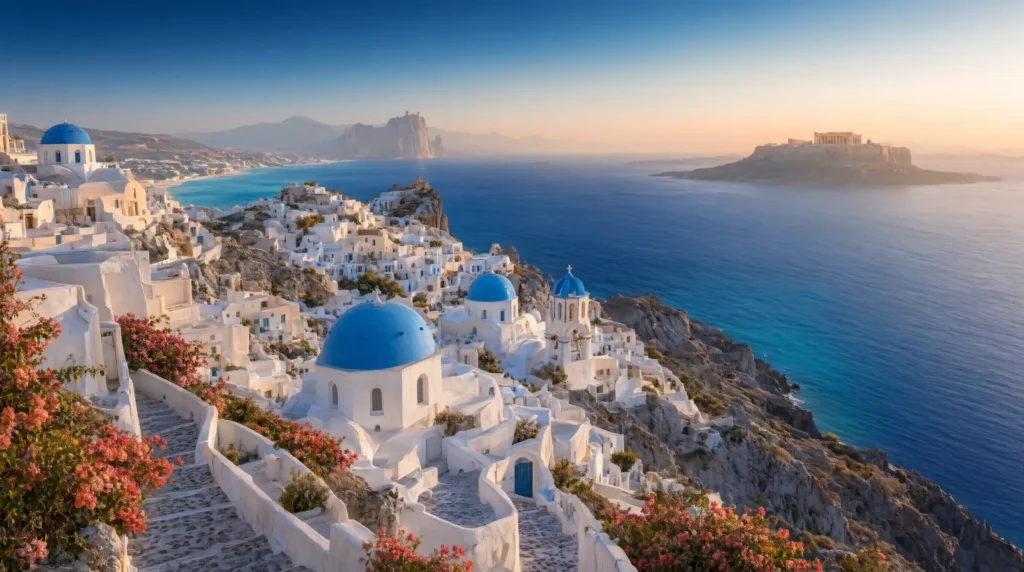
Santorini is a crescent-shaped island around a flooded caldera, with white villages on the cliff edge. It is a popular first island for many visitors. Canada’s advice notes that Greece is in an active seismic zone and that Santorini and Nisyros have active volcanoes.
The island is busy in summer, and prices are high. Spring and autumn give you the views with fewer crowds. Choose one base, such as Oia or Fira, and move around by bus or taxi.
Suggested time: Three days.
Best season: Spring and early autumn.
Planning tip: Book accommodation and ferries early, and watch the sunset from a quieter village.
Mykonos and Delos: Best for Beaches and an Ancient Island
Mykonos is a lively island with white lanes, beaches and a busy nightlife scene. Delos, a short boat ride away, is an archaeological island. UNESCO lists Delos, inscribed in 1990.
Mykonos is expensive in summer. Visit Delos in the morning, because the site is exposed and hot by midday. Keep your drink in sight at night. The UK government warns about drink spiking and advises pre-arranged transport.
Suggested time: Three days.
Best season: Late spring and early autumn.
Planning tip: Book the Delos boat ahead, and go early.
Naxos: Best for Beaches and Mountain Villages
Naxos is a large Cycladic island with long sandy beaches, a historic town and villages in the hills. It suits travelers who want a mix of beach days and walks. It is a good first island for an island-hopping trip.
Ferries link Naxos with Athens and with neighboring islands, but schedules change. Canada advises reconfirming departure schedules before you go to the port.
Suggested time: Three to four days.
Best season: Late spring to early autumn.
Planning tip: Rent a car or scooter for the villages, but ride carefully on narrow roads.
Milos: Best for Colorful Coves and Boat Trips
Milos is a volcanic island with unusual rock formations, colorful coves and small fishing villages. Boat trips around the coast are the best way to see the beaches.
Check the weather before booking boat trips. Strong winds can cancel sailings, and the UK government reminds visitors that people drown in the sea every year. A red flag means you must not enter the water.
Suggested time: Three days.
Best season: Late spring to early autumn.
Planning tip: Book a boat tour for a calm day, and keep a spare day in your plan.
Crete: Best for Minoan Palaces and Mountain Gorges
Crete is a large island, with beaches, mountains, gorges and old harbor towns. UNESCO lists the Minoan Palatial Centres, inscribed in 2025, which includes the Minoan palaces of the island.
Crete is big, so choose a region as a base. The west and the south are good for beaches and gorges, and the north has the main cities. A rental car is the easiest way to move around.
Suggested time: Five to seven days.
Best season: Late spring and early autumn.
Planning tip: Check hiking conditions before any gorge walk. Heat is a risk in summer.
Rhodes: Best for a Medieval Walled City
Rhodes is an island in the Dodecanese with a walled old town. UNESCO’s listing of the Medieval City of Rhodes says the Order of St John of Jerusalem occupied Rhodes from 1309 to 1523 and transformed the city into a stronghold. With the Palace of the Grand Masters, the Great Hospital and the Street of the Knights, the Upper Town is one of the most beautiful urban ensembles of the Gothic period.
The old town is walkable, and beaches and villages fill the rest of the island. A day trip to Lindos is the usual extra.
Suggested time: Three to four days.
Best season: Late spring and early autumn.
Planning tip: Walk the old town early, before cruise ship visitors arrive.
Corfu: Best for Venetian Streets and Green Hills
Corfu is an island in the Ionian Sea, with a historic old town, olive groves and quiet beaches. UNESCO lists the Old Town of Corfu, inscribed in 2007.
It is green and relaxed, and the island suits families and travelers who like to explore by car. Services thin out in winter, so check opening times if you travel then.
Suggested time: Four days.
Best season: Late spring to early autumn.
Planning tip: Stay in the old town for two nights, then move to the coast.
Patmos: Best for a Quiet Island and Sacred Sites
Patmos is a small island in the Dodecanese with a monastery on the hill above the main town. UNESCO lists the Historic Centre (Chorá) with the Monastery of Saint-John the Theologian and the Cave of the Apocalypse, inscribed in 1999.
It is a quiet island that suits a slow trip. It is reached by ferry, so check schedules, which are less frequent than on the main islands.
Suggested time: Two to three days.
Best season: Late spring to early autumn.
Planning tip: Visit the monastery in the morning, and dress modestly.
Sample Greece Itineraries
These are starting points, not fixed routes. Greece’s islands are far apart, so keep the number of bases low and check ferry schedules before you book.
| Trip length | Route | Why it works |
|---|---|---|
| 7 days | Athens (3), Santorini (3), return by ferry or flight (1) | The classic first loop |
| 10 days | Athens (3), Naxos (3), Santorini (3), return (1) | Adds a second island |
| 14 days | Athens (3), Delphi (1), Meteora (1), Naxos (3), Santorini (3), Crete (3) | A fuller loop with mainland and islands |
Best Ways to Get Around Greece
Ferries link Athens’ ports with most islands, and flights cover longer routes, such as Athens to Crete or Rhodes. On the mainland, buses and trains link the main cities, and a rental car is easiest for the Peloponnese and the north.
Ferries are affected by weather and strikes. Canada says weather can cause cancellations or significant delays and that travelers should reconfirm departure schedules before going to the port. The UK government says strikes can disrupt buses, trains, ferries and flights.
Best Time to Visit Greece
Greece is hot in summer and mild in spring and autumn.
| Season | What to expect |
|---|---|
| Spring | Mild weather and wildflowers. Some island services start later. |
| Summer | Hot and busy, with the highest prices and the highest wildfire risk. |
| Autumn | Warm sea, calmer islands and good walking weather. |
| Winter | Quiet and cooler. Many island hotels and ferries run reduced schedules. |
Wildfires are a real risk. The UK government says there is a high risk during the summer season from April to October, and Canada says wildfires are common from July to September, particularly in the Peloponnese, Central Greece, Eastern Macedonia and Thrace, and areas around Athens. Heat is also a concern for hiking and sightseeing.
Entry, Safety and Practical Rules for US, UK, Canadian and Australian Travelers
Visas and entry
Greece is part of the Schengen area. The UK government says you can travel without a visa to the Schengen area for up to 90 days in any 180-day period, and that overstaying can lead to a ban of up to 3 years. Canada’s government gives the same 90 days in any 180-day period rule for Canadians.
- Passport: The UK government says your passport must have been issued less than 10 years before you arrive and must be valid for at least 3 months after you plan to leave the Schengen area. Canada gives the same 3 month rule.
- Entry/Exit System: The EU’s Entry/Exit System is being implemented across Schengen. The UK government says Greek authorities have indicated that they will not collect biometric data. Check the current process when you travel.
- ETIAS: Canada’s government said in October 2026 that ETIAS applications were not yet open. When it launches, apply only through the official EU website.
- Cash: Declare cash or travelers’ checks of 10,000 euros or more at your point of entry.
Entry rules change. Confirm the latest requirements with the Greek authorities or the EU’s official travel site before you book.
Safety: what each government says
Greece is a safe destination for most travelers. The main risks are wildfires, heat, strikes and petty crime.
- United States: The State Department lists Greece at Level 1, Exercise Normal Precautions.
- Canada: Canada’s advice is to take normal security precautions. It warns about wildfires, earthquakes, petty crime, strikes and ferry delays.
- United Kingdom: The UK government says terrorists are likely to try to carry out attacks in Greece, and warns about wildfires, heat, earthquakes, thefts on the metro, drink spiking, demonstrations in central Athens and drowning. The emergency number is 112.
- Australia: Check Smartraveller for the latest advice.
Practical rules
- Wildfires: Do not light fires or barbecues, and extinguish cigarettes fully. Call 112 if you see a fire.
- Hiking: Avoid hiking in the hottest hours and avoid hiking alone if you can. Make sure your insurance covers mountain rescue.
- Beach flags: A red flag means you must not enter the water.
- Drugs: Illegal drugs, including cannabis, carry severe penalties.
- Currency: Greece uses the euro.
- Travel insurance: Get coverage that includes your activities and emergency medical costs.
Frequently Asked Questions
What are the best places to visit in Greece for first-timers?
For a first trip, start with Athens, Santorini and one more island such as Naxos or Crete. Add Delphi or Meteora if you want mainland history.
How many days do you need in Greece?
For a first visit, 10 to 14 days is enough for Athens and two islands. Fewer bases with longer stays work better than moving every night, because ferries take time.
What is the best time to visit Greece?
Late spring and early autumn are the best balance of weather and crowds. Summer is hot, busy and has the highest wildfire risk, and many island services are reduced in winter.
Do Americans need a visa for Greece?
Not for short stays. Greece is in the Schengen area, and visa-free stays are limited to 90 days in any 180-day period. ETIAS had not opened as of Canada’s October 2026 advice.
Is Greece safe for tourists?
Yes, with normal precautions. The U.S. State Department lists Greece at Level 1, and Canada advises normal security precautions. The main risks are wildfires, heat, strikes and petty theft in crowded places.
Are ferries in Greece reliable?
Mostly, but weather and strikes can cause cancellations or delays. Canada advises reconfirming departure schedules before you go to the port, and the UK says strikes can disrupt ferries.
Final Thoughts
The best places to visit in Greece are the ones that fit your season, your ferry schedule and your tolerance for heat. Pick Athens plus one island group, check the Schengen rules for your passport, and give each stop enough time to feel like more than a photo stop. Then come back for another island next time.