
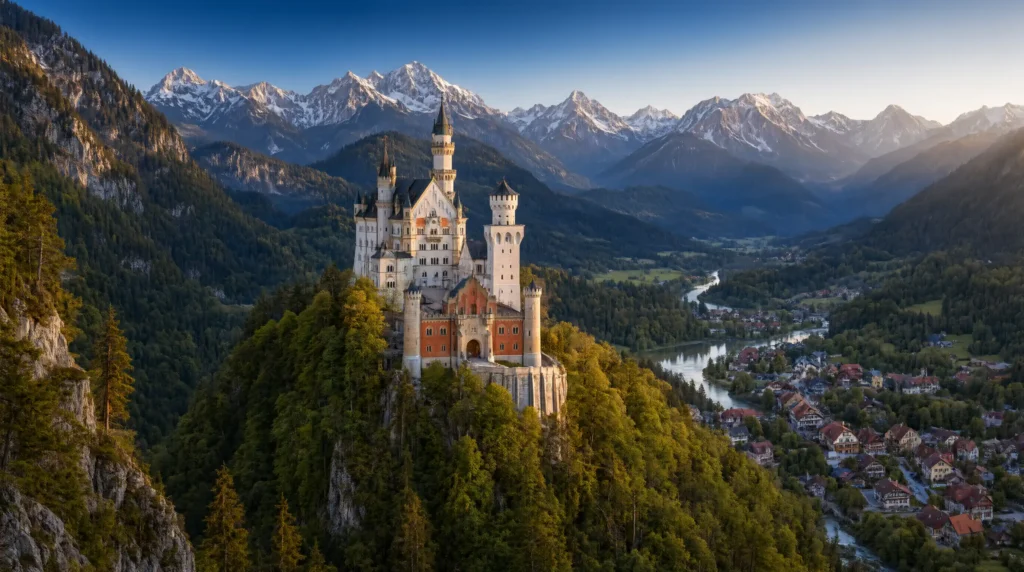
Germany pairs big museum cities and Hanseatic ports with Rhine castles, forest villages and the Bavarian Alps, and the best trips use the rail network and pick a handful of bases rather than chasing every sight. This guide covers 16 of the best places to visit in Germany, from Berlin and Hamburg to the Rhine Valley, Neuschwanstein and the Black Forest, with how long to stay, when to go, and what travelers from the U.S., UK, Canada and Australia should know about Schengen entry rules, temporary border checks and safety advice right now. For more on the country, see our Germany destination guide or browse our Europe destination guides.
- First trip: Berlin, Munich and the Rhine Valley, with Neuschwanstein as a day trip from Munich.
- History and culture: Berlin, Potsdam, Weimar, Trier and Bamberg.
- Castles and palaces: Neuschwanstein, Heidelberg and Potsdam.
- Cities and ports: Berlin, Hamburg, Lübeck, Cologne and Munich.
- Mountains and forest: The Bavarian Alps and the Black Forest.
- Entry rules: Germany is in the Schengen area, and the UK government says you can travel without a visa for up to 90 days in any 180-day period. It also says temporary border controls are in place at Germany’s land borders.
- Safety level: The U.S. State Department lists Germany at Level 2, and Canada advises a high degree of caution, in both cases because of the terrorism threat.
- Neuschwanstein: The castles can only be visited on a guided tour at a fixed entry time, so book ahead on the official site.
Table of contents
- How to Choose the Best Places to Go in Germany
- Berlin: Best for Museums and Modern History
- Potsdam: Best for Palaces and Parks
- Hamburg: Best for Harbor Views and Warehouse Streets
- Lübeck: Best for a Hanseatic Old Town
- Cologne: Best for a Gothic Cathedral and Rhine Riverbanks
- Upper Middle Rhine Valley: Best for Castles and Vineyards
- Trier: Best for Roman Monuments
- Heidelberg: Best for a Castle Ruin and a University Old Town
- Black Forest: Best for Hiking and Forest Villages
- Munich: Best for Beer Halls and Bavarian Culture
- Neuschwanstein and Füssen: Best for a Fairy-Tale Castle
- Garmisch and the Bavarian Alps: Best for Mountain Views and Hikes
- Rothenburg ob der Tauber: Best for a Walled Medieval Town
- Nuremberg and Bamberg: Best for Old Towns and Smoked Beer
- Dresden and Weimar: Best for Art, Music and Classical Heritage
- Sample Germany Itineraries
- Best Ways to Get Around Germany
- Best Time to Visit Germany
- Entry, Safety and Practical Rules for US, UK, Canadian and Australian Travelers
- Frequently Asked Questions
- Final Thoughts
How to Choose the Best Places to Go in Germany
Germany is a large country with an excellent rail network, but the best sights are spread out. The best plan for a first visit is to pick one region, choose three or four bases and treat everything else as a day trip. Berlin and the east suit history, Bavaria suits castles and mountains, and the west suits the Rhine and Cologne.
UNESCO lists 55 World Heritage properties in Germany: 52 cultural and three natural. That is why this guide links to the official listing wherever one exists.
| Your trip | A good starting plan |
|---|---|
| First visit, about 7 days | Berlin, Munich and a Rhine stop |
| 10 days | Add Neuschwanstein, Rothenburg and Cologne |
| History | Berlin, Potsdam, Weimar and Trier |
| Castles and old towns | Neuschwanstein, Heidelberg, Bamberg and Rothenburg |
| Nature | Black Forest, Bavarian Alps and the Rhine Valley |
| Cities and food | Berlin, Hamburg, Munich and Cologne |
Berlin: Best for Museums and Modern History
Berlin is the capital and a good city for a short trip. UNESCO lists the Museumsinsel (Museum Island), inscribed in 1999, in the city center. The city’s history of division, its museums and memorials, its neighborhood cafes and its nightlife fill several days.
Take normal city care. Canada says pickpocketing and bag snatching are common, especially on public transport, and the UK government advises being alert at airports, stations and crowded places.
Suggested time: Four days.
Best season: Late spring to early autumn.
Planning tip: Buy museum tickets in advance for the busiest attractions, and use public transport instead of taxis for most trips.
Potsdam: Best for Palaces and Parks
Potsdam is a short train ride from Berlin and a good day trip. UNESCO lists the Palaces and Parks of Potsdam and Berlin, first inscribed in 1990 and extended in 1992 and 1999. The parks are large, so wear comfortable shoes.
It works as a half day or a full day, and the town center has cafes and a quiet pace after Berlin. Summer is the best time for the gardens.
Suggested time: One day.
Best season: Spring to early autumn.
Planning tip: Start at Sanssouci early, and plan other stops around the park.
Hamburg: Best for Harbor Views and Warehouse Streets
Hamburg is a port city with canals, bridges and a lively waterfront. UNESCO lists the Speicherstadt and Kontorhaus District with Chilehaus, inscribed in 2015, a district of brick warehouses and merchant offices. The harbor, the concert hall on the waterfront and the St. Pauli district fill a long weekend.
It is a good stop on a northern route with Lübeck and the Baltic coast. Boat trips around the harbor are an easy way to see the port.
Suggested time: Two to three days.
Best season: Late spring to early autumn.
Planning tip: Walk the warehouse district in the evening, when the buildings are lit.
Lübeck: Best for a Hanseatic Old Town
Lübeck is a small Baltic city with brick Gothic churches, gates and historic merchant houses. UNESCO lists the Hanseatic City of Lübeck, inscribed in 1987.
It is an easy day trip from Hamburg by train, but an overnight stay gives you a quieter evening in the old town. It also makes a good base for the Baltic coast.
Suggested time: One day or one night.
Best season: Spring to early autumn, and December for the Christmas market.
Planning tip: Climb a church tower for a view over the old town.
Cologne: Best for a Gothic Cathedral and Rhine Riverbanks
Cologne is a Rhine city with a huge Gothic cathedral beside the main train station. UNESCO lists the Cologne Cathedral, inscribed in 1996.
The city is compact and lively, with museums, brewery pubs and river walks. It is also an easy base for the Rhine Valley. Stay alert in busy places such as the station area.
Suggested time: Two days.
Best season: Spring to early autumn, and December for the markets.
Planning tip: Visit the cathedral early, and book a time for the tower climb if you want one.
Upper Middle Rhine Valley: Best for Castles and Vineyards
The Rhine Valley is Germany’s classic river landscape. UNESCO’s listing of the Upper Middle Rhine Valley describes a 65 km stretch between Bingen, Rüdesheim and Koblenz with about sixty small towns, extensive terraced vineyards and the ruins of castles that once defended its trade.
Trains run along both banks, and river boats link the main towns. Choose a base such as Bacharach, Boppard or Rüdesheim and mix a boat trip with a short walk between villages.
Suggested time: Two days.
Best season: Late spring to early autumn.
Planning tip: Take a boat one way and a train back, so you see the valley from both angles.
Trier: Best for Roman Monuments
Trier is a city in the southwest, near the Luxembourg border, with Roman gates, baths and an amphitheater. UNESCO lists the Roman Monuments, Cathedral of St Peter and Church of Our Lady in Trier, inscribed in 1986.
It is a compact town and an easy overnight on a Moselle wine route. Walk the old center and the Roman sites in a day.
Suggested time: One to two days.
Best season: Spring to early autumn.
Planning tip: Combine Trier with a Moselle valley drive or a river trip.
Heidelberg: Best for a Castle Ruin and a University Old Town
Heidelberg is a university town on the Neckar River, with a ruined castle above a baroque old town. It is a short train trip from Frankfurt and suits an easy day or an overnight.
The old town is walkable, and the castle is reached by a funicular or a steep walk. It is popular in summer, so go early or stay for the evening.
Suggested time: One day or one night.
Best season: Spring to autumn.
Planning tip: Walk up to the castle in the morning, then explore the old town and the river.
Black Forest: Best for Hiking and Forest Villages
The Black Forest is a wooded mountain region in the southwest, with hiking trails, small villages, lakes and cuckoo clock culture. Freiburg is a good base for a university city feel, and smaller villages suit a slower trip.
The UK government says risks are greater if you undertake any outdoor activity alone, and advises checking forecasts and leaving your itinerary with someone. A rental car or a regional rail pass makes it easy to reach the trails.
Suggested time: Three days.
Best season: Late spring to autumn for hiking.
Planning tip: Choose a base with good rail links, and carry layers because forest weather changes.
Munich: Best for Beer Halls and Bavarian Culture
Munich is the Bavarian capital, with palaces, museums, beer halls and the English Garden. It is a gateway to the Alps and to the castles near Füssen. UNESCO lists the Palaces of King Ludwig II of Bavaria, inscribed in 2025, which include Herrenchiemsee, Linderhof, Schachen and Neuschwanstein.
The city is walkable in the center, and public transport covers the rest. Large festivals make rooms scarce and expensive, so book early if your trip overlaps one.
Suggested time: Three days.
Best season: Late spring to early autumn, and December for the markets.
Planning tip: Book accommodation early for major festival dates.
Neuschwanstein and Füssen: Best for a Fairy-Tale Castle
Neuschwanstein sits in the Bavarian Alps near Füssen and is one of Ludwig II’s palaces. UNESCO’s listing of The Palaces of King Ludwig II of Bavaria covers Neuschwanstein, Linderhof, Schachen and Herrenchiemsee.
Plan ahead. The official Hohenschwangau site says the castles can only be visited as part of a guided tour at a fixed entry time, and that tours have limited capacity. Tickets are timed, and admission is only at the start time printed on the ticket. Buy on the official ticket site, because same-day tickets at the ticket center often sell out early.
Suggested time: One day from Munich, or one night in Füssen.
Best season: Late spring to early autumn, and winter for snow.
Planning tip: Book your timed ticket as early as possible, and arrive at the ticket center in good time.
Garmisch and the Bavarian Alps: Best for Mountain Views and Hikes
Garmisch-Partenkirchen is the main base for mountain walks and for the Zugspitze, a major peak. Cable cars and trails give access in summer, and skiing runs in winter.
Take mountain safety seriously. The UK government says to check forecasts, carry navigation and communication equipment, and that off-piste skiing is very dangerous and can invalidate your travel insurance. Check avalanche and weather information before any alpine trip.
Suggested time: Two to three days.
Best season: Summer for hiking, winter for skiing.
Planning tip: Check the weather and the cable car status the night before.
Rothenburg ob der Tauber: Best for a Walled Medieval Town
Rothenburg is a small walled town in Bavaria, with half-timbered houses, towers and a walkable wall. It is on the Romantic Road, a scenic route through southern Germany.
It is busy with day trips, so staying overnight changes the mood. Plan a morning walk on the walls and an evening in the quiet streets.
Suggested time: One night.
Best season: Spring to early autumn, and December for the Christmas market.
Planning tip: Walk the walls early or at sunset, and book a room early for December.
Nuremberg and Bamberg: Best for Old Towns and Smoked Beer
Nuremberg is a city in northern Bavaria with an old town, a castle and a strong history museum scene. Bamberg, a short trip away, is a smaller town. UNESCO lists the Town of Bamberg, inscribed in 1993.
The two cities work well together on a loop between Munich and Berlin. Bamberg is known for its beer culture, and it is easy to explore on foot.
Suggested time: Two to three days.
Best season: Spring to early autumn.
Planning tip: Base in Bamberg and take a train to Nuremberg for a day.
Dresden and Weimar: Best for Art, Music and Classical Heritage
Dresden is a city on the Elbe with baroque buildings, museums and a lively old town. Weimar is a smaller town in Thuringia with a strong literary and design heritage. UNESCO lists Classical Weimar, inscribed in 1998, and the Bauhaus and its sites in Weimar, Dessau and Bernau, inscribed in 1996 and extended in 2017.
They suit travelers who want culture and history in the east. Both are easy by train from Berlin or Leipzig.
Suggested time: Three days.
Best season: Spring to early autumn.
Planning tip: Book timed museum slots in Dresden for the major collections.
Sample Germany Itineraries
These are starting points, not fixed routes. Germany has strong rail links, but the sights are far apart, so keep the number of bases low.
| Trip length | Route | Why it works |
|---|---|---|
| 7 days | Berlin (3), Munich (3), Neuschwanstein day trip (1) | The classic first loop |
| 10 days | Berlin (3), Dresden (1), Nuremberg and Bamberg (2), Munich (3), Neuschwanstein (1) | Adds the east and Franconia |
| 14 days | Hamburg (2), Berlin (3), Weimar (1), Nuremberg (1), Munich (3), Rhine Valley (2), Cologne (2) | A fuller loop north to west |
Best Ways to Get Around Germany
Trains are the best way to move between cities, and regional services reach most smaller towns. Buses fill gaps, and a rental car helps in the Black Forest, Bavarian Alps and Moselle. City transit is strong in Berlin, Munich, Hamburg and Cologne.
The UK government says you can drive with a UK photocard licence for up to 6 months, that longer stays require an international driving permit, and that some inner-city areas have low emission zones. Canada says strikes in aviation and ground transport occur regularly, so allow extra time.
Best Time to Visit Germany
Germany is a year-round destination, with mild summers and cold winters.
| Season | What to expect |
|---|---|
| Spring | Mild weather, blossoms and fewer crowds. Good for cities and the Rhine. |
| Summer | Warm, long days and the busiest season for castles and mountains. |
| Autumn | Wine harvest, colors and smaller crowds. |
| Winter | Cold, with Christmas markets in December and skiing in the Alps. |
Christmas markets are popular but crowded. Canada notes that pickpocketing and bag snatching are common at Christmas markets, so keep valuables close.
Entry, Safety and Practical Rules for US, UK, Canadian and Australian Travelers
Visas and entry
Germany is part of the Schengen area. The UK government says you can travel without a visa to the Schengen area, which includes Germany, for up to 90 days in any 180-day period, and that overstaying can lead to a ban of up to 3 years. Canada’s government gives the same 90 days in any 180-day period rule for Canadians.
- Passport: The UK government says your passport must have been issued less than 10 years before you arrive and must be valid for at least 3 months after you plan to leave the Schengen area. Canada gives the same 3 month rule.
- Entry/Exit System: The EU’s Entry/Exit System is being implemented across the Schengen area. Canada says it records trip details, a facial image and fingerprints on entry, and that no action is needed before you travel.
- ETIAS: Canada’s government said in August 2026 that ETIAS applications were not yet open. When it launches, apply only through the official EU website.
- Border controls: The UK government says a temporary reintroduction of border controls is currently in place at Germany’s land borders. Canada advises verifying whether border controls are in effect before you travel.
- Documents and cash: Carry valid travel documents, and be ready to show a return or onward ticket and proof of funds. Declare cash above 10,000 euros.
Entry rules change. Confirm the latest requirements with the German authorities or the EU’s official travel site before you book.
Safety: what each government says
Germany is a safe destination for most travelers, but governments flag terrorism.
- United States: The State Department lists Germany at Level 2, Exercise Increased Caution, citing terrorism.
- Canada: Canada’s advice is to exercise a high degree of caution because of the terrorism threat. It also warns that even peaceful demonstrations can turn violent, and that pickpocketing and bag snatching are common.
- United Kingdom: The UK government says terrorists are very likely to try to carry out attacks in Germany, and advises taking sensible precautions against mugging, bag-snatching and pickpocketing.
- Australia: Check Smartraveller for the latest advice.
Practical rules
- Crowds: Stay alert at stations, markets and festivals, and keep bags closed.
- Demonstrations: Avoid protests, even peaceful ones, and follow police advice.
- Drugs: Illegal drugs, including cannabis, carry severe penalties for visitors, including when transiting.
- Money: Change money only at banks, ATMs or official exchanges, and check your change.
- Currency: Germany uses the euro.
- Travel insurance: Get coverage that includes your activities and emergency medical costs.
Frequently Asked Questions
What are the best places to visit in Germany for first-timers?
For a first trip, start with Berlin, Munich and the Rhine Valley, then add Neuschwanstein as a day trip from Munich. They cover the capital, Bavaria and the best known river landscape in one route.
How many days do you need in Germany?
For a first visit, 7 to 10 days is enough for Berlin, Munich and one other region. Fewer bases with longer stays work better than moving every night.
What is the best time to visit Germany?
Spring and early autumn suit most trips, with mild weather and fewer crowds. Summer is the busiest season for castles and mountains, and December is popular for Christmas markets.
Do Americans need a visa for Germany?
Not for short stays. Germany is in the Schengen area, and visa-free stays are limited to 90 days in any 180-day period. The EU’s Entry/Exit System now records entries, and ETIAS had not opened as of Canada’s August 2026 advice.
Is Germany safe for tourists?
Mostly, with care. The U.S. State Department lists Germany at Level 2 because of terrorism, and Canada advises a high degree of caution. The most common problems are pickpocketing and bag snatching in crowded places.
Do you need to book Neuschwanstein in advance?
Yes. The official site says the castles can only be visited on a guided tour at a fixed entry time, with limited capacity. Book timed tickets on the official site, and avoid unofficial sellers.
Final Thoughts
The best places to visit in Germany are the ones that fit your season, your rail plan and your interest in history, castles or mountains. Pick one region, check the Schengen rules and any border checks for your route, and give each stop enough time to feel like more than a photo stop. Then come back for another region on your next trip.