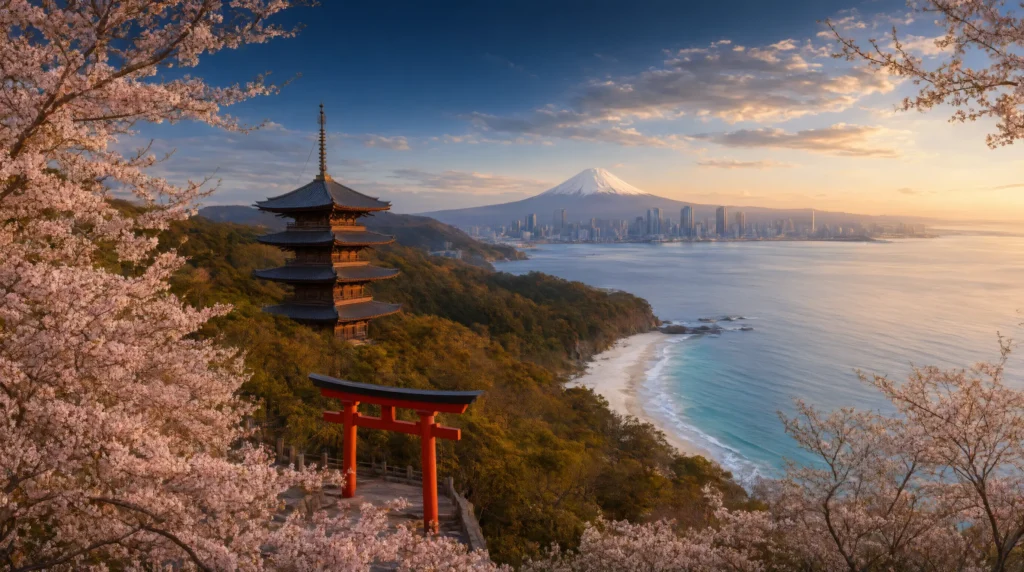
Japan fits ancient capitals, mountain temple towns, island art and subtropical beaches into one country, and the best way to see it is to pick a region and give it time. This guide covers 16 of the best places to visit in Japan, from Tokyo and Kyoto to Hokkaido and Okinawa, with how long to stay, when to go, and what travelers from the U.S., UK, Canada, Australia and Europe should know about entry rules and safety right now. For more on the country, see our Japan destination guide or browse our Asia destination guides.
- First trip: Tokyo, Kyoto and Osaka, with Nara as an easy day trip.
- Culture and history: Kyoto, Nara, Hiroshima, Nikko and Koyasan.
- Food and city energy: Tokyo, Osaka and Fukuoka.
- Mountains and nature: Mount Fuji, Hakone, Hokkaido and Yakushima.
- Islands and coast: Miyajima, Naoshima and Okinawa.
- Traditional villages: Takayama and Shirakawa-go.
- Entry rules: The Ministry of Foreign Affairs of Japan lists the U.S., Canada, Australia, the UK, Ireland and most European countries as visa exempt for short stays. The period granted is 90 days. Paid work is not covered.
- Best seasons: Spring and autumn. Japan’s national tourism organization puts the best autumn color from late September to early December, depending on the place.
- Mount Fuji: The official 2026 Yoshida Trail climbing season ran July 1 to September 10. Dates are set each year, so check before you plan.
Table of contents
- How to Choose the Best Places to Go in Japan
- Tokyo: Best for City Energy and Food
- Kyoto: Best for Temples and Gardens
- Osaka: Best for Street Food and Nightlife
- Nara: Best for Ancient Temples and Deer
- Hiroshima and Miyajima: Best for Peace History and Island Shrines
- Hakone: Best for Hot Springs and Mountain Views
- Mount Fuji: Best for Climbing and Lake Views
- Nikko: Best for Shrines and Autumn Color
- Kanazawa: Best for Gardens and Traditional Crafts
- Takayama and Shirakawa-go: Best for Mountain Villages
- Koyasan: Best for Temple Stays
- Naoshima: Best for Contemporary Art
- Hokkaido: Best for Nature and Winter Sports
- Fukuoka and Kyushu: Best for Food and Hot Springs
- Okinawa: Best for Beaches and Ryukyu History
- Yakushima: Best for Ancient Cedar Forests
- Sample Japan Itineraries
- Best Ways to Get Around Japan
- Best Time to Visit Japan
- Entry, Safety and Practical Rules for US, UK, Canadian, Australian and European Travelers
- Frequently Asked Questions
- Final Thoughts
How to Choose the Best Places to Go in Japan
Japan is a long chain of islands, and the big cities are linked by fast trains while the islands and mountain regions take more time. The best plan for a first visit is to choose one main region, pick two or three bases, and treat everything else as a day trip.
UNESCO lists 27 World Heritage properties in Japan, 22 cultural and five natural. That is why this guide links to the official listing wherever one exists.
| Your trip | A good starting plan |
|---|---|
| First visit, about 7 days | Tokyo, Kyoto and Osaka |
| 10 to 14 days | Add Hiroshima and Miyajima, Nara and Hakone |
| Temples and history | Kyoto, Nara, Koyasan and Nikko |
| Mountains and nature | Mount Fuji, Hokkaido and Yakushima |
| Warm weather and beaches | Okinawa |
| Food focus | Osaka, Tokyo and Fukuoka |
Tokyo: Best for City Energy and Food
Tokyo is the usual first stop, and it works as a base for a full week. The city is a collection of neighborhoods rather than one center. Asakusa and its old temple streets feel traditional, Shibuya and Shinjuku are the neon and crowd image most people expect, and quieter areas around the Meiji Shrine give you green space and shade. Food runs from sushi counters to department store basements to station ramen shops, and eating well rarely requires planning.
Nightlife districts need a little care. Canada’s travel advice says petty theft, drink spiking and card or ATM fraud occur in areas such as Kabukicho and Roppongi. Keep your drink in sight and use official taxis or trains.
Nikko, Kamakura and Hakone all work as day trips, so Tokyo can anchor a trip without needing a hotel change.
Suggested time: Four to five days.
Best season: Spring and late autumn. JNTO’s 2026 forecast lists Tokyo’s average peak autumn color in late November.
Planning tip: Complete the Visit Japan Web steps before you fly, and pick a hotel near a major rail line.
Kyoto: Best for Temples and Gardens
Kyoto was the imperial capital of Japan for more than a thousand years. UNESCO’s listing of the Historic Monuments of Ancient Kyoto says the city was built in A.D. 794 and stayed the capital until the middle of the 19th century. The listing covers 17 component parts, with 198 buildings and 12 gardens, and all but Nijo Castle are religious sites. In practice that means you can walk from a Zen garden to a hillside shrine in the same morning, and the strongest days here are the ones with only two or three stops.
Fushimi Inari’s gate-lined mountain path and the Arashiyama bamboo grove draw the biggest crowds, so go early. Gion and the Higashiyama streets are best at the start or end of the day.
Suggested time: Three to four days.
Best season: Spring and autumn, which are also the busiest.
Planning tip: Start at the popular sites at opening time, then move to quieter temples after midday.
Osaka: Best for Street Food and Nightlife
Osaka is the food city of the Kansai region, and its reputation is earned in the Dotonbori and Namba areas, where street stalls and casual restaurants run late. Osaka Castle and the city’s big entertainment district round out a visit, and Universal Studios Japan is the draw for families.
The city is also a practical base. Nara, Kyoto and Himeji are all reachable by train, so Osaka works as a hotel base if you want one bed for several day trips. Himeji Castle is worth the trip. UNESCO calls it the finest surviving example of early 17th century Japanese castle architecture, with 83 buildings.
Suggested time: Two to three days.
Best season: Spring and autumn. Summer is hot and humid.
Planning tip: Eat your way through Dotonbori in the evening and save the castle for the morning.
Nara: Best for Ancient Temples and Deer
Nara was Japan’s capital from 710 to 784, according to UNESCO’s listing of the Historic Monuments of Ancient Nara. The listing describes Buddhist temples, Shinto shrines and the excavated remains of the Imperial Palace. The compact center sits inside and around Nara Park, where free-roaming deer share the paths with visitors.
Nara is one of the easiest day trips from either Kyoto or Osaka, and the main sites can be covered on foot in half a day. Stay overnight if you want the park to yourself after the day trippers leave.
Suggested time: Half a day to one day.
Best season: Spring and autumn.
Planning tip: Treat the deer as wild animals. Keep food out of sight and follow the posted park rules.
Hiroshima and Miyajima: Best for Peace History and Island Shrines
Hiroshima is a city many travelers visit for reflection. UNESCO’s listing of the Hiroshima Peace Memorial (Genbaku Dome) describes the dome as the only structure left standing near the hypocenter of the first atomic bomb, which exploded on August 6, 1945. The surrounding Peace Memorial Park is part of the listing’s buffer zone. Give the park and its museum a full morning and plan a quieter afternoon afterward.
Miyajima is the island next door, and you reach it by ferry. UNESCO’s listing of the Itsukushima Shinto Shrine says the island has been a holy place of Shintoism since the earliest times, that the first shrine buildings were probably built in the 6th century, and that the present shrine dates from the 12th century. The shrine plays on the contrast between the mountains and the sea.
Suggested time: One to two days.
Best season: Spring and autumn.
Planning tip: Check ferry times before you go, and plan Miyajima for the afternoon so you can see the shrine as the light changes.
Hakone: Best for Hot Springs and Mountain Views
Hakone is a hot spring and scenery stop an easy trip from Tokyo. The area is known for onsen ryokan, Lake Ashi, volcanic landscapes and, on a clear day, a view of Mount Fuji. It is a sightseeing and relaxation stop rather than a ski resort, so do not plan it for snow sports.
Many travelers use Hakone as a one night break between Tokyo and Kyoto. Pick a ryokan with a private or shared onsen, and expect the Fuji view to depend on the weather.
Suggested time: One night, or a long day trip.
Best season: Autumn and winter for clear air.
Planning tip: Book the ryokan first, then build the transport around it. Fuji views are never guaranteed.
Mount Fuji: Best for Climbing and Lake Views
Fuji is a symbol of Japan and a UNESCO site. UNESCO’s listing of Fujisan, sacred place and source of artistic inspiration describes a 3,776 meter volcano, with 25 sites that reflect its sacred and artistic landscape.
If you plan to climb, the rules matter. The official Yamanashi site for the Yoshida Trail says the 2026 season ran from July 1 to September 10, and the start can be delayed by weather or remaining snow. A hiking fee of 4,000 yen per person is required, and the gate is closed from 2 PM to 3 AM for climbers without a mountain hut booking. The gate also closes when 4,000 climbers have entered in a day. Reservations are optional and can be made up to the day of the climb. Check the official site for next season’s dates.
Outside the climbing season, the lakes around the base give you views without the climb.
Suggested time: One to two days.
Best season: Summer for climbing, autumn and winter for clear views.
Planning tip: Do not climb in the off season. Admire the mountain from the lakes instead.
Nikko: Best for Shrines and Autumn Color
Nikko is the most popular day trip from Tokyo for shrine lovers. UNESCO’s listing of the Shrines and Temples of Nikko describes a single complex of 103 religious buildings within two Shinto shrines, Toshogu and Futarasan, and one Buddhist temple, Rinno-ji, in a forested setting. The complex is closely associated with the Tokugawa Shoguns.
JNTO says Nikko’s landscape turns red and yellow in autumn, which makes it one of the best fall color trips from Tokyo. Spend the night if you can, because the town is quiet after the day trippers leave.
Suggested time: One to two days.
Best season: Autumn.
Planning tip: Check the autumn color forecast before you book, since timing shifts from year to year.
Kanazawa: Best for Gardens and Traditional Crafts
Kanazawa is a former castle town on the Sea of Japan side of Honshu. It is known for Kenrokuen garden, the Higashi Chaya teahouse district, and gold leaf and other traditional crafts. The city is walkable, and it rewards visitors who want Kyoto-style streets with fewer crowds.
A high-speed train links Kanazawa with Tokyo, so it works as a stop on a loop through the Japan Alps and the coast.
Suggested time: Two days.
Best season: Spring and autumn.
Planning tip: Pair Kanazawa with Takayama and Shirakawa-go for a traditional Japan loop.
Takayama and Shirakawa-go: Best for Mountain Villages
Takayama is a mountain town with a preserved old quarter, and Shirakawa-go is the thatched roof village most people picture. UNESCO’s listing of the Historic Villages of Shirakawa-go and Gokayama describes villages in a mountainous region that was cut off from the outside world for a long time. The large Gassho-style houses have steeply pitched thatched roofs, which UNESCO says are the only examples of their kind in Japan. The listed villages are Ogimachi, Ainokura and Suganuma.
Shirakawa-go is popular in winter for its snow-covered roofs and in autumn for its color. Visit outside the busiest midday hours if you can.
Suggested time: Two days for both.
Best season: Winter for snow, autumn for color.
Planning tip: Check winter road and bus conditions before you travel.
Koyasan: Best for Temple Stays
Koyasan is a mountain temple complex south of Osaka, and it is the best place in Japan to stay in a working temple. UNESCO lists it as one of three sacred sites in the Kii Mountain Range, together with Yoshino and Omine and Kumano Sanzan. The sites are linked by 307 km of pilgrimage routes and reflect a fusion of Shinto and Buddhism over more than 1,200 years.
A temple stay usually includes vegetarian meals and an early morning prayer service. It is a quiet, simple overnight that suits travelers who want to slow down.
Suggested time: One night.
Best season: Spring and autumn.
Planning tip: Book the temple lodging early, because rooms are limited.
Naoshima: Best for Contemporary Art
Naoshima is an art island in the Seto Inland Sea, known for contemporary art museums and installations set among quiet fishing villages. You reach it by ferry, and the nearby islands add more art and a slower pace.
It is a good fit for travelers who have already done the big temple circuit and want something different. Plan around museum opening days and ferry times, and avoid trying to fit it into a rushed day.
Suggested time: One to two days.
Best season: Spring and autumn.
Planning tip: Check museum opening days and book timed entry where it is offered.
Hokkaido: Best for Nature and Winter Sports
Hokkaido is Japan’s northernmost main island, with a cooler climate and wider open spaces. UNESCO’s listing of Shiretoko describes a peninsula in the north-east of Hokkaido that is an outstanding example of the interaction of marine and terrestrial ecosystems, shaped by seasonal sea ice at the lowest latitude in the northern hemisphere.
JNTO says Niseko is among the ski resorts with a world-class reputation for powder snow. For autumn color, JNTO’s 2026 forecast lists Sapporo’s average peak in late October, well before Tokyo.
Canada’s advice notes that bears have been seen in northern areas, including Hokkaido. If you hike, follow local warnings and avoid walking alone where bears have been reported.
Suggested time: Four to six days.
Best season: Winter for skiing, late summer and autumn for hiking.
Planning tip: Rent a car for the countryside, and check bear advice before any hike.
Fukuoka and Kyushu: Best for Food and Hot Springs
Fukuoka is the gateway to Kyushu, Japan’s southwestern main island, and it is known for yatai food stalls and ramen. From there you can reach Nagasaki, which has a deep history as a port city. The UNESCO listing includes the Hidden Christian Sites in the Nagasaki Region, inscribed in 2018. Beppu and other hot spring towns give the island an onsen focus.
Kyushu has active volcanoes, so follow local advice if you plan to hike near one. The UK government notes that there are several active volcanoes in Japan.
Suggested time: Three to five days.
Best season: Spring and autumn.
Planning tip: Base in Fukuoka for the city, then take a train or bus to the hot springs.
Okinawa: Best for Beaches and Ryukyu History
Okinawa is a chain of subtropical islands far south of the main islands, with its own history and culture. UNESCO’s listing of the Gusuku Sites and Related Properties of the Kingdom of Ryukyu represents five hundred years of Ryukyuan history, from the 12th to the 17th century, including castle ruins and sacred sites. Okinawa is a separate prefecture, not part of Kyushu, and you usually fly there.
JNTO says the cherry blossom season starts in late winter in Okinawa and moves north, so it can be a winter escape. Typhoon season is the main risk. The UK government says the typhoon season runs from June to December, with the highest risk in the south, so check the forecast and your flexibility before you book.
Suggested time: Four to six days.
Best season: Late winter to spring.
Planning tip: Buy flexible tickets and travel insurance if you go during typhoon season.
Yakushima: Best for Ancient Cedar Forests
Yakushima is a forested island 60 km off the southern tip of Kyushu. UNESCO’s listing of Yakushima says the island has a rich flora of some 1,900 species and subspecies, including ancient sugi cedars, and a remnant of warm temperate ancient forest. It is a hiking destination, and the trails are best for people who are comfortable with rain and mud.
Expect to plan around the weather. Rain is common, and conditions can change quickly.
Suggested time: Two to three days.
Best season: Spring and autumn.
Planning tip: Bring good rain gear and book a local guide for the longer hikes.
Sample Japan Itineraries
These are starting points, not fixed routes. Japan’s trains make it easy to adjust, but moving every night wastes time.
| Trip length | Route | Why it works |
|---|---|---|
| 7 days | Tokyo (3), Kyoto (3), Osaka or Nara (1) | The classic first loop with minimal hotel changes |
| 10 days | Tokyo (3), Hakone (1), Kyoto (3), Hiroshima and Miyajima (2), Osaka (1) | Adds mountains and island history |
| 14 days | Tokyo (4), Nikko (1), Kanazawa (2), Takayama (1), Kyoto (3), Koyasan (1), Osaka (2) | A fuller loop through traditional Japan |
Best Ways to Get Around Japan
High-speed trains link Tokyo, Kyoto, Osaka, Hiroshima and Kanazawa, and they are the best way to cover long distances. Local trains and buses reach most other towns. Ferries serve islands such as Miyajima and Naoshima, and short domestic flights connect Hokkaido, Okinawa and Kyushu with the main island.
Rural areas such as Hokkaido, Yakushima and parts of Kyushu are easier with a rental car. Check the driving permit rules for your passport country before you book one. In cities, a train and subway network covers almost everything.
Best Time to Visit Japan
JNTO does not name one best season, because each has its own appeal. Spring and autumn are the most popular.
| Season | What to expect |
|---|---|
| Spring | JNTO says cherry blossoms can be seen from as early as February to as late as May, starting in Okinawa and moving north. Popular trips are busier and pricier. |
| Early summer | The rainy season, called tsuyu, brings cooler temperatures and regular rainfall. |
| Summer | Hot and humid, with major festivals. Coasts and mountains are the usual escape, and the Fuji climbing season runs in summer. |
| Autumn | JNTO’s 2026 forecast says the best viewing runs from late September to early December, moving south from Hokkaido. |
| Winter | Skiing in Hokkaido and Nagano, hot springs, and fewer crowds in many cities. |
Typhoons are the main weather risk. The UK government says the typhoon season is between June and December, peaking between July and September, with the highest risk in the south.
Entry, Safety and Practical Rules for US, UK, Canadian, Australian and European Travelers
Visas and entry
The Ministry of Foreign Affairs of Japan’s visa exemption list, dated September 1, 2025, includes Canada, the United States, Australia, the UK, Ireland, and many European countries such as Italy, Spain, Croatia and Germany. The period of stay granted on landing is 90 days. The Embassy of Japan in the U.S. says U.S. citizens do not need a visa for short stays for tourism and business without paid activities. The UK government describes it as a visa on arrival for up to 90 days for tourism or business, and says your passport must be valid for the length of your stay.
Japan runs an online service called Visit Japan Web for immigration and customs steps before arrival. Using it can speed up the airport process.
Entry rules change. Confirm the latest rules with the Japanese embassy or consulate in your country before you book.
Safety: what each government says
Japan is a safe country for most travelers, but a few risks are worth knowing.
- United States: The State Department lists Japan at Level 1, Exercise Normal Precautions, the lowest level.
- Canada: Canada’s advice is to take normal security precautions, and it flags bear sightings, petty theft and drink spiking in nightlife districts, and strict drug penalties.
- United Kingdom: The UK says Japan is in a major earthquake zone, and warns about drink spiking, credit card fraud, strict drug laws, and increased bear sightings and attacks in parts of Japan.
- Australia and Europe: Check Smartraveller and your own government’s advice before you go.
Practical rules
- Drugs: The UK says Japan has zero tolerance of drug crime and severe penalties, and that you may be charged even if you did not know you had taken drugs.
- Earthquakes: Follow the instructions in hotel rooms and at train stations, and monitor Japan Meteorological Agency warnings.
- Help: The UK page lists the Japan Visitor Hotline, +81 50 3816 2787, for English-language help during natural disasters.
- Travel insurance: Get coverage that includes your activities and emergency medical costs.
Frequently Asked Questions
What are the best places to visit in Japan for first-timers?
For a first trip, start with Tokyo, Kyoto and Osaka, then add Nara, Hiroshima and Miyajima, or Hakone. They are well connected by high-speed trains and cover modern cities, temples, food and history in one route.
How many days do you need in Japan?
For a first visit, 10 to 14 days is comfortable for three or four bases, such as Tokyo, Kyoto, Osaka and Hiroshima. A week can work if you keep to Tokyo and Kyoto and skip the extras.
What is the best time to visit Japan?
Spring and autumn suit most travelers. JNTO says the best autumn color runs from late September to early December, and cherry blossoms can appear from February to May depending on where you are. Summer is hot and humid, and typhoon season runs from June to December.
Do Americans need a visa for Japan?
Not for short stays for tourism. The Embassy of Japan in the U.S. says U.S. citizens do not need a visa for short stays that do not involve paid activities, and the Ministry of Foreign Affairs lists a 90 day period of stay. Confirm current rules before you book.
Is Japan safe for tourists?
Yes, with normal precautions. The U.S. State Department lists Japan at Level 1 and Canada advises normal security precautions. The main risks are earthquakes, typhoons, drink spiking in nightlife districts, and bear sightings in some northern areas.
Can you climb Mount Fuji any time of year?
No. The official Yoshida Trail season in 2026 ran from July 1 to September 10, with a 4,000 yen hiking fee and gate closures overnight for climbers without a hut booking. Check the official site for the next season’s dates.
Final Thoughts
The best places to visit in Japan are the ones that fit your season, your pace and how much time you have. Pick one region, learn the entry rules, and give each stop enough time to feel like more than a photo stop. Then come back for another region on your next trip.