
Mali
Mali: Empire of Gold and Crossroads of Ancient Africa
Home to the legendary city of Timbuktu, ancient empires, desert landscapes, and a living tradition of music that has influenced the world.
Mali is a large landlocked country in West Africa, bordered by Algeria to the north, Niger to the east, Burkina Faso and Ivory Coast to the south, Guinea and Senegal to the southwest, and Mauritania to the northwest. Most of its territory is Saharan or Sahelian, with the more habitable south along the Niger River where the country’s major cities, including the capital Bamako, are concentrated.
Mali has been the location of some of the greatest empires in African history. The Mali Empire of the 13th to 15th centuries, which gave the country its name, was one of the wealthiest in the world at its peak. Mansa Musa, the 14th-century emperor, was by some estimates the wealthiest individual in human history, his fortune built on the gold and salt trade that flowed through the Niger River basin.
Mali currently faces significant security challenges. Armed groups have been active in the north and center of the country since 2012, and travel to these regions is extremely high risk. The government of Mali has also experienced political instability. Travelers should consult current advisories carefully.
Timbuktu and Mali’s Historical Legacy
Timbuktu was the greatest intellectual center in sub-Saharan Africa during the 15th and 16th centuries. At its peak, the city had more than 150 Quranic schools and attracted scholars from across the Islamic world. The Sankore, Djinguereber, and Sidi Yahia mosques, all UNESCO World Heritage Sites, survive today as testimony to that era. The Ahmed Baba Institute houses hundreds of thousands of ancient manuscripts that scholars are working to preserve and digitize.
The Dogon Country in the central region of the country is one of the most extraordinary cultural landscapes in Africa. The Dogon people live in villages carved into and below a dramatic cliff face, the Bandiagara Escarpment, and have maintained a complex cosmology and ceremonial tradition that has fascinated anthropologists for decades. Traditional Dogon granaries, masks, and dances are distinctive and deeply rooted in a worldview very different from neighboring cultures.
The Niger Inland Delta, an area where the Niger River spreads into a vast network of lakes, channels, and floodplains, was historically one of the most productive agricultural areas in the Sahel. The town of Mopti, where two rivers meet and fishermen, herders, and traders have gathered for centuries, was the commercial hub of inland Mali.
Bamako and Malian Music
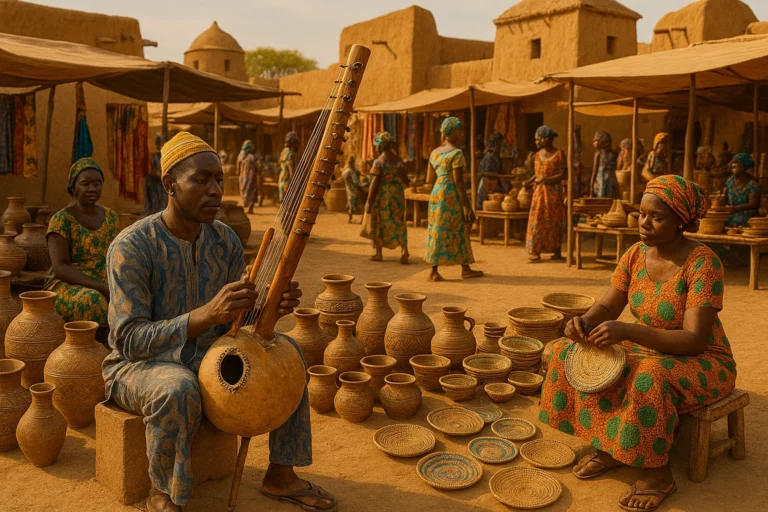
Bamako has one of the most vibrant music scenes in Africa. The griot tradition, in which hereditary musicians serve as the living memory of their communities through song and storytelling, is still alive and active. The kora, a 21-stringed instrument made from a gourd and goat skin, is one of the most beautiful instruments in the world, and Mali’s kora players are among the finest. Ali Farka Touré, whose guitar style blended traditional Malian music with blues, remains one of the most celebrated musicians in world music history.
Malian food centers on rice and sorghum-based staples served with peanut sauce, okra stew, or fish from the Niger. Toh, a starchy dough similar to fufu, is widely eaten. Street food in Bamako includes brochettes (grilled meat skewers) and various fried snacks.
Practical Travel Tips for Mali
Security conditions in Mali have been severe in the north and center since 2012, with the situation shifting over time. Check your government’s current travel advisory before any planning. Travel to Bamako and the far south may be possible with proper precautions, but much of the country’s most interesting historical attractions are in areas that carry high risk. The official language is French. The CFA franc is the currency. Yellow fever vaccination is required. Malaria prevention is essential.
 Ghana
 Benin
 Burkina Faso
 Cabo Verde
 Gambia
 Guinea