Ivory Coast: A Land of Heritage and Vibrant Traditions
Ivory Coast, officially Cote d’Ivoire, is the most economically powerful country in Francophone West Africa. It sits on the Gulf of Guinea coast, bordered by Ghana to the east, Burkina Faso and Mali to the north, Guinea and Liberia to the west, and the Atlantic Ocean to the south. The country produces more cocoa than any other nation in the world, which gives it a level of agricultural wealth unusual in the region.
Ivory Coast experienced a period of political instability between 2002 and 2011, but has since stabilized significantly. Abidjan, the economic capital, has rebuilt its reputation as one of the most dynamic and cosmopolitan cities in West Africa, with a food scene, music culture, and commercial energy that draws visitors and business travelers from across the region.
Why Visit Ivory Coast
Abidjan is the reason most people come, and it rewards the visit. It is a city of genuine complexity: the futuristic towers of Plateau, the waterside nightlife of Treichville, the upscale restaurants of Marcory, and the vibrant working-class neighborhoods of Adjame and Yopougon all exist within a metropolitan area connected by bridges across a coastal lagoon. The Musee des Civilisations de Cote d’Ivoire has one of the best collections of West African masks and traditional art in the region.
The sacred city of Yamoussoukro, the official capital, contains the Basilica of Our Lady of Peace, the largest Christian church in the world. Built by former president Houphouet-Boigny in the 1980s and consecrated by Pope John Paul II in 1990, it is a somewhat surreal structure rising from the middle of a small city in the Ivorian savanna, modeled closely on St. Peter’s Basilica in Rome.
Tai National Park in the west is one of the last remaining areas of primary tropical rainforest in West Africa and a UNESCO World Heritage Site. The park is home to chimpanzees, pygmy hippos, and an extraordinary variety of birds and smaller mammals. Chimpanzee research here has contributed significantly to our understanding of tool use and culture among great apes.
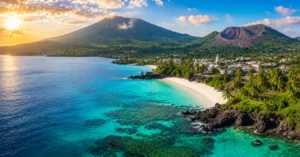
The beaches along the southeastern coast, particularly around Assinie and Grand Bassam, are popular weekend destinations for residents of Abidjan. Grand Bassam is a UNESCO-listed former colonial capital with a beautiful collection of French colonial architecture, now partially restored and home to artisans and small restaurants.
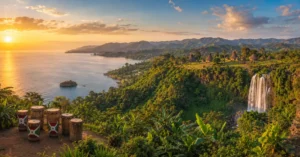
The Man region in the west has dramatic mountain scenery, suspension bridges, and traditional Dan and Wobe communities with famous mask traditions.
Ivorian Food and Culture
Attieke, fermented cassava granules similar in texture to couscous, served with grilled fish and vegetables, is one of the most distinctive and satisfying foods in the country. Aloco, fried sweet plantains, are eaten as a side dish or street snack everywhere. Kedjenou, a slow-cooked chicken dish with vegetables and spices, is a national specialty. Palm nut soup and peanut sauce appear frequently.
Ivory Coast has a rich music tradition. Zouglou and coupé-décalé are the dominant popular genres, both characterized by complex rhythms, dance movements, and satirical lyrics that comment on everyday social life. The country has produced numerous artists with pan-African followings.
Travel Tips for Ivory Coast
Most nationalities need a visa to enter Ivory Coast. The e-visa system is available for many passport holders and is the most convenient option. The official language is French. The CFA franc is the currency. Yellow fever vaccination is required. Malaria prevention is essential. The best time to visit is November to March when rainfall is lower.