Chad: Land of Diversity and Ancient Heritage
Chad is one of the largest countries in Africa and one of the least visited. It sits in the north-central part of the continent, bordered by Libya to the north, Sudan to the east, the Central African Republic to the south, Cameroon and Nigeria to the southwest, and Niger to the west. Most of its territory is Saharan or Sahelian, with the more fertile agricultural south around the Chari and Logone rivers giving the country a geographic range from desert to tropical.
Chad takes its name from Lake Chad, a large body of water on its western border that was once one of the largest lakes in Africa. Climate change and increased agricultural use have reduced Lake Chad to roughly 10 percent of its 1960s size, which represents one of the most visible environmental changes in modern Africa and has had dramatic consequences for the communities that depend on it.
Why Visit Chad
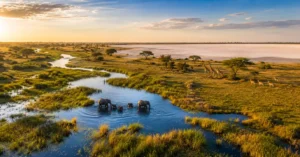
Zakouma National Park in the south is the most significant wildlife destination in central Africa. The park has been transformed over the past two decades through a partnership with African Parks, which has brought stability, conservation expertise, and resources to what had been a heavily poached area.
Today Zakouma has one of the largest remaining elephant herds in central Africa, along with lions, buffalo, giraffes, roan antelope, and extraordinary birdlife. The isolation of the park and the absence of large tourist crowds make for genuinely intimate safari experiences.
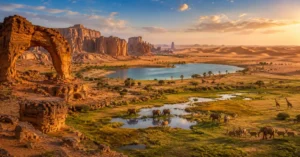
The Ennedi Plateau in the northeast is one of the most spectacular landscapes in Africa. A sandstone massif covering roughly 60,000 square kilometers, it has been sculpted by wind and water over millions of years into an extraordinary collection of arches, towers, canyons, and rock formations.
The plateau contains thousands of prehistoric rock paintings and engravings, some dating back more than 7,000 years. The Guelta d’Archeï, a permanent water source deep in the plateau, has a population of desert-adapted Nile crocodiles that have survived here in isolation since the Sahara dried out thousands of years ago.
N’Djamena, the capital, sits at the confluence of the Chari and Logone rivers on the border with Cameroon. The National Museum of Chad has good collections of prehistoric artifacts and traditional objects from across the country. The capital is a working base for trips south to Zakouma.
Chadian Food and Culture
Chad has more than 200 ethnic groups and an equally diverse culinary tradition. The south produces millet, sorghum, and cassava based dishes, while the north has a more Sahelian diet of millet and dried meat. Daraba, a sauce made from ground sesame or okra, accompanies most meals. River fish from the south, including capitaine (Nile perch), are excellent.
The Tuareg and Toubou peoples of the north have strong desert nomadic traditions. The Sara peoples of the south have distinct initiation and ceremonial cultures. The musical traditions of Chad, particularly the lute-based music of the Saharan communities, have a hypnotic quality that is unlike anything in more accessible parts of West Africa.
Practical Travel Tips for Chad
A visa is required for most nationalities, obtained in advance. French and Arabic are official languages. The CFA franc is the currency. Security conditions in much of the country are difficult and vary by region. The east and borders with Sudan and the CAR carry significant risks. Zakouma and the Ennedi are best accessed through specialist tour operators who have established security protocols. The best time to visit Zakouma is February to April.