
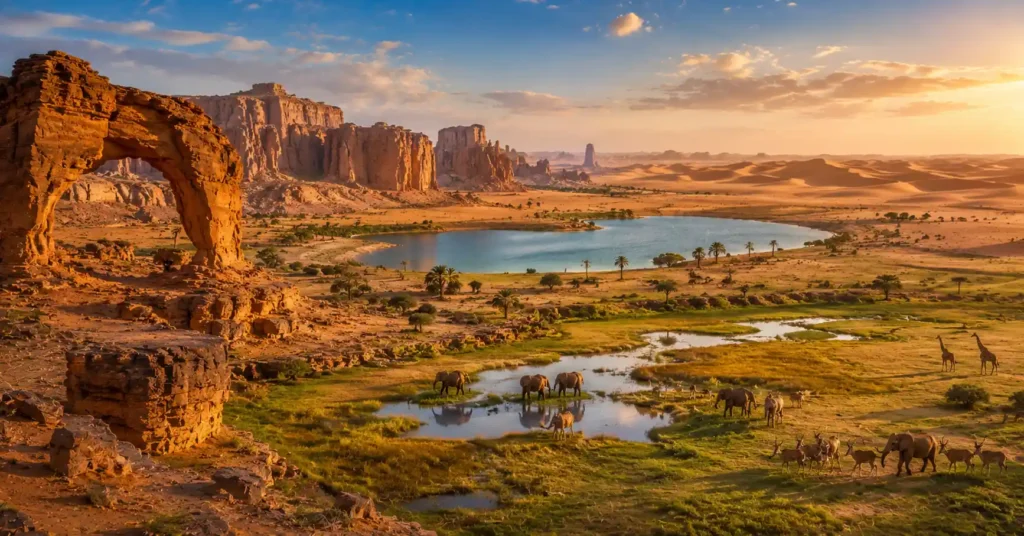
Chad is one of the most remote and least visited countries in Africa. If you are searching for the best places to visit in Chad, you will find a country of extraordinary Sahara landscapes, dramatic rock formations, surprising wildlife and a rich cultural diversity shaped by over 200 ethnic groups.
From the wildlife-packed plains of Zakouma National Park to the ancient rock arches of the Ennedi Plateau and the strange desert lakes of Ounianga, Chad offers expedition-style travel that almost no other destination can match. This 2026 guide covers the top destinations and everything you need to know before planning a trip.
Table of Contents
Why Visit Chad?
1. Untouched Sahara and Sahel Landscapes
Chad contains some of the most dramatic and least disturbed desert landscapes on Earth. The Sahara covers the northern third of the country in a vast expanse of sand dunes, rocky plateaus, volcanic peaks and ancient canyon systems.
The Sahel belt across the center transitions from semi-arid scrubland to tropical savanna in the south. The sheer scale and emptiness of these landscapes is unlike anything most travelers have ever experienced.
2. Unique Geological Formations
The Ennedi Plateau and Tibesti Mountains contain some of the most extraordinary geological features in the world. Ancient rock arches, towering sandstone towers, deep canyons and prehistoric rock art left by civilizations that lived here thousands of years ago make this one of the most visually and historically fascinating landscapes in Africa.
3. Authentic Off-the-Beaten-Path Travel
Chad receives a tiny fraction of the tourists that visit neighboring countries. There is virtually no mass tourism infrastructure and everything here feels completely unfiltered. For serious travelers who want genuine discovery and experiences that almost nobody else has had, Chad is one of the last great frontiers.
6 Best Places to Visit in Chad
1. N’Djamena
N’Djamena is Chad’s capital city and the entry point for almost all international visitors. The city sits on the western bank of the Chari River at the border with Cameroon. It is a functional, busy city that reflects Chad’s mix of Arab and sub-Saharan African cultures.
The National Museum of Chad holds a notable collection of artifacts including the famous Toumai skull, one of the oldest known hominid fossils ever discovered, estimated to be between 6 and 7 million years old. The Grande Marché central market is lively and colorful, selling spices, textiles, crafts and everyday goods. N’Djamena is best used as a one to two-day base for organizing logistics before heading into the interior.
Key highlights of N’Djamena:
- National Museum and the Toumai hominid fossil display
- Grande Marché for local shopping and cultural observation
- Chari River waterfront for evening walks
- Main base for arranging guided tours and transport
- Good selection of hotels and logistics companies for expedition planning
2. Zakouma National Park
Zakouma National Park is one of the greatest conservation success stories in Africa and the top wildlife destination in Chad. Located in the south-center of the country, the park covers about 3,000 square kilometers of savanna woodland, floodplains and seasonal wetlands. After suffering devastating poaching losses in the 2000s, Zakouma has made a remarkable recovery under the management of African Parks, the same organization that has restored wildlife in several other African countries.
Today the park is home to a growing elephant population, lions, leopards, giraffes, buffalo, hippos, wild dogs and one of the most spectacular concentrations of waterbirds in Africa. During the dry season from December to May, large herds of animals concentrate around the permanent water sources in and around the park, creating wildlife encounters that rival the best in East Africa.
Key highlights of Zakouma National Park:
- Elephant herds, one of the greatest conservation comebacks in Africa
- Lions, leopards and wild dogs in open savanna habitat
- Extraordinary waterbird concentrations during the dry season
- Guided game drives with knowledgeable rangers
- Best visited from December to May during the dry season
3. Ennedi Plateau
The Ennedi Plateau in northeastern Chad is one of the most visually spectacular landscapes in the world and is Chad’s most celebrated natural attraction. This vast sandstone plateau covers thousands of square kilometers and has been sculpted by millions of years of wind and water erosion into an extraordinary collection of arches, towers, canyons, caves and narrow gorges.
The Ennedi is a UNESCO World Heritage Site and contains thousands of ancient rock paintings and engravings left by peoples who lived here when the Sahara was a greener, wetter place. Images of cattle, horses, crocodiles and human figures tell the story of a very different landscape that existed thousands of years ago.
The guelta of Archei, a permanent water pool deep within the plateau, is famous for its population of desert-adapted crocodiles and the dramatic canyon setting that surrounds it. Getting to the Ennedi requires a 4×4 expedition across rough desert tracks and takes several days from N’Djamena, but the experience is extraordinary.
Key highlights of the Ennedi Plateau:
- Dramatic sandstone arches, towers and canyons
- Ancient rock art depicting prehistoric life in the Sahara
- Guelta d’Archei, a desert pool with crocodiles in a canyon setting
- Complete desert solitude and one of Africa’s least visited landscapes
- UNESCO World Heritage Site status recognizing its outstanding value
4. Lake Chad
Lake Chad sits at the meeting point of Chad, Niger, Nigeria and Cameroon and was once one of the largest freshwater lakes in Africa. Due to climate change, irrigation and regional drought, the lake has shrunk dramatically over recent decades and is now a fraction of its former size. Despite this, it remains ecologically and culturally important.
The lake supports millions of people across four countries through fishing and agriculture, and its remaining wetlands are home to large populations of waterbirds. The communities around the lake maintain traditional fishing and farming cultures that have existed for centuries. Visiting the lake offers a window into one of Africa’s most significant environmental challenges alongside a genuine cultural experience.
Key highlights of Lake Chad:
- One of Africa’s historically most important freshwater bodies
- Rich birdlife in the remaining wetlands and reed beds
- Traditional fishing communities with centuries of lake culture
- Important context for understanding climate change in the Sahel
- Accessible from N’Djamena on a day or overnight trip
5. Tibesti Mountains
The Tibesti Mountains in the far north of Chad contain the highest peaks in the Sahara, including Emi Koussi which rises 3,415 meters above sea level and is the highest point in the entire Sahara Desert. The range is dominated by ancient and still active volcanic craters, lava fields, hot springs and geothermal features that make the landscape feel completely alien.
The Tibesti is one of the most remote and least visited mountain ranges in the world. Access is extremely difficult and the region has significant security concerns related to its proximity to conflict zones in Libya. It remains a future destination for when conditions improve rather than a practical option for most travelers in 2026.
Key highlights of the Tibesti Mountains:
- Emi Koussi, the highest peak in the Sahara at 3,415 meters
- Ancient volcanic craters and lava landscapes
- Extreme remoteness and almost zero tourism
- Geothermal features including hot springs
- Currently not accessible due to security concerns in the far north
6. Ounianga Lakes
The Ounianga Lakes are one of the most extraordinary natural phenomena in the Sahara. A series of 18 interconnected lakes sits in the middle of one of the driest and most remote deserts on Earth, fed by ancient underground aquifers that have been slowly releasing water for thousands of years. The lakes are a UNESCO World Heritage Site and range in color from bright blue to deep green and reddish-brown depending on the mineral content and algae present.
The contrast of vivid blue and green water set against orange sand dunes and rocky desert is one of the most surreal and beautiful sights in all of Africa. Getting to the Ounianga Lakes is a serious desert expedition but for those who make it, the experience is completely unforgettable.
Key highlights of the Ounianga Lakes:
- Series of 18 Saharan lakes fed by ancient underground aquifers
- Vivid colors ranging from blue to green to reddish-brown
- UNESCO World Heritage Site for its unique hydrological system
- Extraordinary visual contrast of water, dunes and desert rock
- One of the most remote and unusual landscapes on Earth
Hidden Gems in Chad
1. Faya-Largeau – Sahara Gateway
Faya-Largeau is the main town in northern Chad and serves as the gateway for expeditions into the deep Sahara. It is an oasis settlement surrounded by date palm groves and sand dunes and has a frontier atmosphere that reflects its position at the edge of one of the harshest environments on Earth. It is the last reliable supply point before heading into the Tibesti or deeper desert regions.
2. Guelta d’Archei – Desert Oasis
Guelta d’Archei is a permanent water pool hidden within a dramatic canyon in the Ennedi Plateau. It is famous for its population of desert-adapted Nile crocodiles, believed to be a relic population left over from when the Sahara was wetter thousands of years ago. The canyon walls above the pool are covered in ancient rock paintings. It is one of the most photogenic and historically fascinating spots in Chad.
Is It Safe to Visit Chad?
This is the most critical question any traveler considering Chad must answer before making any plans.
Chad has experienced significant political instability, regional conflict and security challenges for many years. Multiple Western governments including the United States, United Kingdom, France and Australia maintain elevated travel advisories for Chad, with some regions rated as do-not-travel destinations.
The areas that maintain a degree of controlled, organized tourism are N’Djamena, Zakouma National Park and parts of the Ennedi Plateau when accessed through reputable licensed operators. The northern regions including the Tibesti and border areas with Libya, Sudan and the Central African Republic carry very serious security risks.
Important safety points:
- Check your government’s official travel advisory before booking and again before departure
- Travel only through a reputable, internationally recognized tour operator with current local knowledge
- Never attempt self-drive or independent travel outside N’Djamena
- Register with your country’s embassy in N’Djamena on arrival
- Avoid all border regions with Libya, Sudan and the Lake Chad basin conflict zone
- Carry a satellite communication device for all remote travel
Chad is a destination for experienced expedition travelers only. It is not suitable for first-time Africa travelers or anyone without a high tolerance for uncertainty and risk.
Best Time to Visit Chad
1. Cooler Months: November to February (Best Conditions)
This is the best overall time to visit Chad. Temperatures in the south and center are manageable, roads are in their best condition and wildlife viewing at Zakouma is at its peak. The harmattan wind brings some haze in December and January but temperatures are far more comfortable than at other times of year.
2. Extreme Heat Considerations
From March to September, temperatures in northern Chad regularly exceed 45 degrees Celsius and can reach 50 degrees in the Sahara. Travel in these months is dangerous without extensive preparation and should only be attempted by experienced desert travelers with full equipment and logistical support.
3. Seasonal Wildlife Viewing
- Zakouma elephants and large mammals: December to May
- Waterbirds at Zakouma: January to March at peak concentration
- Ennedi Plateau expeditions: November to February
- Ounianga Lakes: accessible year-round but best November to February
Travel Tips for Visiting Chad
1. Visa Requirements
Most nationalities need a visa to enter Chad and there is no widely available eVisa system. Most travelers must apply through a Chadian embassy or consulate before departure. You will need a valid passport with at least six months remaining, a return flight booking, passport photos, proof of accommodation and a yellow fever vaccination certificate which is mandatory for entry. Apply at least four to six weeks before your trip as processing can be slow.
2. Getting Around Chad
Getting around Chad is one of the most logistically demanding aspects of any visit. Road infrastructure outside N’Djamena is extremely limited. Most routes to major attractions require 4×4 vehicles, experienced drivers and careful fuel and water management.
- All travel outside N’Djamena must be arranged through a reputable tour operator
- A 4×4 vehicle with experienced local driver is essential for all remote travel
- Carry enough fuel and water for several days as supply points are extremely scarce in the north
- Domestic flights connect N’Djamena to a small number of regional towns
- Satellite communication devices are strongly recommended for all remote expeditions
3. Currency and Costs
The official currency is the Central African CFA franc (XAF), pegged to the euro and shared with five other Central African countries. Cash is almost universally required as card payments are not reliably available outside a handful of N’Djamena hotels.
- Budget a minimum of $200 to $350 USD per day for organized guided travel
- Zakouma National Park fees and accommodation add significant cost
- Desert expeditions to the Ennedi require all-inclusive operator packages
- Carry more cash than you expect to need as ATMs are unreliable
- US dollars and euros can be exchanged at N’Djamena banks and larger hotels
Suggested 5 to 8 Day Chad Itinerary (Advanced Travelers Only)
Sample Day-by-Day Breakdown
| Day | Destination | Main Activities |
| Day 1 to 2 | N’Djamena | National Museum, Grande Marché, Chari River, logistics and briefing |
| Day 3 to 4 | Zakouma National Park | Game drives, elephant herds, waterbird viewing, guided walks |
| Day 5 to 7 | Ennedi Plateau and Ounianga Lakes | Desert expedition, rock arches, ancient rock art, Guelta d’Archei, lake views |
| Day 8 | Return to N’Djamena | Desert drive back, final night in capital, departure |
Itinerary Tips:
- Book Zakouma accommodation through African Parks well in advance as capacity is very limited
- Use a charter flight to reach Zakouma rather than driving to save two days of difficult road travel
- The Ennedi expedition requires a minimum of three days and should be booked through a specialist desert operator
- Build flexibility into your schedule as weather and road conditions can cause unexpected delays
What is Chad Famous For?
1. Sahara Landscapes
Chad contains some of the most dramatic Sahara landscapes on Earth, from the vast sand seas of the northern desert to the volcanic peaks of the Tibesti and the ancient canyon systems of the Ennedi. For serious desert travelers, Chad is one of the ultimate destinations.
2. Ennedi Plateau Rock Formations
The Ennedi Plateau is Chad’s most celebrated attraction and one of the most extraordinary geological landscapes in Africa. Its UNESCO World Heritage status reflects its global significance as a natural and cultural treasure.
3. Wildlife Conservation at Zakouma
Zakouma National Park has become one of Africa’s most inspiring conservation success stories. The recovery of its elephant population and the return of predators under African Parks management has made it a symbol of what is possible when wildlife protection is properly funded and managed.
FAQs About Visiting Chad
-
Is Chad Safe for Tourists?
Parts of Chad are accessible through organized, guided tours but significant security risks exist across much of the country. Always check your government’s official travel advisory before booking. Travel only with reputable operators and never independently outside N’Djamena.
-
Can You Travel to Chad?
Yes, tourism is possible but only in specific areas and only through organized guided trips. Zakouma National Park and the Ennedi Plateau are the main tourist destinations with established access routes. Independent travel is not recommended.
-
What Language is Spoken in Chad?
French and Arabic are the two official languages of Chad. French is used in government, education and business. Arabic is widely spoken across the north and center of the country. Over 120 local languages are spoken by different ethnic groups across the country. Basic French is very useful for navigating most tourist situations.
-
Is Chad Expensive to Visit?
Yes, Chad is one of the more expensive destinations in Africa for tourists. The high costs reflect the extreme logistical challenges of operating in such a remote and underdeveloped environment. Budget a minimum of $200 to $350 USD per day for a properly organized and safe guided trip.
Map of the Chad
Final Thoughts on Visiting Chad
Chad is not a destination for everyone. It is a destination for experienced expedition travelers who are drawn to extreme wilderness, ancient landscapes and genuine adventure at the very edge of what is accessible. The wildlife of Zakouma, the rock art of the Ennedi and the surreal desert lakes of Ounianga are among the most extraordinary experiences available anywhere in Africa. Go with a reputable operator, go with realistic expectations, go fully prepared and go ready to be completely humbled by one of the last truly wild places on Earth.