
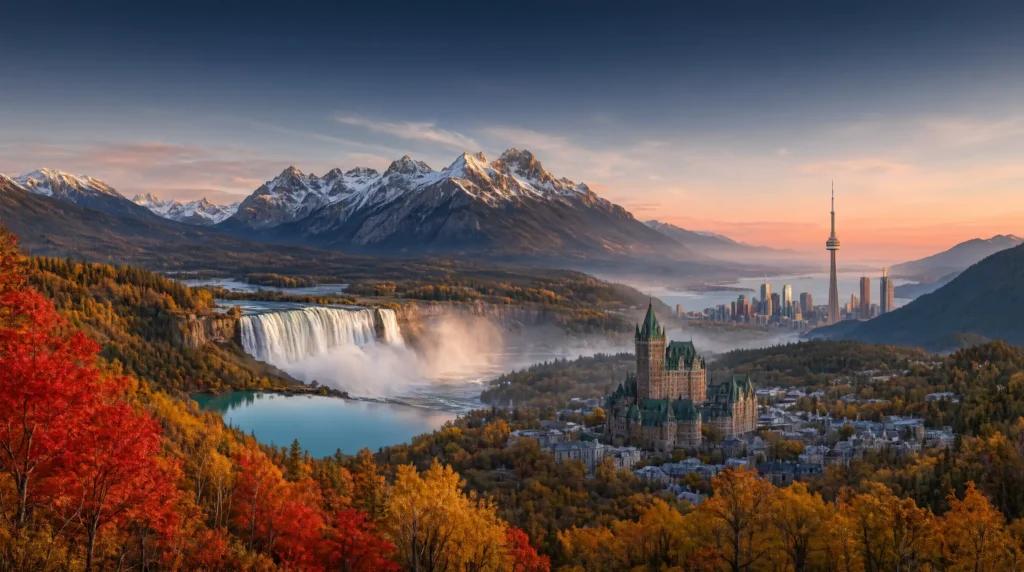
Canada is a huge country, and the best trips here pick a region and stay long enough to see it properly. This guide covers 16 of the best places to visit in Canada, from the Rockies and Vancouver to Quebec City and Newfoundland, with how long to stay, when to go, and what travelers from the U.S., UK, Australia and Europe should know about entry rules, wildfire season and safety right now. For more on the country, see our Canada destination guide or browse our North America destination guides.
- First trip: Banff and Lake Louise, Vancouver, Toronto with Niagara Falls, and Quebec City.
- Mountains and lakes: Banff, Lake Louise, Jasper and Whistler.
- Cities: Vancouver, Toronto, Montreal and Ottawa.
- History: Quebec City, Lunenburg, Ottawa and L’Anse aux Meadows in Newfoundland.
- Coast and islands: Vancouver Island, Prince Edward Island and the Cabot Trail.
- Wildlife and fossils: Gros Morne and the Alberta Badlands.
- Entry rules: U.S. citizens are exempt from Canada’s eTA. Visitors from visa-exempt countries who fly need an eTA that costs CAN$7. Arriving by land or sea does not require one.
- Lake Louise and Moraine Lake: Parks Canada says the Moraine Lake Road is closed to personal vehicles year-round, and shuttle seats must be reserved.
- Wildfire season: The UK government says wildfires can start at any time, whatever the season. Check conditions before you go.
Table of contents
- How to Choose the Best Places to Go in Canada
- Banff and Lake Louise: Best for Mountain Lakes and Glaciers
- Jasper: Best for Wildlife and Dark Skies
- Vancouver: Best for Mountains Meeting the Sea
- Vancouver Island: Best for Victoria and Tofino
- Whistler: Best for Skiing and Mountain Biking
- Okanagan Valley: Best for Lakes and Wineries
- Toronto: Best for Neighborhoods and Food
- Niagara Falls: Best for Waterfalls and Wine Country
- Ottawa: Best for Museums and the Rideau Canal
- Montreal: Best for Food, Festivals and Old Streets
- Quebec City: Best for Walled Streets and French Heritage
- Halifax and Lunenburg: Best for Harbor Towns and Colonial History
- Cabot Trail: Best for Coastal Driving and Highlands
- Prince Edward Island: Best for Beaches and Quiet Roads
- Newfoundland: Best for Fjords and Viking History
- Alberta Badlands: Best for Dinosaur Fossils
- Sample Canada Itineraries
- Best Ways to Get Around Canada
- Best Time to Visit Canada
- Entry, Safety and Practical Rules for US, UK, Australian and European Travelers
- Frequently Asked Questions
- Final Thoughts
How to Choose the Best Places to Go in Canada
Canada is huge, and flying between regions often makes more sense than driving. The best plan for a first trip is to choose one region, pick two or three bases, and treat everything else as a day trip. The Rockies and British Columbia pair well, as do Toronto, Niagara and Montreal, and Quebec City and the Atlantic provinces.
UNESCO lists 22 World Heritage properties in Canada: 10 cultural, 11 natural and one mixed. That is why this guide links to the official listing wherever one exists.
| Your trip | A good starting plan |
|---|---|
| First visit, about 10 days | Vancouver, Banff, Jasper and either Toronto or Quebec City |
| Rockies and mountains | Banff, Lake Louise, Jasper and Whistler |
| East coast cities | Toronto, Niagara, Montreal and Quebec City |
| Atlantic Canada | Halifax, Lunenburg, the Cabot Trail and Prince Edward Island |
| Nature and wildlife | Jasper, Gros Morne and the Alberta Badlands |
| Food and culture | Montreal, Toronto, Vancouver and Quebec City |
Banff and Lake Louise: Best for Mountain Lakes and Glaciers
Banff is the classic Canadian Rockies stop. Parks Canada describes Banff National Park as Canada’s first national park. UNESCO’s listing of the Canadian Rocky Mountain Parks covers the contiguous Banff, Jasper, Kootenay and Yoho national parks and three provincial parks, with mountain peaks, glaciers, lakes, waterfalls, canyons and limestone caves, plus the Burgess Shale fossil site. The town of Banff is a good base for hot springs, gondola rides and short hikes, and Lake Louise is a short drive away.
Plan the two famous lakes ahead of time. Parks Canada says that Moraine Lake Road is closed to personal vehicles year-round and that a reservation is required for all Parks Canada shuttles. In 2026 the Moraine Lake shuttle ran from June 1 to October 12, weather permitting, and seats typically sell out well in advance. Roam Public Transit is the option for visitors staying in the town of Banff.
Suggested time: Three to four days.
Best season: Summer for hiking and lakes, winter for skiing.
Planning tip: Reserve your shuttle seats as soon as the booking window opens, and keep a flexible plan for weather.
Jasper: Best for Wildlife and Dark Skies
Jasper is the quieter Rockies park, with wider valleys, lakes and a strong chance of seeing wildlife. Parks Canada says Jasper National Park is open year-round, with the peak visitor season from June through August. It also says the park is the second largest dark sky preserve in the world, which makes clear nights worth planning around.
Check conditions before you book. Parks Canada publishes information on rebuilding and recovery in Jasper, plus what is open, road updates and trail conditions, on its Jasper pages. Confirm lodging and services before you commit.
Suggested time: Two to three days.
Best season: Summer for hiking, autumn and winter for dark skies.
Planning tip: Give wildlife plenty of room. The UK government advises taking particular care in areas where bears have been sighted.
Vancouver: Best for Mountains Meeting the Sea
Vancouver sits between the ocean and a wall of mountains, and the city is compact and walkable. Stanley Park’s seawall, Granville Island’s market and the waterfront neighborhoods give you an easy first two days. The North Shore adds hiking and bridges, and the city’s food scene is strong across several cuisines.
Vancouver is also the gateway for the rest of British Columbia, so it works as the start or end of a Rockies trip. Many visitors pair it with Vancouver Island or Whistler.
Suggested time: Three days.
Best season: Late spring to early autumn.
Planning tip: Book the waterfront and island stops early in summer, when ferries and hotels fill up.
Vancouver Island: Best for Victoria and Tofino
Vancouver Island is a ferry ride from the mainland. Victoria, at the southern tip, is a harbor city with gardens, museums and a historic old town. Tofino, on the Pacific coast, is the island’s surf town, with long beaches, rainforest walks and storm watching in winter. Tofino sits next to Pacific Rim National Park Reserve rather than inside it.
The drive across the island is slower than it looks, so give each end at least two nights.
Suggested time: Four to five days.
Best season: Summer for beaches, winter for storm watching.
Planning tip: Reserve ferries and Tofino lodging well ahead in July and August.
Whistler: Best for Skiing and Mountain Biking
Whistler is a purpose-built mountain resort north of Vancouver. In winter it is a well-known ski destination, and in summer the same lifts serve hikers and mountain bikers. The village is pedestrian-friendly, with restaurants and spas, and it works for a short break or a longer stay.
The road from Vancouver can be affected by weather in winter. The UK government notes that highways may close because of snowstorms and avalanches, mainly in Alberta and British Columbia, so check conditions before you drive.
Suggested time: Two to three days.
Best season: Winter for skiing, summer for hiking.
Planning tip: Check road conditions and carry winter tires or chains in winter.
Okanagan Valley: Best for Lakes and Wineries
The Okanagan is an inland valley in British Columbia with a string of warm lakes, orchards and wineries. Kelowna is the largest city, and Penticton and Osoyoos are smaller bases with beaches and tasting rooms. It is a calm change of pace after the Rockies.
Summer is the main season, but wildfire smoke can affect the region. Check air quality and fire updates before you go, and keep your plans flexible.
Suggested time: Two to three days.
Best season: Late spring and early autumn.
Planning tip: Book a driver or tour if you plan to taste at several wineries.
Toronto: Best for Neighborhoods and Food
Toronto is a big, varied city, and its strength is variety. The CN Tower and the waterfront draw first-time visitors, while Kensington Market, Chinatown and the neighborhoods farther out show the city’s food and culture. The Toronto Islands give you a break from the downtown grid.
Toronto is also the usual base for Niagara Falls. A day trip is easy, and you can add wine country on the same route.
Suggested time: Three days.
Best season: Late spring to early autumn.
Planning tip: Use the transit network instead of a car downtown, where parking is expensive.
Niagara Falls: Best for Waterfalls and Wine Country
Niagara Falls is on the border between Ontario and New York, and the Canadian side faces the Horseshoe Falls. The area also has Niagara-on-the-Lake, a small town with wineries and historic streets. The falls are the draw, but the surrounding countryside is worth a second look.
If you plan to cross into the United States from Niagara, remember that U.S. entry rules apply to your passport. Check them before you cross. Carry your passport with you either way.
Suggested time: One to two days.
Best season: Summer for boat rides, winter for fewer crowds.
Planning tip: Visit the falls early or in the evening, then spend the middle of the day in wine country.
Ottawa: Best for Museums and the Rideau Canal
Ottawa is the capital, and it is compact and easy to see on foot. Parliament Hill, the national museums and the ByWard Market cover most of a first visit. The UNESCO-listed Rideau Canal runs through the city. UNESCO says it covers 202 km from Ottawa south to Kingston Harbour on Lake Ontario, and that it is the only canal from the early 19th century North American canal-building era to remain operational along its original line with most of its structures intact.
Ottawa is close to Montreal by road or rail, so the two cities combine well.
Suggested time: Two days.
Best season: Summer for the canal paths, winter for skating where conditions allow.
Planning tip: Check which museums close on Mondays before you plan the days.
Montreal: Best for Food, Festivals and Old Streets
Montreal is a French-speaking city with a European feel and a busy festival calendar. Old Montreal’s cobbled streets, Mount Royal’s park and the food scene, from bagels to fine dining, fill several days. The city’s neighborhoods each have their own character.
French is the main language of daily life, but most visitors manage in English in tourist areas. A few French phrases are appreciated.
Suggested time: Three days.
Best season: Late spring to early autumn, and winter for holiday markets.
Planning tip: Book popular restaurants ahead, especially on weekends and during festivals.
Quebec City: Best for Walled Streets and French Heritage
Quebec City is one of the most distinctive stops in North America. UNESCO’s listing of the Historic District of Old Québec says the city was founded by Champlain in the early 17th century and is the only North American city to have preserved its ramparts. The Upper Town sits on the cliff, and the Lower Town holds the older districts. Château Frontenac and the Citadel are the landmarks.
Walk the ramparts, then spend time in the Lower Town’s small streets. The city is compact, so a car is not needed.
Suggested time: Two to three days.
Best season: Summer and autumn, with winter for holiday atmosphere.
Planning tip: Stay inside or near the walled city so you can walk everywhere.
Halifax and Lunenburg: Best for Harbor Towns and Colonial History
Halifax is the main city of Nova Scotia, with a working waterfront and a lively restaurant scene. Lunenburg, on the south shore, is the main reason to rent a car. UNESCO’s listing of Old Town Lunenburg calls it the best surviving example of a planned British colonial settlement in North America, established in 1753 and laid out on a rectangular grid. Its wooden houses, some from the 18th century, still define the town.
Peggy’s Cove and the south shore’s fishing villages fill the drive between the two.
Suggested time: Three days.
Best season: Summer and early autumn.
Planning tip: Stay overnight in Lunenburg rather than rushing back to Halifax.
Cabot Trail: Best for Coastal Driving and Highlands
The Cabot Trail loops around the northern tip of Cape Breton Island in Nova Scotia, through Cape Breton Highlands National Park. The road climbs headlands, runs along the sea and passes small fishing and Acadian villages. It is a driving trip, with hikes and lookouts as the stops.
Weather changes quickly on the coast. Build in slack time, and fill the tank before the remote stretches.
Suggested time: Two to three days.
Best season: Summer and early autumn.
Planning tip: Drive the loop in whichever direction puts the sea beside you, and stop often.
Prince Edward Island: Best for Beaches and Quiet Roads
Prince Edward Island is a small island province, with red-soil farmland, long beaches and small fishing communities. Charlottetown is the capital and the main base. Many visitors come for the literary connection to Anne of Green Gables, and others for seafood and cycling.
You can reach the island by bridge or ferry. It is a slow, easy trip, best for travelers who like to drive and stop without a plan.
Suggested time: Two to three days.
Best season: Summer.
Planning tip: Book beach cottages and ferry crossings early for July and August.
Newfoundland: Best for Fjords and Viking History
Newfoundland sits on Canada’s east coast, and it has two UNESCO sites. UNESCO’s listing of Gros Morne National Park says the park is a rare example of continental drift, where deep ocean crust and rock from the earth’s mantle lie exposed, with fjords, glacial valleys, sheer cliffs and waterfalls. At the northern tip of the island, L’Anse aux Meadows holds the remains of an 11th century Viking settlement, which UNESCO calls the earliest evidence of Europeans in North America.
St. John’s, the provincial capital, is a lively harbor city with colorful houses. Distances on the island are long, so allow plenty of driving time.
Suggested time: Five to seven days.
Best season: Summer.
Planning tip: Fly into St. John’s or Deer Lake and rent a car, then plan the drive in stages.
Alberta Badlands: Best for Dinosaur Fossils
The Alberta Badlands are a dry, eroded landscape east of Calgary. UNESCO’s listing of Dinosaur Provincial Park says it holds some of the most important fossil discoveries from the Age of Reptiles, including dinosaurs dating back some 75 million years. Drumheller, a town in the Badlands, is a base for fossil museums and badlands drives.
Summer can be hot, and access to some areas may be limited, so check the park’s current rules and tour times before you go.
Suggested time: One to two days.
Best season: Late spring to early autumn.
Planning tip: Check tour times and access rules in advance, and bring water and sun protection.
Sample Canada Itineraries
These are starting points, not fixed routes. Canada’s distances are large, so keep the number of bases low.
| Trip length | Route | Why it works |
|---|---|---|
| 7 days | Vancouver (2), Banff (3), Lake Louise (1), Jasper (1) | The classic west coast and Rockies loop |
| 10 days | Toronto (3), Niagara (1), Montreal (3), Quebec City (3) | The east coast cities route |
| 14 days | Vancouver (3), Banff (3), Jasper (2), Toronto (3), Montreal (2), Quebec City (1) | A coast to coast mix by air |
Best Ways to Get Around Canada
Flying is the practical way to cover long distances between regions. Within regions, rental cars are the easiest choice, especially in the Atlantic provinces, the Okanagan and Newfoundland. Trains and buses link the main cities in Ontario and Quebec, and city transit works well in Toronto, Montreal, Vancouver and Ottawa.
In winter, driving conditions can be dangerous. The UK government says that driving conditions can be dangerous even when roads remain open during a winter storm, and that highways may close, mainly in Alberta and British Columbia. Use winter tires and check conditions before each drive.
Best Time to Visit Canada
Canada’s weather varies widely by region, and each season has its own draw.
| Season | What to expect |
|---|---|
| Spring | Quiet and changeable. Some mountain roads, trails and shuttles have not yet opened. |
| Summer | The peak season for the Rockies, the coasts and the Atlantic provinces. Parks Canada says Jasper’s peak season runs from June through August. |
| Autumn | Cooler weather, fall color in many regions and thinner crowds. |
| Winter | Skiing in the Rockies and Whistler, plus snow and long cold stretches elsewhere. |
The UK government says winter storms are common from November to April and summer thunderstorms are frequent from April to September. It also says hurricanes can affect coastal areas from July to November. Wildfires can start at any time of year, with the highest summer risk in the grasslands and forests of western Canada, plus forested areas of Quebec, Ontario and Nova Scotia.
Entry, Safety and Practical Rules for US, UK, Australian and European Travelers
Visas and entry
The Government of Canada says visa-exempt foreign nationals need an eTA to fly to or transit through a Canadian airport. It is valid for up to five years or until the passport expires, whichever comes first, and the application fee is CAN$7. Travelers arriving by car, bus, train or boat do not need one.
- United States: U.S. citizens are exempt from the eTA requirement and must carry proper identification, such as a valid U.S. passport.
- United Kingdom, Australia and Europe: Citizens of visa-exempt countries need an eTA to fly in. Apply on the official Government of Canada site only, because look-alike sites charge extra.
- Other nationalities: Some travelers need a visitor visa instead. Check the official Canada.ca tool before you book.
Entry rules change. Confirm the latest requirements on Canada.ca before you travel.
Safety: what each government says
Canada is a safe destination for most travelers. The main risks are weather, wildlife and wildfires.
- United States: The State Department lists Canada at Level 1, Exercise Normal Precautions.
- United Kingdom: The UK government says terrorists are likely to try to carry out attacks in Canada, so stay aware of your surroundings. It also warns about wildfires, bears, severe winter weather, avalanches in the mountains, and severe penalties for illegal drugs. Cannabis is legal in Canada but cannot be taken across the border without a permit.
- Australia and Europe: Check Smartraveller and your own government’s advice before you go.
Practical rules
- Wildlife: Keep a safe distance from all wildlife, seal your rubbish, and take particular care where bears have been sighted.
- Outdoor safety: Review Parks Canada’s visitor safety advice before outdoor activities. Follow avalanche advice and stay away from closed trails.
- Crime: Keep valuables and your passport in a safe place, and keep luggage out of sight in cars.
- Currency: Canada uses the Canadian dollar.
- Travel insurance: Get coverage that includes your activities and emergency medical costs.
Frequently Asked Questions
What are the best places to visit in Canada for first-timers?
For a first trip, start with Banff and Lake Louise, Vancouver, Toronto with Niagara Falls, and Quebec City. They cover the Rockies, the west coast, Canada’s largest city and its most historic walled city.
How many days do you need in Canada?
For a first visit, 10 to 14 days is enough for two regions, such as the Rockies and Vancouver, or Toronto, Montreal and Quebec City. Distances are large, so fewer, longer stays work better than rushing.
What is the best time to visit Canada?
Summer is the peak season for the Rockies and the coasts, and Parks Canada says Jasper’s peak runs from June through August. Autumn is quieter with fall color, and winter suits skiing. Weather varies widely by region.
Do Americans need a visa for Canada?
No. U.S. citizens are exempt from the eTA requirement and do not need a Canadian visa for short visits. Carry proper identification, such as a valid U.S. passport.
Is Canada safe for tourists?
Yes, with normal precautions. The U.S. State Department lists Canada at Level 1. The main risks are wildfires, severe winter weather and wildlife, so follow park rules and check conditions.
Can you drive to Moraine Lake?
No. Parks Canada says Moraine Lake Road is closed to personal vehicles year-round. You can use a Parks Canada shuttle with a reservation, a licensed commercial operator or Roam Public Transit.
Final Thoughts
The best places to visit in Canada are the ones that fit your season, your pace and how much distance you want to cover. Pick one region, check the entry rules for your passport, and give each stop enough time to feel like more than a photo stop. Then come back for another region on your next trip.