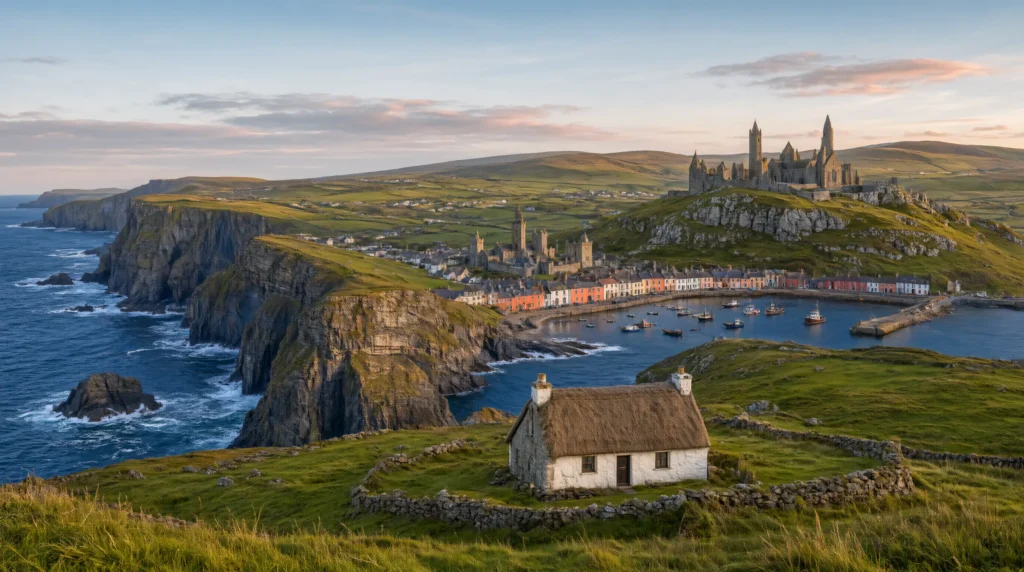
Ireland is small enough to cross in a day and varied enough to fill several trips, with Atlantic cliffs, medieval towns, prehistoric tombs and lively cities. This guide covers 16 of the best places to visit in Ireland, from Dublin and the Cliffs of Moher to the Giant’s Causeway, with how long to stay, when to go, and what travelers from the U.S., UK, Canada and Australia should know about entry rules and safety right now. Two entries are in Northern Ireland, which is part of the UK and has its own entry rules. If you want the bigger picture first, start with our guide to the best places to visit in Europe or browse our Ireland destination guide.
- First trip: Dublin, the Cliffs of Moher and Galway, plus either Killarney or the Ring of Kerry.
- History and ancient sites: Newgrange and the Boyne Valley, Kilkenny, Glendalough and Skellig Michael.
- Coast and scenery: The Cliffs of Moher, the Dingle Peninsula, Connemara and Donegal.
- Music, food and cities: Dublin, Galway, Cork and Belfast.
- Islands: The Aran Islands.
- Northern Ireland: Belfast and the Giant’s Causeway.
- Entry rules: Ireland’s immigration service lists who needs a visa by nationality, and Canada’s government says Canadians can stay up to 90 days for tourism without one. Northern Ireland follows UK rules, and most visitors from outside the UK and Ireland need a UK Electronic Travel Authorisation that costs 20 pounds.
- Wild Atlantic Way: Discover Ireland describes the route as 2,500 km of coastline, running from Donegal to Kinsale in Cork.
- Skellig Michael: Closed for the 2026 season. Heritage Ireland says it reopens in 2027.
Table of contents
- How to Choose the Best Places to Go in Ireland
- Dublin: Best for Literary History and Pubs
- Wicklow and Glendalough: Best for Mountains and Monastic Ruins
- Newgrange and the Boyne Valley: Best for Prehistoric Monuments
- Kilkenny: Best for Medieval Streets and Crafts
- Cork and Kinsale: Best for Food and Harbor Towns
- Killarney and the Ring of Kerry: Best for Lakes and Scenic Drives
- Dingle Peninsula: Best for Coastal Scenery and Music
- Skellig Michael: Best for an Island Monastery
- Cliffs of Moher and the Burren: Best for Sea Cliffs
- Galway: Best for Live Music and Festivals
- Aran Islands: Best for Island Culture and Stone Forts
- Connemara: Best for Mountains and Bogland
- Sligo: Best for Yeats Country and Ancient Tombs
- Donegal: Best for Remote Coastline
- Belfast: Best for Titanic History and Street Art
- Giant’s Causeway and the Causeway Coast: Best for Basalt Columns
- Sample Ireland Itineraries
- Best Ways to Get Around Ireland
- Best Time to Visit Ireland
- Entry, Safety and Practical Rules for US, UK, Canadian and Australian Travelers
- Frequently Asked Questions
- Final Thoughts
How to Choose the Best Places to Go in Ireland
Ireland looks compact on a map, but narrow roads and slow rural travel make distances feel longer than they are. The best plan for a first visit is to pick one or two regions, base yourself in three or four places, and treat everything else as a day trip. The west coast rewards slow days, and the east is easier by train.
UNESCO lists two World Heritage properties in the Republic of Ireland, both cultural: Brú na Bóinne and Sceilg Mhichíl (Skellig Michael). The Giant’s Causeway is also listed, but it is in Northern Ireland and counted under the UK.
| Your trip | A good starting plan |
|---|---|
| First visit, about 7 days | Dublin, Galway, the Cliffs of Moher and Killarney |
| 10 days | Add Kilkenny, Dingle and Cork |
| History and archaeology | Newgrange, Glendalough, Kilkenny and Sligo |
| Scenery and driving | Ring of Kerry, Dingle, Connemara and Donegal |
| Cities and music | Dublin, Galway, Cork and Belfast |
| Northern Ireland add-on | Belfast and the Giant’s Causeway |
Dublin: Best for Literary History and Pubs
Dublin is the entry point for most visitors and a good base for the first three days. The city is walkable. Trinity College, Grafton Street, St Stephen’s Green and the Liffey quays sit within a short walk of one another, and the Guinness Storehouse and Kilmainham Gaol are a short ride away. Evenings revolve around pubs with live traditional music, and the best ones are often the quiet ones away from the busiest tourist streets.
Take normal city precautions. The UK government says that bag-snatching and pickpocketing are a risk and that most incidents occur in the larger cities. Canada’s advice adds that car break-ins happen, particularly in Dublin’s tourist areas, so do not leave anything visible in a rental car.
Suggested time: Three days.
Best season: Late spring and early autumn, when the days are long and crowds are thinner.
Planning tip: Book the busiest attractions ahead, and take day trips to the Boyne Valley or Wicklow rather than moving hotels.
Wicklow and Glendalough: Best for Mountains and Monastic Ruins
The Wicklow Mountains sit just south of Dublin and are the easiest escape from the city. Glendalough is the main stop, a valley of two lakes with the ruins of an early monastic settlement, including a round tower. Walking trails of different lengths start near the visitor center, so you can choose a short lakeside loop or a longer hike into the hills.
Weather changes quickly here. Pack a waterproof layer even if the forecast looks dry, and wear proper shoes. Canada’s advice notes that hiking trails may be unmarked in places, so use a map or app.
Suggested time: One day.
Best season: Spring to early autumn.
Planning tip: Go early, because the car park and the main trails fill up on summer weekends.
Newgrange and the Boyne Valley: Best for Prehistoric Monuments
The Boyne Valley holds some of Europe’s oldest monuments. UNESCO’s listing of Brú na Bóinne describes the three main prehistoric sites, Newgrange, Knowth and Dowth, on the north bank of the River Boyne, and calls it Europe’s largest and most important concentration of prehistoric megalithic art. The three great burial mounds are surrounded by about forty smaller passage graves.
It is an easy day trip from Dublin. Visitors usually start at the visitor center, so check the current booking rules before you go and reserve ahead in busy months.
Suggested time: Half a day to one day.
Best season: Any time, and winter is quieter.
Planning tip: Book your Newgrange slot first, then plan the rest of the day around it.
Kilkenny: Best for Medieval Streets and Crafts
Kilkenny is a compact medieval city with a castle, a stretch of old streets called the Medieval Mile, and a strong craft and food scene. It is small enough to see on foot, and it makes a good overnight stop between Dublin and the south or west.
Plan an afternoon at the castle and gardens, then spend the evening in the pubs and restaurants along the main streets. Nearby villages and country roads reward a slower second day.
Suggested time: One to two days.
Best season: Spring to autumn.
Planning tip: Stay in the center so you can walk everywhere and skip the rental car for a day.
Cork and Kinsale: Best for Food and Harbor Towns
Cork is Ireland’s second city, with a covered market, a busy food scene and a relaxed pace. Kinsale, a short drive south, is a colorful harbor town known for its restaurants. It also matters on the map: Discover Ireland says the Wild Atlantic Way runs from the Inishowen Peninsula in Donegal to Kinsale in Cork, so Kinsale marks the southern end of the route.
Blarney Castle is close to Cork if you want a classic stop. Use the city as a base for day trips, or continue west toward Kerry.
Suggested time: Two to three days.
Best season: Late spring to early autumn.
Planning tip: Eat at Cork’s market for lunch, then head to Kinsale for a long dinner.
Killarney and the Ring of Kerry: Best for Lakes and Scenic Drives
Killarney is a lakeside town on the edge of a national park, with walking trails, boat trips and old estates. The Ring of Kerry is the well-known scenic loop around the Iveragh Peninsula, with coastal views, small villages and mountain passes. Many visitors drive it in a single day, but it is better with an overnight stop.
Rural roads are narrow, and Canada’s advice warns that they can be hazardous in bad weather. Drive on the left, take it slowly, and start early so tour buses do not set your pace. The UK advises checking the rules of the road and parking rules before you drive.
Suggested time: Two to three days.
Best season: Late spring to early autumn.
Planning tip: Drive the Ring of Kerry in the direction the buses do not, or leave before they do.
Dingle Peninsula: Best for Coastal Scenery and Music
Dingle is a small harbor town at the end of a long peninsula, with pubs that host traditional music most nights. The loop drive around the peninsula passes beaches, headlands and Irish-speaking villages, and the road is scenic but slow. It makes a good alternative to the Ring of Kerry if you want smaller roads.
Plan at least one night here. The town works best in the evening, once the day trippers have left.
Suggested time: Two days.
Best season: Late spring to early autumn.
Planning tip: Allow extra time for photo stops, and book your table or boat trip in advance in summer.
Skellig Michael: Best for an Island Monastery
Skellig Michael is a steep rock off the Kerry coast with a monastery near the top. UNESCO’s listing of Sceilg Mhichíl, inscribed in 1996, says the island rises from the Atlantic almost 12 km west of the Iveragh Peninsula. Heritage Ireland says the monks lived in beehive-shaped stone huts, many of which remain, and that reaching the top involves climbing 618 steep, uneven steps.
Access is limited. Heritage Ireland says the site is closed for the 2026 season and reopens in 2027, and that you can only land through boat operators that hold a permit. Check the current dates before you plan around it. Boat trips that circle the island without landing may be offered by other operators, but confirm what they include.
Suggested time: Half a day for a boat trip.
Best season: The landing season, once dates are announced.
Planning tip: Book a permitted operator as soon as 2027 dates open, because places are limited.
Cliffs of Moher and the Burren: Best for Sea Cliffs
The Cliffs of Moher are Ireland’s best-known coastal sight. The official site says the highest point, Knockardakin, stands at 214 meters, and that the area is a Special Protection Area for birds. The South Platform looks over a puffin colony on Goat Island. Paved pathways lead to the viewing areas, but stay behind the barriers, because the cliff edge is abrupt.
Pair the cliffs with the Burren, a rocky limestone landscape inland, and with the nearby village of Doolin for music. The cliffs are open daily, according to the official site, and booking ahead online is encouraged.
Suggested time: One day.
Best season: Late spring to early autumn, and evenings for softer light.
Planning tip: Check the weather before you go, because fog and wind can hide the view.
Galway: Best for Live Music and Festivals
Galway is a compact, lively city on the west coast, known for street performers, pubs with live music and a busy festival calendar. Shop Street, the Latin Quarter and the Salthill promenade give you an easy first day on foot.
Galway is also the best base for the west. The Cliffs of Moher, Connemara and the Aran Islands are all reachable on day trips, so it works as a base for several nights.
Suggested time: Two to three days.
Best season: Late spring to early autumn.
Planning tip: Book ahead during festival weeks, because rooms fill quickly.
Aran Islands: Best for Island Culture and Stone Forts
The Aran Islands sit off the coast of Galway and Clare, and Inis Mor, the largest, is the usual choice. Visitors rent bikes, walk the stone-walled lanes and visit Dun Aonghasa, a prehistoric stone fort on the edge of a cliff. Irish is widely spoken, and the pace is slow.
You reach the islands by ferry, so check sailing times and the weather before you commit to a day trip. Rough seas can cancel crossings.
Suggested time: One to two days.
Best season: Late spring to early autumn.
Planning tip: Stay one night if you can, because the island is quietest after the last ferry leaves.
Connemara: Best for Mountains and Bogland
Connemara, north-west of Galway, is a landscape of mountains, lakes, bogs and rugged coast. Connemara National Park offers walking trails, and Kylemore Abbey is a popular stop on the drive. Small villages and beaches break up the road.
The area is best by car, though rural roads are narrow. Take your time and plan fewer stops with more walking.
Suggested time: One to two days.
Best season: Late spring to early autumn.
Planning tip: Check the weather for hill walks, since conditions change fast.
Sligo: Best for Yeats Country and Ancient Tombs
Sligo is a small town in the north-west, set between mountains and the sea, and it is closely linked to the poet W. B. Yeats. The countryside holds a dense collection of prehistoric tombs. UNESCO’s state page for Ireland lists The Passage Tomb Landscape of County Sligo on Ireland’s tentative list for World Heritage status, which signals how important the area is.
Sligo works as a stop between Galway and Donegal, and it has good surf beaches for those who want to get in the water.
Suggested time: One to two days.
Best season: Late spring to early autumn.
Planning tip: Combine the tombs with a walk in the hills for the full landscape.
Donegal: Best for Remote Coastline
Donegal is Ireland’s far north-west, with long empty beaches, sea cliffs and small Irish-speaking communities. Slieve League’s cliffs are a major draw, and the northern coast ends at the Inishowen Peninsula, which Discover Ireland names as the starting point of the Wild Atlantic Way.
Donegal is remote, so plan for long drives and a slower pace. Services thin out away from the main towns, so fill the tank and book rooms ahead in summer.
Suggested time: Three days.
Best season: Late spring to early autumn.
Planning tip: Treat Donegal as its own trip, not a stop, because the distances are bigger than they look.
Belfast: Best for Titanic History and Street Art
Belfast is the capital of Northern Ireland, which is part of the UK. The city is known for the Titanic Belfast museum on the former shipyard site, political murals and the peace walls that tell the story of the conflict known as the Troubles, and a growing food scene. Many visitors take a guided tour to understand the history properly.
Because Belfast is in the UK, UK entry rules apply. The UK government says you usually need an ETA rather than a visa if you are from Europe, the USA, Australia, Canada or certain other countries, and that people with a British or Irish passport do not. The ETA costs 20 pounds and lets you travel for up to six months. Canada’s advice says that if you plan to travel to the UK, including Northern Ireland, you must meet the UK’s entry requirements. Money is also different, because Northern Ireland uses pounds sterling.
Suggested time: Two days.
Best season: Late spring to early autumn.
Planning tip: Apply for your ETA on the official government site only, because look-alike sites charge extra.
Giant’s Causeway and the Causeway Coast: Best for Basalt Columns
The Giant’s Causeway is on the north coast of Northern Ireland. UNESCO’s listing of the Giant’s Causeway and Causeway Coast says it is made up of some 40,000 black basalt columns sticking out of the sea, caused by volcanic activity 50 to 60 million years ago. The sight has inspired legends of giants striding over the sea to Scotland.
The coast road has more stops, including cliff walks and ruined castles. As with Belfast, UK entry rules apply, so check the ETA requirement before you cross or fly in.
Suggested time: One day.
Best season: Late spring to early autumn, and winter for fewer crowds.
Planning tip: Wear shoes with grip, because the basalt is slippery when wet.
Sample Ireland Itineraries
These are starting points, not fixed routes. Ireland’s roads are slower than the map suggests, so keep the number of bases low.
| Trip length | Route | Why it works |
|---|---|---|
| 7 days | Dublin (2), Galway (2), Cliffs of Moher (1), Killarney (2) | The classic first loop |
| 10 days | Dublin (2), Kilkenny (1), Cork (2), Dingle (2), Galway (2), Cliffs of Moher (1) | Adds history and the southwest |
| 14 days | Dublin (2), Boyne Valley (1), Belfast (2), Giant’s Causeway (1), Donegal (2), Sligo (1), Galway (2), Dingle (2), Cork (1) | A fuller loop with Northern Ireland |
Best Ways to Get Around Ireland
Trains and buses connect Dublin with the larger cities, and they are the easy choice for city hopping. The west and the small villages are much easier with a rental car. Ireland drives on the left, and rural roads can be narrow. The UK government advises checking the rules of the road and local parking regulations before driving.
Ferries serve the Aran Islands, and boats run to other islands in good weather. If you fly into Dublin and plan to visit Belfast, remember the UK entry rules for Northern Ireland.
Best Time to Visit Ireland
Tourism Ireland says every season has its charm, and that travelling in off-peak seasons means fewer crowds.
| Season | What to expect |
|---|---|
| Spring | Longer days and changeable weather. Tourism Ireland highlights gardens and St Patrick’s Day on March 17. |
| Summer | The busiest and most expensive period, with the longest days. Book rooms and popular attractions ahead. |
| Autumn | A good balance of lighter crowds and festivals, with weather that can still be mild. |
| Winter | Quieter sites and lower prices, with shorter days and more rain. |
Weather can change within a day in any season, so pack layers and a waterproof jacket. Canada’s advice notes that storms, flooding and wildfire smoke can disrupt travel.
Entry, Safety and Practical Rules for US, UK, Canadian and Australian Travelers
Visas and entry
Ireland is not in the Schengen area. The UK government says Schengen rules do not apply, and you do not need to register for the EU’s Entry/Exit System when entering Ireland. Ireland’s Department of Foreign Affairs says whether you need a visa depends on your nationality, the purpose of your visit and how long you plan to stay, and that all non-EEA nationals are subject to immigration control on arrival, whether or not they need a visa.
- United States: The Irish embassy in San Francisco says U.S. citizens do not need a visa to visit Ireland for up to 90 days for tourism or business. Check the Irish Immigration visa tool before you book.
- Canada: Canada’s government says Canadians do not need a visa for stays up to 90 days, and that your passport must be valid for the length of your stay.
- United Kingdom: The UK government says British and Irish citizens can travel freely between the UK and Ireland under the Common Travel Area, and that British nationals are not legally required to show a passport, though you should carry one because airlines and ferries may ask.
- Australia and Europe: Use the Irish Immigration visa tool to check your passport. EU and EEA citizens are not subject to the immigration control that applies to non-EEA nationals.
- Northern Ireland: UK rules apply, including the ETA for most visitors from outside the UK and Ireland.
Entry rules change. Confirm the latest rules with the Irish embassy or the official immigration service before you book.
Safety: what each government says
Ireland is a safe destination for most travelers. The main issues are petty crime, weather and rural roads.
- United States: The State Department lists Ireland at Level 1, Exercise Normal Precautions.
- Canada: Canada’s advice is to take normal security precautions, and it flags pickpocketing and bag snatching, car break-ins in Dublin’s tourist areas, card and ATM fraud, demonstrations that can turn violent, narrow rural roads and unmarked hiking trails.
- United Kingdom: The UK says terrorist attacks cannot be ruled out, warns about bag-snatching and pickpocketing mostly in larger cities, notes that demonstrations can happen with little warning, and says expect a long jail sentence for illegal drugs.
- Australia: Check Smartraveller for the latest advice.
Practical rules
- Currency: The Republic of Ireland uses the euro. Northern Ireland uses pounds sterling.
- Cliff safety: Stay behind the barriers at the Cliffs of Moher, because the cliff edge is abrupt.
- Weather gear: Pack a waterproof jacket in every season.
- Travel insurance: Get coverage that includes your activities and medical costs.
Frequently Asked Questions
What are the best places to visit in Ireland for first-timers?
For a first trip, start with Dublin, the Cliffs of Moher and Galway, then add Killarney or the Dingle Peninsula. They cover the capital, the west coast and the best-known scenery in one route.
How many days do you need in Ireland?
For a first visit, 7 to 10 days is enough for three or four bases, such as Dublin, Galway, Killarney and Cork. Fewer bases with longer stays work better than moving every night, because rural roads are slow.
What is the best time to visit Ireland?
Tourism Ireland says every season has its charm. Late spring and early autumn are a good balance of daylight and thinner crowds, summer is busiest, and winter is quieter with lower prices.
Do Americans need a visa for Ireland?
Not for short stays. The Irish embassy in San Francisco says U.S. citizens can stay up to 90 days for tourism or business without a visa. Northern Ireland is part of the UK, and U.S. visitors there usually need a UK ETA.
Is Ireland safe for tourists?
Yes, with normal precautions. The U.S. State Department lists Ireland at Level 1, and Canada advises normal security precautions. The most common problems are pickpocketing, car break-ins in tourist areas and bad weather on rural roads.
Can you visit Skellig Michael in 2026?
No. Heritage Ireland says Skellig Michael is closed for the 2026 season and reopens in 2027, and that landing is only possible through boat operators that hold a permit.
Final Thoughts
The best places to visit in Ireland are the ones that fit your season, your pace and how much driving you can stand. Pick a region, check the entry rules for both the Republic and Northern Ireland, and give each stop enough time to feel like more than a photo stop. Then come back for another region on your next trip.