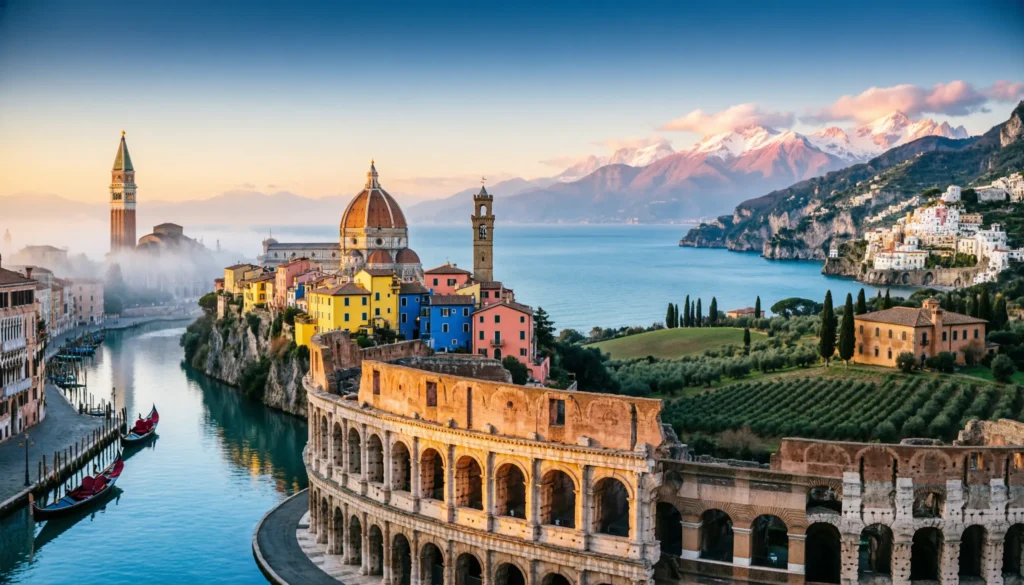
Italy rewards the traveler who chooses a region and slows down. This guide covers 16 of the best places to visit in Italy, from the classic cities to the islands, with how long to stay, when to go, and what travelers from the U.S., UK, Canada and Australia should know about entry rules, safety and the Venice fee right now. If you want the bigger picture first, start with our guide to the best places to visit in Europe or browse our Italy destination guide.
- First trip: Rome, Florence and Venice.
- Food and culture: Bologna, Naples and Tuscany’s hill towns.
- Coast and islands: The Amalfi Coast, Cinque Terre, Sicily and Sardinia.
- Mountains and lakes: The Dolomites and Lake Como.
- Ancient history: Rome, Pompeii and Sicily’s Greek sites.
- Off the main circuit: Matera, Puglia and Assisi.
- Best season: Spring and autumn suit most cities, and the official Italian tourism site says Italy has much to offer regardless of the time of year. Summer is hot in the south, and some regions have their own seasonal risks (see the best-time section below).
- Venice fee: The city’s official site says the 2026 access fee trial has ended and no fee has applied since July 27. Check it again before you book.
Table of contents
- How to Choose Where to Go in Italy
- Rome: Best for Ancient History
- Florence: Best for Renaissance Art
- Venice: Best for Canals and Lagoon Views
- Verona: Best for Romance and Roman Ruins
- The Dolomites: Best for Mountain Scenery
- Lake Como: Best for Lakeside Villages
- Cinque Terre: Best for Coastal Villages
- Bologna: Best for Food and Porticoes
- Tuscany’s Hill Towns: Best for Landscapes and Medieval Streets
- Assisi and Umbria: Best for Quiet Hill-Town Pilgrimage
- Naples and Pompeii: Best for Pizza and Roman Ruins
- The Amalfi Coast: Best for Cliffside Villages
- Matera: Best for Cave Dwellings
- Puglia: Best for Trulli and Whitewashed Towns
- Sicily: Best for Greek Temples and Volcanoes
- Sardinia: Best for Beaches and Bronze Age Towers
- Sample Italy Itineraries
- Getting Around Italy
- Best Time to Visit Italy
- Entry, Safety and Practical Rules for US, UK, Canadian and Australian Travelers
- Frequently Asked Questions
- Final Thoughts
How to Choose Where to Go in Italy
Italy is long, and the distance between the north and the south is bigger than most maps suggest. Trains are fast between the main cities, but the south and the islands take more time. The best plan for a first visit is to pick one region, choose two or three bases, and treat everything else as a day trip.
UNESCO lists 62 World Heritage properties in Italy, 56 cultural and six natural. That is why this guide links to the official listing wherever one exists.
| Your trip | A good starting plan |
|---|---|
| First visit, about 10 days | Rome, Florence and Venice |
| Two weeks, culture and food | Rome, Tuscany, Bologna and Venice |
| Coast and ruins | Naples, Pompeii and the Amalfi Coast |
| Mountains and lakes | The Dolomites and Lake Como |
| Slower, less crowded | Matera, Puglia and Sicily |
| Islands | Sicily, then Sardinia |
The “Suggested time” lines below are our own planning suggestions, not official figures. Season and entry details that come from an official source are linked to it.
Rome: Best for Ancient History
Rome is the one city almost every Italy trip includes, and it earns it. The Forum, the Colosseum area and the Pantheon cover the ancient city, and the Vatican covers the Renaissance and the papacy. UNESCO’s listing of the Historic Centre of Rome (1980, extended 1990) covers the historic center inside the 17th-century walls, plus the Holy See’s properties and San Paolo Fuori le Mura. UNESCO’s description names the Forums, the Pantheon and Trajan’s Column among the monuments, and dates the city’s legendary founding to 753 BC. In practice that means you can walk from a 2,000-year-old temple dome to a Baroque fountain in one afternoon, which is exactly why Rome rewards slow days over a checklist. Plan a separate half day for Vatican City, because the museums and St. Peter’s Basilica are large enough to fill one on their own.
Suggested time: Three to four days.
Best season: Spring and autumn. Summer is hot around the main monuments.
Planning tip: Book timed tickets on each site’s official website, and do the big monuments early in the day before the heat and the tour groups arrive.
Florence: Best for Renaissance Art
Florence is compact, walkable and packed with art. UNESCO lists the Historic Centre of Florence (1982) for six centuries of extraordinary artistic activity, with works by Giotto, Brunelleschi, Botticelli and Michelangelo, including the cathedral (Santa Maria del Fiore) and the Uffizi Gallery. The center is small enough to cover on foot, so you rarely need transit once you arrive, and most visitors find two full days enough for the headline art and a third for neighborhoods and day trips. Cross the river to the Oltrarno for artisan workshops and quieter dinners. Pisa is an easy day trip, and the Piazza del Duomo in Pisa is UNESCO-listed too.
Suggested time: Two to three days.
Best season: Spring and autumn. Summer can be very hot.
Planning tip: Reserve the Uffizi and any cathedral climb ahead, and keep afternoons for the outdoor sights.
Venice: Best for Canals and Lagoon Views
Venice is unlike any other city, and it is also one of the most crowded. UNESCO lists Venice and its Lagoon (1987) and says the city was founded in the 5th century, spans 118 small islands and became a major maritime power in the 10th century. Skip the rush around St. Mark’s by walking into the quieter neighborhoods early in the morning and late in the evening. Getting lost on purpose is half the pleasure here, and the lagoon islands, reached by public water bus, make a calm half-day away from the main crowds.
On cost, the city’s official access fee page says the 2026 trial period has ended and the fee has not applied since July 27. It also says any measures for later years are up to the city’s governing bodies, so check the page before you book.
Suggested time: Two to three days.
Best season: Spring and early autumn. Canada’s travel advice notes that tidal flooding called acqua alta occurs mainly in fall and spring, so pack for wet streets.
Planning tip: Stay overnight if you can. The city is far calmer after the day-trippers leave.
Verona: Best for Romance and Roman Ruins
Verona is a good-value stop between Venice and the lakes. UNESCO lists the City of Verona (2000), which it says was founded in the 1st century BCE, flourished under the Scaliger family in the 13th and 14th centuries, and later became part of the Republic of Venice. Its Roman arena is still the centerpiece, and the city is tied to the Romeo and Juliet legend.
Suggested time: One to two days.
Best season: Late spring through early autumn, when the arena hosts summer performances.
Planning tip: Treat the Juliet balcony as a quick photo stop and spend your time in the old streets and squares instead.
The Dolomites: Best for Mountain Scenery
The Dolomites are the best mountain scenery in Italy. UNESCO lists The Dolomites (2009) as nine areas in the northern Italian Alps, including 18 peaks above 3,000 meters across 141,903 hectares. The region sits close to the Austrian border, so it pairs easily with a trip into Austria. Cable cars and high trails make the peaks reachable, and the area works for both summer hiking and winter skiing. The range is spread across several provinces, so it helps to pick a valley that matches your plans: Val di Fassa, mentioned by the national tourism site for its autumn foliage and mountain refuges, is a good choice for hikers who want quieter trails after the summer rush.
The official Italian tourism site mentions winter ski areas combined with spas across the Alps and Dolomites, and autumn foliage in the Val di Fassa.
Suggested time: Four to five days.
Best season: Summer for hiking, winter for snow sports. Mountain huts and lifts often operate seasonally, so check dates before you plan.
Planning tip: Base yourself in one valley instead of moving every night, and check the weather before every high-altitude outing.
Lake Como: Best for Lakeside Villages
Lake Como is a deep Alpine lake ringed by steep hills and small towns. Como, Bellagio and Varenna are the best-known bases, and public ferries link the villages, so you can travel without a car. The lake sits close to the Swiss border, which makes it easy to continue into Switzerland. The official Italian tourism site says spring is a splendid time of year on the northern Italian lakes, with mild temperatures. That is also a good reason to avoid the busiest summer weekends, when ferries and lakeside roads fill up. Lake Como is small enough that a base in one town and a ferry day to a second or third village covers most of what visitors come for.
Suggested time: Two to three days.
Best season: Spring and early autumn.
Planning tip: Pick one or two villages as a base and use ferries for the rest. Driving the lake roads in peak season is slow.
Cinque Terre: Best for Coastal Villages
Cinque Terre is five colorful villages on the Ligurian coast, linked by trail and train. UNESCO lists Portovenere, Cinque Terre, and the Islands (1997) and says the property stretches about 15 km along the coast between Levanto and La Spezia. Its stone-walled terraces for vines and olives were mostly built in the 12th century, and the area was nearly inaccessible except by sea until the Genoa to La Spezia railway opened in the 1870s. From here you can keep going west along the coast into France.
Suggested time: Two days.
Best season: Spring and early autumn, when hiking is comfortable.
Planning tip: Check trail and train status before you go, because conditions can change.
Bologna: Best for Food and Porticoes
Bologna is Italy’s food capital in the eyes of many Italians, and it is far less crowded than Florence or Venice. UNESCO lists The Porticoes of Bologna (2021), twelve representative component parts selected from about 62 km of porticoes. UNESCO describes them as “private property for public use,” which is why you can walk much of the city under cover. Emilia-Romagna also puts you within reach of the tiny republic of San Marino.
Suggested time: Two days.
Best season: Spring and autumn. The porticoes make it comfortable in rain, too.
Planning tip: Plan meals first and sightseeing second. Book popular restaurants ahead.
Tuscany’s Hill Towns: Best for Landscapes and Medieval Streets
Tuscany is best seen from a base outside the big cities. UNESCO lists the Historic Centre of Siena (1995) as an embodiment of a medieval city, with a seven-kilometer wall that still surrounds the site (the protected area covers about 170 hectares), and the Val d’Orcia (2004) for its flat chalk plains and conical hills topped by fortified settlements. San Gimignano and Pienza are also UNESCO-listed and make good additions.
Suggested time: Three to four days.
Best season: Spring and autumn.
Planning tip: If you drive, learn about limited traffic zones before you arrive. The State Department says authorities fine drivers without the proper permits in historic downtown areas across Italy, with cameras photographing license plates and fines mailed to your home.
Assisi and Umbria: Best for Quiet Hill-Town Pilgrimage
Assisi is a medieval hill town and the birthplace of Saint Francis. UNESCO lists Assisi, the Basilica of San Francesco and Other Franciscan Sites (2000) and says its medieval masterpieces, including paintings by Cimabue, Lorenzetti, Martini and Giotto, are a fundamental reference point for Italian and European art. Umbria around it is quieter than Tuscany, which makes it a good base for slow travel. The basilica is the main draw, but the lanes, small piazzas and surrounding countryside are worth a slow afternoon, and the town works well as a calm stop between Florence and Rome.
Suggested time: Two days.
Best season: Spring and autumn.
Planning tip: Dress modestly for churches, and expect pilgrim crowds around religious holidays.
Naples and Pompeii: Best for Pizza and Roman Ruins
Naples is loud, gritty and full of life, and it is the best base for the ruins around Vesuvius. UNESCO lists the Historic Centre of Naples (1995), a city founded by Greek settlers in 470 B.C., and the Archaeological Areas of Pompei, Herculaneum and Torre Annunziata (1997), buried by the eruption of Vesuvius on August 24, AD 79. Churches such as Santa Chiara and fortresses such as Castel Nuovo sit among the city’s dense street grid. Naples is also known as the birthplace of pizza, and eating one in the old center is as much a reason to visit as the museums.
Stay alert in the city. Australia’s travel advice names Naples among the Italian cities where drink spiking has been reported, and all three English-language governments note that petty crime is common.
Suggested time: Two to three days.
Best season: Spring and autumn. Summer is hot for open-air ruins.
Planning tip: Bring water, a hat and sturdy shoes to Pompeii, since most of the site is open and exposed.
The Amalfi Coast: Best for Cliffside Villages
The Amalfi Coast is a stretch of cliffs, terraced lemon groves and pastel villages above the sea. UNESCO lists the Costiera Amalfitana (1997), covering 15 municipalities, and says Amalfi was a powerful maritime republic between the 9th and 11th centuries. Positano gets the photos, Ravello has the gardens and Amalfi town has the cathedral and harbor. If you want a calmer pace, stay in one village and treat the others as short ferry or bus trips instead of trying to see the whole coast in a day.
Suggested time: Three to four days.
Best season: Late spring and early autumn.
Planning tip: The coastal road is narrow and slow in summer. Use ferries and buses where you can, and consider basing yourself in Sorrento or Salerno for more room.
Matera: Best for Cave Dwellings
Matera is one of the most unusual towns in Europe. UNESCO lists The Sassi and the Park of the Rupestrian Churches of Matera (1993) and calls it the most outstanding, intact example of a troglodyte settlement in the Mediterranean region, with the first inhabited zone dating to the Palaeolithic period. Many visitors stay in a restored cave hotel and explore the lanes on foot. The Sassi look best in early morning and at dusk, when the stone changes color and the day-trip crowds are gone.
Suggested time: One to two days.
Best season: Spring and autumn. Summer can be very hot on the exposed stone.
Planning tip: The old town is steep and full of steps, so wear good shoes and pack light.
Puglia: Best for Trulli and Whitewashed Towns
Puglia is the heel of Italy’s boot, with olive groves, baroque towns and a long coast. UNESCO lists The Trulli of Alberobello (1996), limestone dwellings built by mortarless drywall construction with conical roofs, many still inhabited. Ferries link Puglia’s ports with Greece, so the region can also be a gateway to the Ionian side of Greece.
Suggested time: Three to four days.
Best season: Spring and early autumn. Summer is hot and busy on the coast.
Planning tip: Puglia works best with a car, so build in time for slow country roads and read the limited traffic zone rules before entering old towns.
Sicily: Best for Greek Temples and Volcanoes
Sicily packs ancient Greek sites, Arab-Norman churches and a live volcano into one island. UNESCO lists Syracuse and the Rocky Necropolis of Pantalica (2005), where Greek settlers from Corinth founded Syracuse in the 8th century BC and where Pantalica holds more than 5,000 rock-cut tombs, and the Archaeological Area of Agrigento (1997), where Doric temples dominate the ancient town. Mount Etna (2013) is described by UNESCO as the most active stratovolcano in the world. Malta is a short hop away if you want to add another island.
Plan for Etna’s moods. The State Department warns that eruptions can occur with little to no warning and that Sicily travelers should expect possible disruptions, including airport closures, when Etna is active. Canada also notes that summer wildfires often occur in Sicily, Calabria and Sardinia.
Suggested time: Five to seven days.
Best season: Spring and autumn. Summer brings heat and the wildfire risk Canada mentions.
Planning tip: Keep flexible flights if you plan to be near Etna, and check volcano and fire updates before you travel.
Sardinia: Best for Beaches and Bronze Age Towers
Sardinia is the best island for beach time. Inland, it also has some of Europe’s oldest architecture. UNESCO lists Su Nuraxi di Barumini (1997) and calls it the finest and most complete example of the nuraghi, Bronze Age defensive towers shaped like truncated cones that are unique to Sardinia. The official Italian tourism site says autumn temperatures in Sardinia are still mild enough to enjoy the sea, which makes September and October a sensible way to get beach weather without peak-season pricing and crowds. Pair a coastal base with a day or two inland, where the nuraghi and quiet hill villages show a different side of the island.
Suggested time: Four to seven days.
Best season: Late spring and early autumn. Summer brings crowds, and Canada’s travel advice notes frequent summer wildfires.
Planning tip: Rent a car, because the best beaches and the inland sites are far apart, and book ferries or flights early in summer.
Sample Italy Itineraries
These are our own planning suggestions, built around the train-friendly north and center. They are starting points, not official routes.
| Trip length | Route | Why it works |
|---|---|---|
| 7 days | Rome (3), Florence (2), Venice (2) | The classic first trip, with fast rail links between the three |
| 10 days | Rome (3), Tuscany hill towns (2), Florence (2), Venice (2) | Adds the countryside that most people picture when they imagine Italy |
| 14 days, food focus | Venice (2), Bologna (2), Florence (3), Rome (3), Naples and Amalfi Coast (4) | Moves north to south, so the heat of the south hits in your last days |
| 10 days, slow south | Naples (2), Amalfi Coast (3), Matera (1), Puglia (3), Rome (1) | Fewer crowds, more time in the car or on regional trains |
If you only have a week, resist adding a fourth city. Italy’s best moments tend to happen on the third evening in one place, not the first hour in a new one.
Getting Around Italy
Fast trains connect Rome, Florence, Bologna, Venice and Milan, so you rarely need a car for the main cities. Buy tickets on the rail operators’ official websites and keep to a modest number of hops. The south, Sicily, Sardinia and the countryside are different: buses are slower and a rental car gives you much more freedom.
Two cautions apply. First, strikes are a regular feature of Italian travel. Canada’s travel advice says strikes and demonstrations happen regularly, often with little notice, and can disrupt air, rail and bus services, so leave buffer time before flights and avoid tight connections on your last day. Second, historic centers have limited traffic zones. The U.S. State Department says drivers without the proper permits are fined, with cameras photographing license plates and fines mailed to your home, so park outside the old center and walk in. Check your own country’s rules on an International Driving Permit before you rent.
Best Time to Visit Italy
Italy has no single best season, and the official tourism site does not give month ranges. Use this table for the official seasonal notes we could source, then the general guidance below it.
| Region or hazard | What the official source says | Source |
|---|---|---|
| Venice | Tidal flooding (acqua alta) occurs mainly in fall and spring | Government of Canada |
| Sicily, Calabria, Sardinia | Wildfires often occur in summer | Government of Canada |
| Mount Etna | Eruptions can occur with little to no warning, and airport closures are possible | U.S. State Department |
| Alps and Dolomites | Ski areas and spas in winter, foliage in the Val di Fassa in autumn | Italian national tourism site |
| Northern lakes | Spring is a splendid time, with mild temperatures | Italian national tourism site |
As general guidance, spring and autumn mean fewer crowds and more comfortable walking in the big cities than midsummer, and the south and the islands are hottest in summer. Check regional tourism boards for exact dates before you book.
Entry, Safety and Practical Rules for US, UK, Canadian and Australian Travelers
This is the section most guides skip, and it is the one most likely to change. Check every item against the official source before you book. EU citizens are not affected by the entry rules.
Visas, the 90 in 180 rule and new border systems
Italy is in the Schengen area, where short stays are limited to a maximum of 90 days within any 180-day period. The EU’s Entry/Exit System began operating on October 12, 2025 and became fully operational on April 10, 2026, replacing passport stamping. It records fingerprints and a facial image, so expect to provide both at the border. The EU’s separate ETIAS travel authorization is due to start in the last quarter of 2026, and the EU says it will announce the exact date several months ahead. Your passport must be valid for at least three months after you leave and issued within the last 10 years.
Australia’s travel advice also notes that Italy has introduced temporary border checks with Slovenia, so allow extra time if you are crossing by road.
Safety: what each government says
| Government | Advice for Italy |
|---|---|
| U.S. State Department | Level 2, “Exercise increased caution,” because of terrorism. The page shows conflicting issue dates, so re-check it. |
| UK FCDO | Updated October 2, 2026. Check the page for current warnings. |
| Canada | Exercise a high degree of caution because of the threat of terrorism (updated September 29, 2026). |
| Australia Smartraveller | Exercise normal safety precautions. |
The governments agree on the day-to-day risks. Petty crime, including pickpocketing, is common in tourist areas and on trains and public transit. Strikes often affect airlines, trains and buses, and Canada notes they can happen with little notice. Italy is also in an active seismic zone, and Canada says there are nine active volcanoes in the country.
Practical rules
- Venice: The official city site says the 2026 access fee trial has ended and no fee has applied since July 27. Any later measures are up to the city.
- Driving: Historic city centers have restricted traffic zones. The State Department says cameras photograph license plates and fines are mailed to your home.
- Counterfeits and monuments: The State Department says tourists can be fined or detained for buying counterfeit goods or defacing historic monuments.
- Health: The CDC says it recommends that all travelers get fully vaccinated against measles before traveling to any international destination. Check your own national travel health page too.
- Insurance: The State Department encourages U.S. citizens to buy medical evacuation insurance.
Frequently Asked Questions
What are the best places to visit in Italy for first-timers?
For a first trip, start with Rome, Florence and Venice, then add the Amalfi Coast or Tuscany. They are well connected by fast trains and cover ancient history, Renaissance art and the Italian coast in one route.
How many days do you need in Italy?
For a first trip, 10 to 14 days is enough for three or four bases, such as Rome, Florence, Venice and one coastal stop. Fewer, longer stays work better than moving every night, because each hop costs half a day.
What is the best time to visit Italy?
Spring and autumn are the most comfortable for most cities, and summer is hottest in the south and the islands. Check the regional notes above for Venice flooding, summer wildfires on the islands and mountain seasons.
Do Americans need a visa for Italy?
Not for short stays. Italy is in the Schengen area, which allows up to 90 days in any 180-day period, and the Entry/Exit System has been fully operational since April 10, 2026. The EU’s ETIAS authorization is due in the last quarter of 2026, so check the official EU site for the start date before you book.
Is Italy safe for tourists?
Yes, with normal precautions. The U.S. State Department rates Italy Level 2, mainly for terrorism, and Australia advises normal safety precautions. The most common problems are pickpocketing, strikes and, occasionally, volcanic or seismic activity, so keep valuables close and check transport updates.
Is there a fee to enter Venice?
Not at the moment. The city’s official site says the 2026 trial period for the access fee has ended and the fee has not applied since July 27. It also says decisions for later years are up to the city, so check the page before you travel.
Final Thoughts
The best places to visit in Italy are the ones that fit your season, your pace and your tolerance for crowds. Pick one region, check the official entry rules, and give each stop enough time to feel like more than a photo stop. Then come back for another region on your next trip.