
Tunisia
Tunisia: A Land of History and Mediterranean Heritage
Mediterranean beaches, ancient Carthage, the edge of the Sahara, and one of North Africa’s most accessible and rewarding travel destinations.
Tunisia is the smallest country in North Africa and arguably the most accessible for first-time visitors to the region. It sits at the northern tip of the continent, facing the Mediterranean across a narrow stretch of water from Italy and Sicily.
The country has a long Mediterranean coastline to the north and east, the Atlas Mountains crossing its northwest, fertile agricultural plains in the center, and the Sahara Desert stretching across the south.
Tunisia was the heart of ancient Carthage, one of the great powers of the ancient Mediterranean world, and later a significant Roman province. It has more Roman ruins than any country outside Italy and Libya.
Its Islamic heritage is equally deep, with medinas in Tunis, Kairouan, and Sousse that are among the finest in the Arab world. And its coastline, from the chic resort of Sidi Bou Said to the white beaches of Jerba Island, has been drawing Mediterranean sun-seekers for decades.
Why Visit Tunisia
Carthage and its aftermath left Tunisia with a remarkable concentration of archaeological sites. The ruins of Carthage itself, now incorporated into suburban Tunis, include temples, cisterns, and a tophet (sacrificial precinct) that give a glimpse of the Phoenician civilization that rivaled Rome.
The Bardo National Museum in Tunis houses what is widely considered the finest collection of Roman mosaic art in the world, including floor mosaics of extraordinary scale and detail recovered from Roman villas across Tunisia.
Kairouan, in the center of the country, is considered the fourth holiest city in Islam after Mecca, Medina, and Jerusalem. The Great Mosque of Kairouan, founded in 670 AD, is one of the oldest and most important mosques in the world. The medina around it is a UNESCO World Heritage Site and one of the best-preserved historic Islamic cities in North Africa.
Dougga, a two-hour drive from Tunis, is the best-preserved Roman town in North Africa. Set on a hillside overlooking fertile plains, the site has an intact theatre, capitol, forum, baths, and private homes spread across a landscape that has been largely free of modern development. It is one of the most atmospheric Roman sites in the world.
The Sahara experience in Tunisia is accessible from the oasis town of Tozeur, in the southwest. The surrounding landscape of salt flats, canyons, and dunes provides the backdrop for Star Wars filming locations that draw fans from around the world, but the landscape itself is extraordinary regardless of any cinematic associations. Camel trekking and overnight desert camps are well-organized here.
Jerba Island is Tunisia’s most popular beach destination, connected to the mainland by a causeway. The island has a distinct character from the rest of Tunisia, with a strong Jewish heritage visible in the ancient Ghriba synagogue, an important pilgrimage site for Jewish communities across North Africa and beyond.
Sidi Bou Said, perched on a cliff above the sea just outside Tunis, is one of the most photographed places in North Africa. Its uniform blue-and-white architecture, narrow streets, and views across the Gulf of Tunis are genuinely beautiful.
Tunisian Food and Culture
Tunisian food is bolder and spicier than most North African cuisines. Harissa, a fiery chili paste, appears on virtually every table. Brik is a thin pastry filled with egg, tuna, and parsley, fried until crisp, and one of the most satisfying street foods in the region.
Couscous with lamb or fish and vegetables is the staple weekend meal. Lablabi, a chickpea soup eaten for breakfast, is one of the most comforting dishes in the country.
Travel Tips for Tunisia
Citizens of many countries, including the US, UK, EU, and Australia, do not need a visa to enter Tunisia. The official language is Arabic, with French widely spoken in tourism and business contexts. The Tunisian dinar is the currency.
The best time to visit is spring (March to May) or autumn (September to November), avoiding the summer heat in the south and winter cold in the mountains.
 Egypt
 Morocco
 Algeria
 Libya
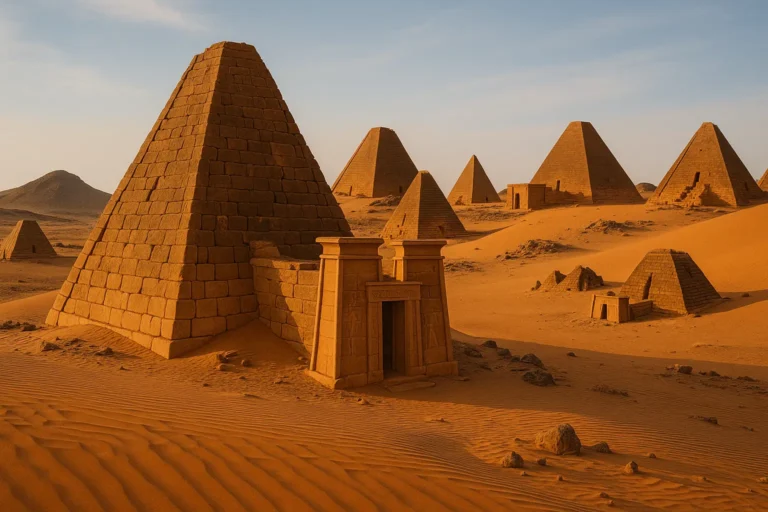 Sudan
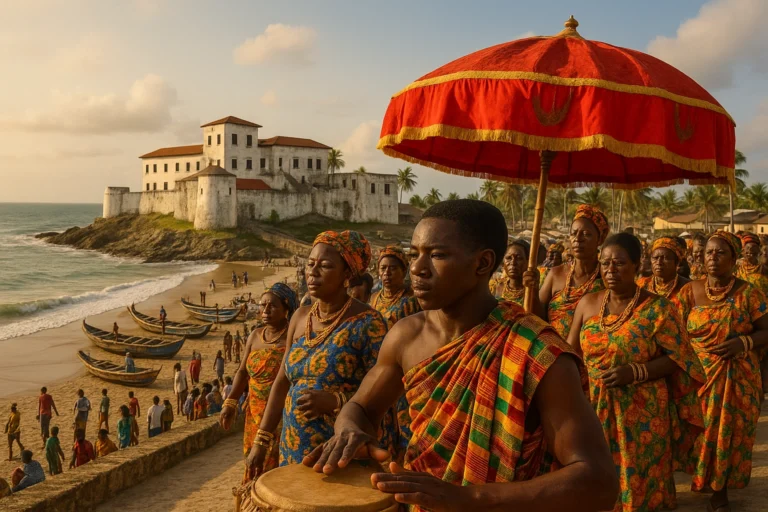 Ghana