Cameroon: Africa in Miniature
Cameroon is sometimes described as “Africa in miniature” because its geography, cultures, and ecosystems represent such a broad cross-section of what the continent has to offer. It sits at the junction of West and Central Africa, bordered by Nigeria to the west, Chad and the Central African Republic to the east, the Republic of Congo, Gabon, and Equatorial Guinea to the south, and the Gulf of Guinea to the southwest.
The country has been shaped by an extraordinary range of influences. Portuguese, Dutch, British, and German colonial powers each passed through. French and English are both official languages, a legacy of the post-World War I division of the country between France and Britain. Indigenous cultures number well over 200 distinct groups, each with their own language, traditions, and history.
Why Visit Cameroon
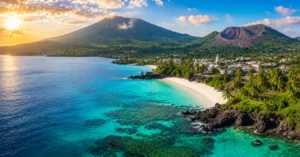
Mount Cameroon is one of the most impressive volcanoes in Africa and one of the few active ones on the continent. Rising to 4,040 meters from near sea level at the coast, it creates an extraordinary range of ecosystems from tropical beach to alpine moorland within a vertical distance that few places on earth can match. Climbing to the summit is a serious multi-day trekking challenge, but the experience of standing on the rim and looking out over the Gulf of Guinea is genuinely spectacular.
The Dja Faunal Reserve in the south is one of the best-preserved equatorial rainforests in Africa and a UNESCO World Heritage Site. It is home to western lowland gorillas, forest elephants, chimpanzees, bongos, and an extraordinary diversity of smaller mammals and birds. The reserve is surrounded on three sides by the Dja River and is extremely remote, which has helped preserve its integrity.
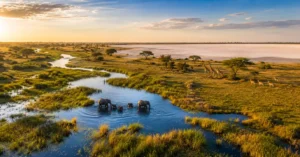
The Waza National Park in the north, in the semi-arid Sahel zone, offers a completely different wildlife experience. Lions, elephants, giraffes, ostriches, and large herds of kob antelope are present in a flat, open landscape very different from the forested south. The park is best visited between February and May.
The Ring Road in the Northwest Region is one of the most scenic driving routes in West Africa. The highland towns of Foumban, Bamenda, and Bafut along the route have strong traditional rulers who maintain elaborate palace complexes, weekly markets, and ceremonial traditions. Foumban is particularly famous for its sultan’s palace and its tradition of bronze casting.
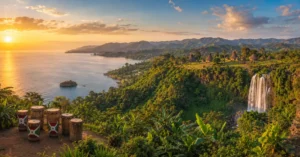
The coast around Kribi in the south has beautiful beaches, lobster fishing communities, and a small town with a relaxed atmosphere that makes it a pleasant base for exploring the nearby Lobe Falls, where a river drops directly into the ocean.
Cameroonian Food and Culture
Cameroon has a rich culinary tradition shaped by its geographic and cultural diversity. Ndole, a dish of cooked bitter leaves with ground peanuts and meat or shrimp, is considered the national dish. Eru, a stew of shredded waterleaf and okok (a vine) cooked with smoked fish and palm oil, is a specialty of the southwest. Poulet DG, chicken braised with plantains and vegetables, is one of the most popular dishes at celebrations and restaurants.
The diversity of ethnic groups in Cameroon creates a country of remarkable cultural variety. The Bamileke of the west highlands are known for their hierarchical society, elaborate festivals, and strong business acumen. The Fulani herders of the north have a distinct culture tied to cattle and Islamic tradition. The Baka people of the south are one of the oldest surviving hunter-gatherer communities in the Congo Basin rainforest.
Practical Travel Tips for Cameroon
Most nationalities need a visa to enter Cameroon, and the application process can be slow. Apply well in advance. The official languages are French and English, though the English-speaking northwest and southwest regions have distinct anglophone cultures. The CFA franc is the currency.
Yellow fever vaccination is required. Malaria prevention is essential. The best time to visit varies by region: the north is best December to May, the south year-round with a long dry season from November to March.